Address Sanitizer: Find Memory Bugs at Runtime
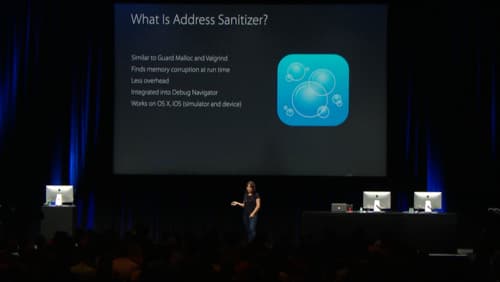
Address Sanitizer (ASan) is a runtime debugging tool that finds memory corruption bugs. Enable it in Xcode to catch buffer overflows and use-after-free errors as they happen, preventing crashes that are hard to trace back to their source.
WHY IT EXISTS: Memory corruption bugs are among the hardest to solve. An error like writing past the end of a buffer might not cause an immediate crash, but can corrupt other data, leading to a failure much later in a completely different part of the code. This makes tracing the bug back to its root cause extremely difficult.
THE MENTAL MODEL: Think of Address Sanitizer (ASan) as a runtime security guard for your app's memory. It's a feature within Xcode's debugging toolbox that watches every memory access. When it detects an invalid operation, it stops your app immediately at the source of the error, rather than letting it proceed in a corrupted state.
HOW IT WORKS: ASan is a debugging feature you enable in Xcode. When enabled, it instruments your compiled code to find memory corruption bugs at runtime. The exact mechanism involves complex compiler and runtime techniques, but the result is that it can detect specific classes of bugs the moment they happen. The tool is designed to help you "scrub your code" of these issues during the development phase.
WHEN TO USE IT: Use Address Sanitizer during development and testing, especially in complex applications. It is particularly valuable in hybrid apps using both Swift and Objective-C, where memory management can be tricky. Enable it to find buffer overflows, use-after-free errors, and other memory corruption issues before they become mysterious crashes for your users.
WHEN NOT TO USE IT: As a powerful debugging tool, ASan adds performance overhead to your application. Because of this, it is not intended for use in production builds that you ship to the App Store. Its purpose is to catch bugs during development, not to be an always-on protection mechanism in a live app.
ONE CANONICAL EXAMPLE: The WWDC presentation introduces a hybrid Swift and Objective-C fitness app called "Jogr". After adding new features and converting some code, the developers suspect they may have introduced new bugs. Address Sanitizer is presented as the ideal tool to run against the app to find any hidden memory corruption issues that resulted from these changes.
Read the original → developer.apple.com
Get five bites like this every day.
Tezvyn delivers a daily feed of 60-second tech bites with quizzes to lock in what you learn.