Bite-sized tech learning
A little learning.
Every time you scroll.
Scroll through bite-sized tech explanations, interview questions and updates in your field. Learn on your commute, revisit a topic in a queue, or fit in a little revision between meetings.
One bite at a time. No long study session needed.
The iPhone app is on the way
We are building it. Until it lands, nothing here is held back from you: every interview card, your saved cards, streaks and the job board all work in Safari, plus hundreds of free practice quizzes of thirty questions each. Sign in and it all carries over to the app the day it arrives.
Want it as an icon? Tap Share at the bottom of Safari, then Add to Home Screen. It opens full screen and the cards you have read stay available offline.
- Free to start
- No account to read
- Save bites for revision
Inside Tezvyn
Learning that fits the way you already scroll.
Read a short explanation, check what you remember, save what matters, and keep an eye on your field. When you are ready, practise or explore your next role in the same place.
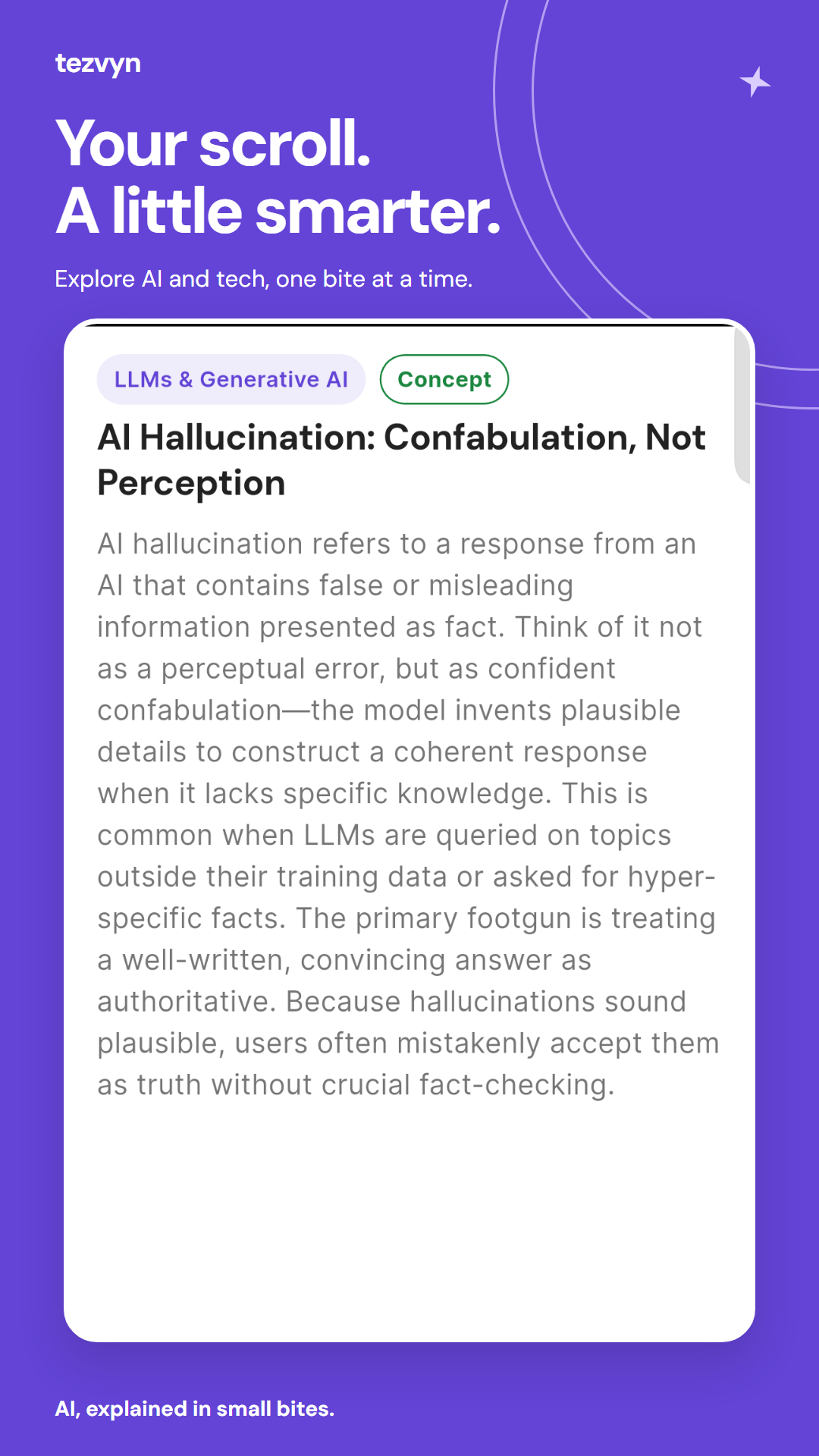
Explore AI and tech, one bite at a time.
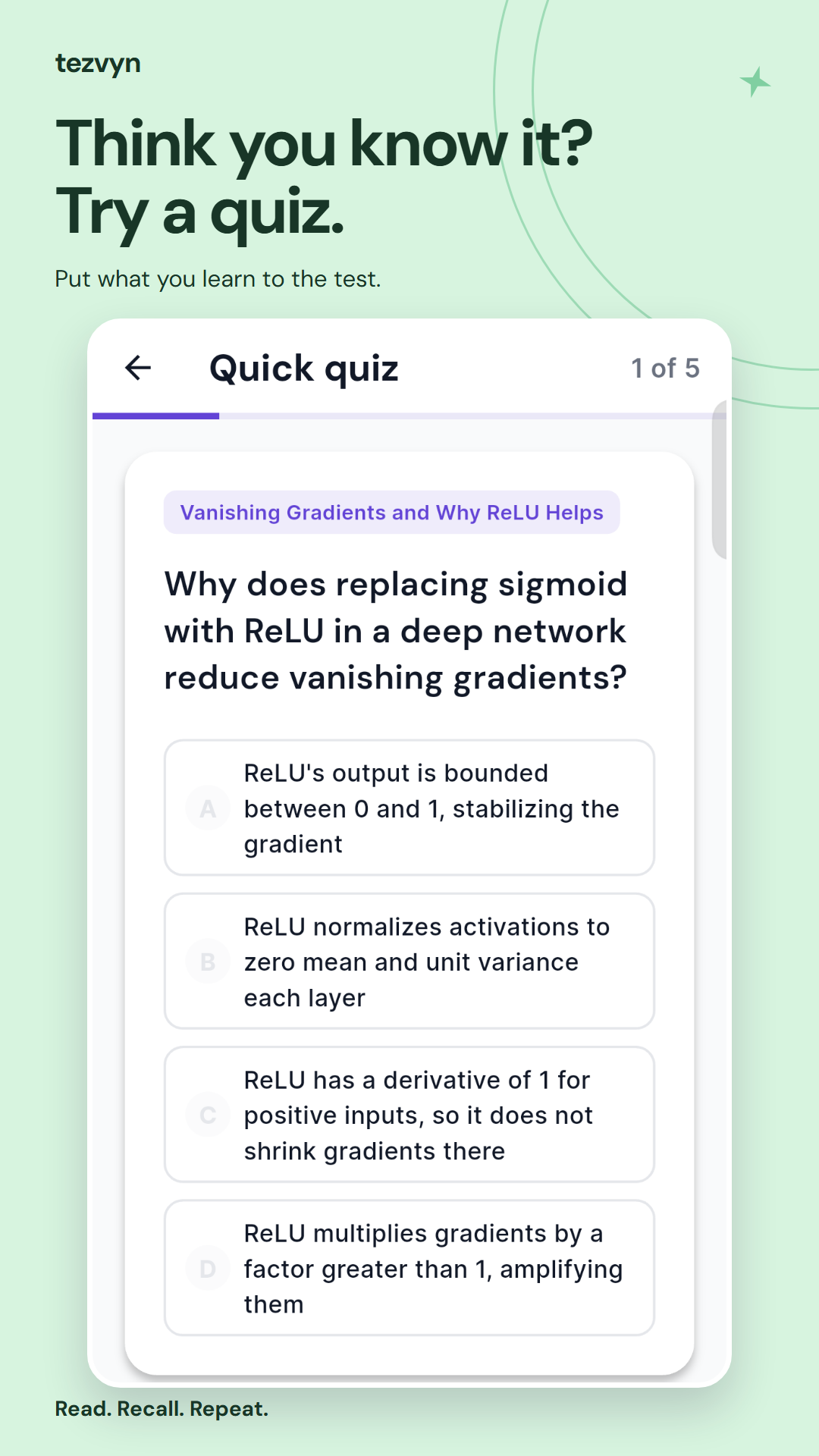
Put what you learn to the test.
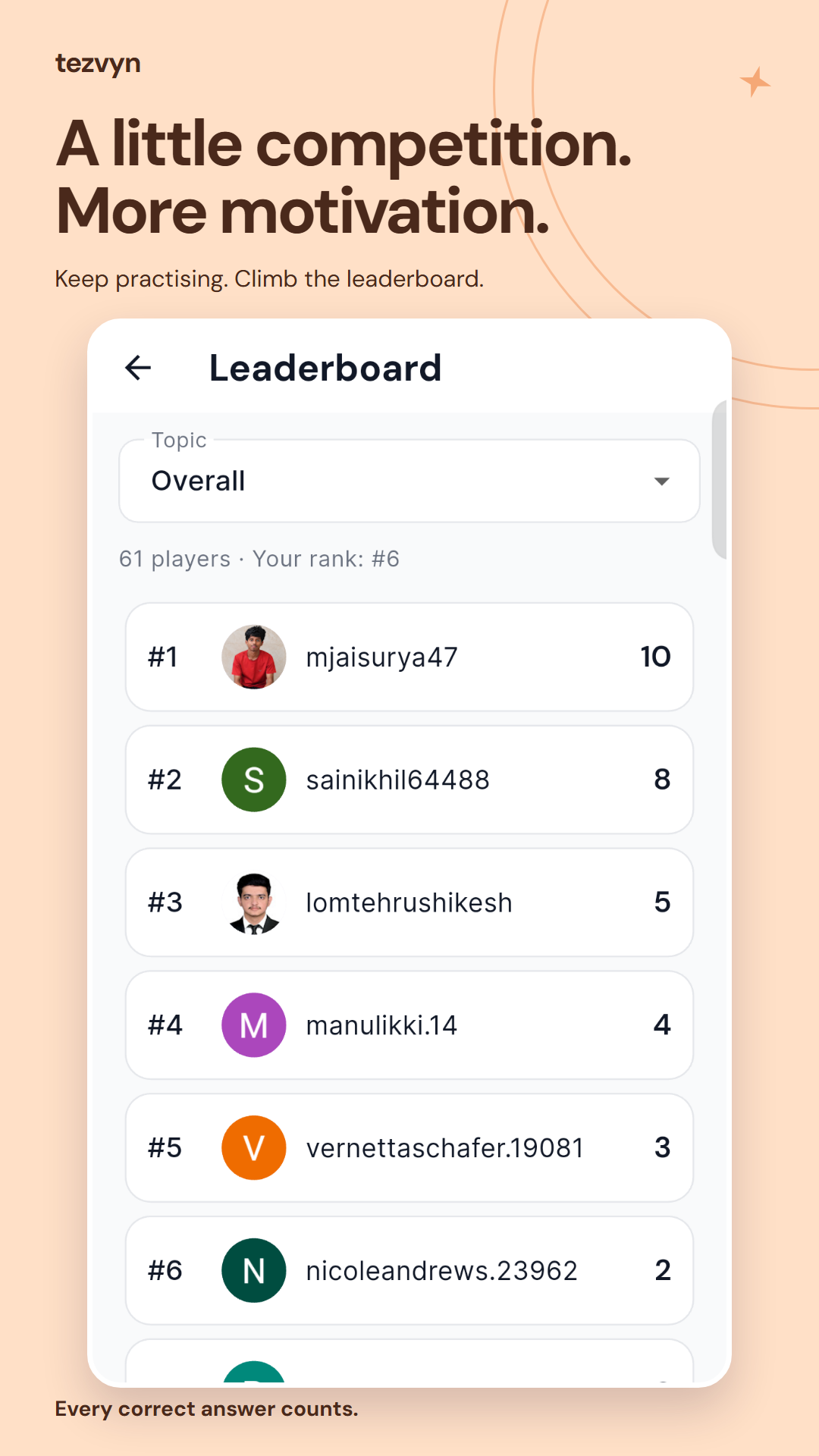
Keep practising and climb the leaderboard.
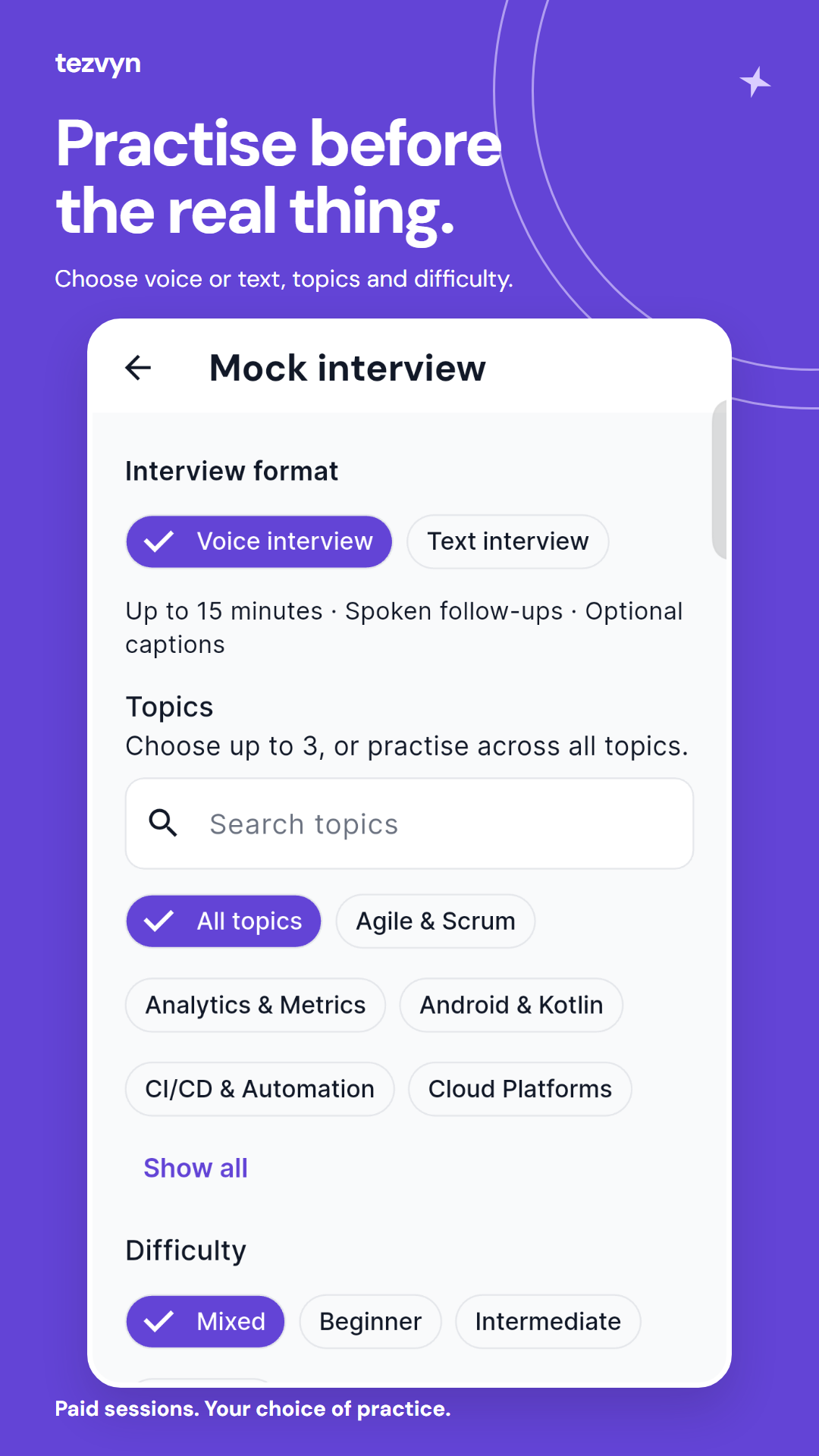
Choose voice or text, topics and difficulty.
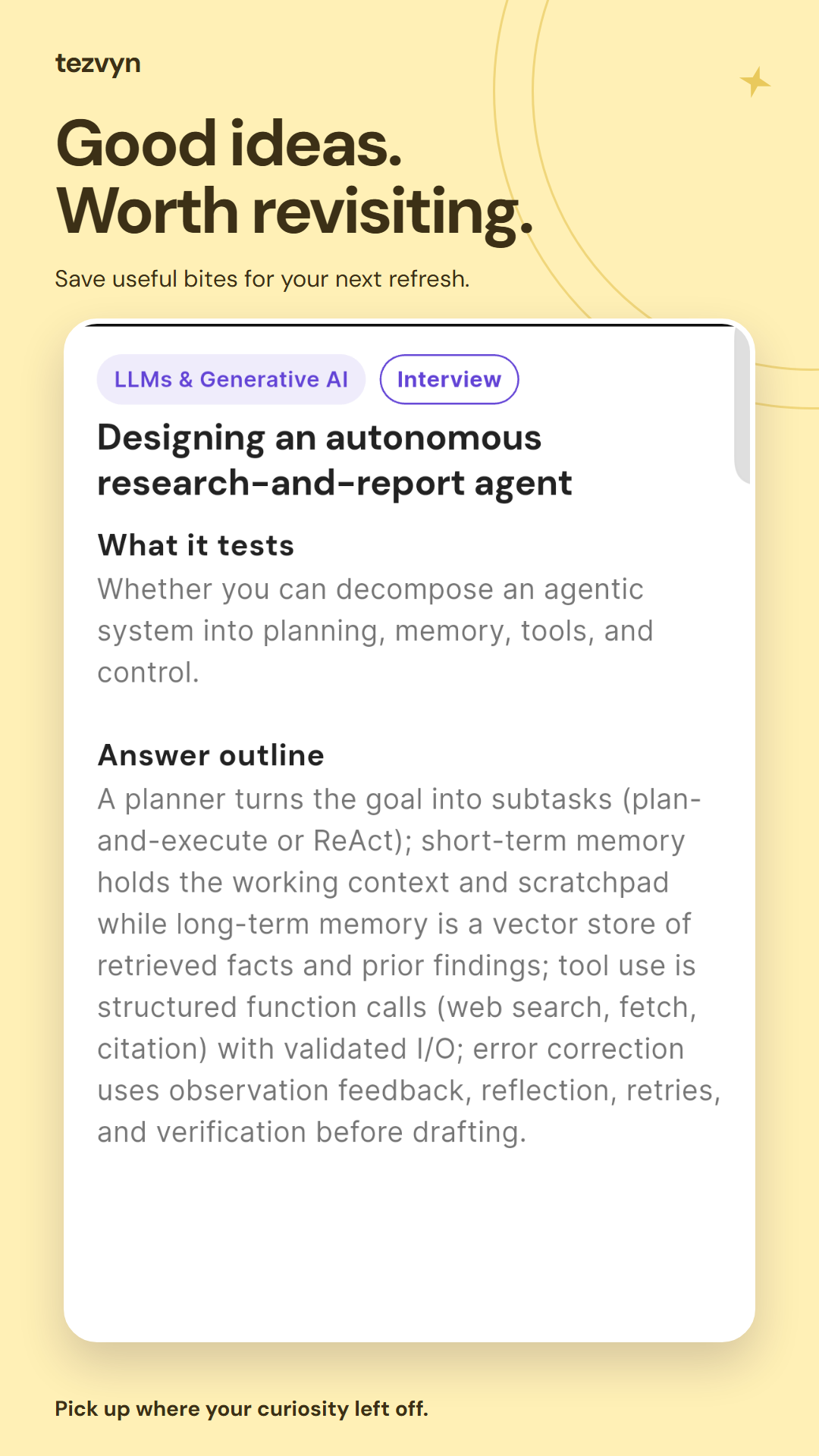
Save useful bites for your next refresh.
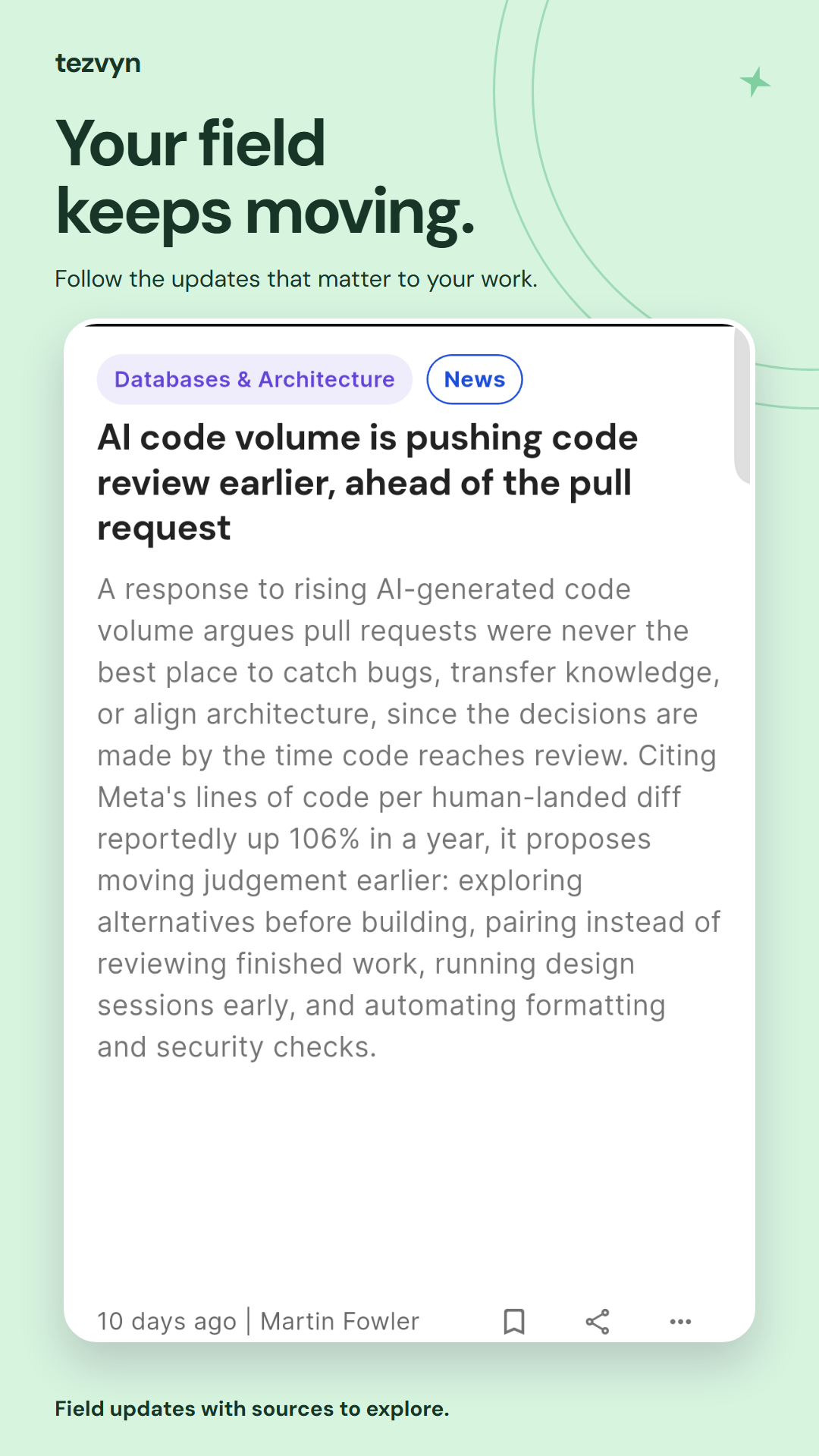
Follow the updates that matter to your work.
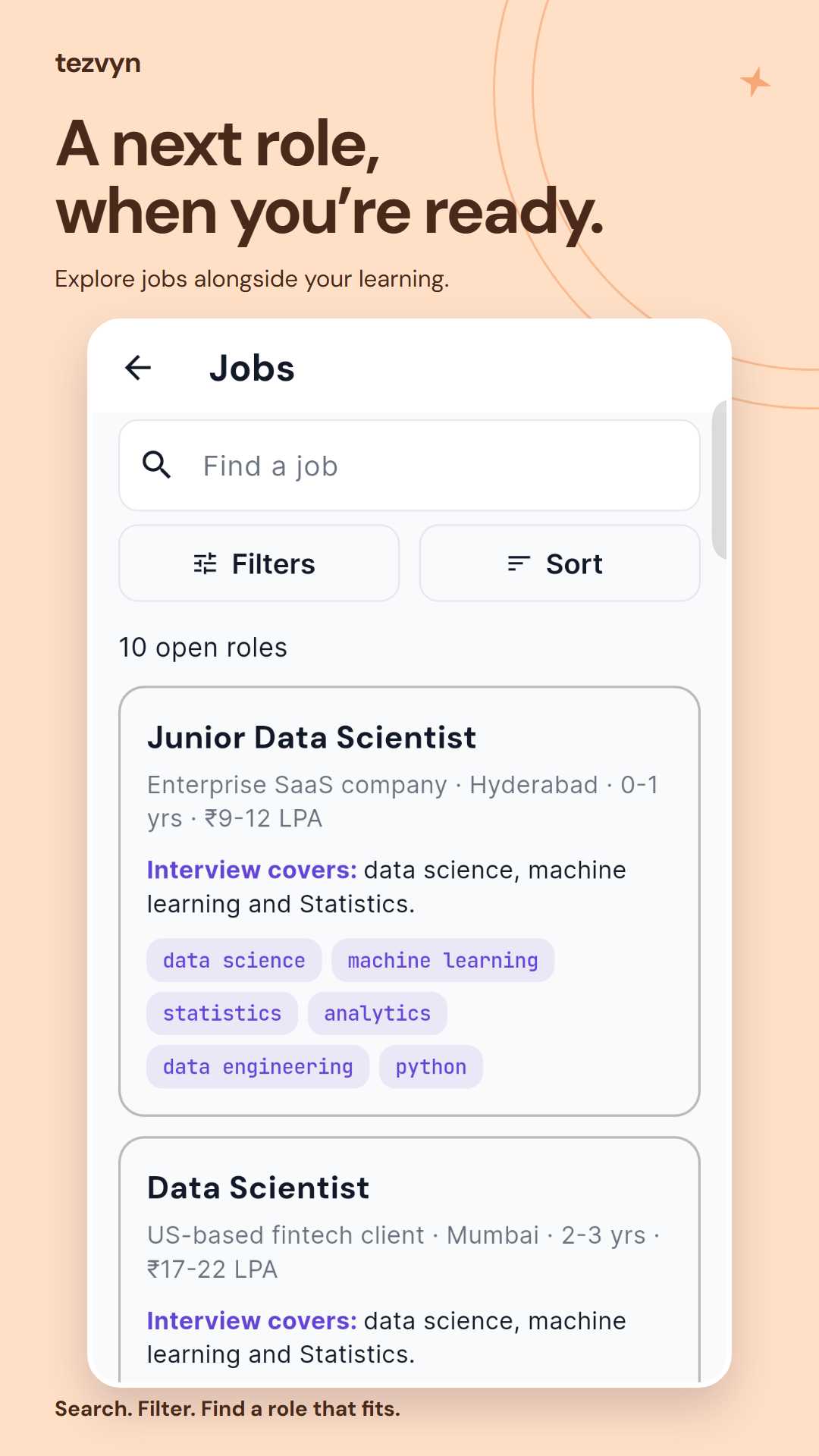
Explore jobs alongside your learning.
Make a little room for learning
Open your field and start with one idea. No prompt to write or long lesson to finish.
Try a short Python session →A new idea on your break
Pick a topic and scroll through short explanations. Read one bite or a few, depending on the time you have.
Explore concepts →A quick refresh before an interview
Revisit a familiar concept, try an interview question, and check your understanding with a quiz. Save useful bites to find them again.
Try a quiz →Something new in your field
Catch up on tools, releases and technical developments in the same bite-sized format. Open the source when you want the full story.
Explore field updates →8,600+ bites across the available topics. Browse before you install.
What readers say
This feels like scrolling through reels, but I'm learning. I prefer scrolling through text to watching videos, and I keep coming back to the app. Thank you, Tezvyn team!
NanditaSoftware engineer Tezvyn makes learning feel fun and easy for me.
Ajay VashisthSoftware engineer The leaderboard motivates me to practise more and keep improving.
MeghaSoftware engineer I keep coming back to the bite-sized content. It's making my interview preparation easier.
DishubSoftware engineer · Bengaluru Scrolling is already a habit for me. Now I use those spare moments to learn and revise.
Syam NagaSoftware engineer · Hyderabad
Find your next bite
All topics →Free to read. No account needed to start.
Recent bites
Epsilon in differential privacy and its trade-offs
Epsilon is the privacy budget bounding how much one record can change outputs; smaller epsilon means stronger privacy but more noise and lower accuracy.
Template syntax vs JSX: framework design trade-offs?
Templates (Vue, Angular) are declarative, easier to learn, enable static analysis; JSX (React, Solid) is code-based, flexible, familiar to JavaScript developers.
NVIDIA's AVO harness ran Claude Opus 5 autonomously for seven days straight
NVIDIA paired Claude Opus 5 with a new harness called AVO to run long-horizon autonomous tasks, including a seven-day GPU kernel optimisation run and a separate reasoning benchmark. AVO uses persistent memory and a supervisor process so the agent keeps working past a single context window instead of restarting.
Rosetta ends for Intel-only Mac apps at macOS 27 as Apple sets a hard deadline
Apple is winding down Rosetta, the translation layer that let Intel-only Mac apps run on Apple silicon since 2020. From macOS 26.4, users launching non-native apps may see an update notification, and macOS 27 is the last release that runs them at all, except older unmaintained games.
Generating a signed release APK or AAB
Create a keystore, reference its credentials via gradle.properties (gitignored), wire a release signingConfig in build.gradle, then assembleRelease or bundleRelease.
Critical vm2 sandbox escape (CVSS 10.0) traced to its own README example
GitLab's Threat Research Group found a CVSS 3.1: 10.0 sandbox escape in vm2, a widely used Node.js sandbox library, in a config copied from vm2's own README. Version 3.11.7 fixes the attack, but the underlying risk remains for anyone using require.external. Update immediately and prefer containers for untrusted code.
Federating reliability ownership to product teams
Build a self-service reliability platform (golden paths, paved roads), train teams and embed SLO/on-call practices, and govern with standards plus error budget…
Making the case for reliability over a risky feature
Quantify reliability cost in churn and revenue, show the feature's risk to existing customers, propose a sequenced path.
How to sync eye-tracking data with DOM events?
Record gaze points with millisecond precision, map to DOM via bounding box lookup, correlate with click events via shared timestamp.
Declarative vs imperative ML platform design
Declarative GitOps gives auditable, reproducible, reviewable desired-state config with strong governance but a steeper learning curve; imperative SDKs are flexible and fast for scientists but harder to…
Server-side data fetching in Nuxt 3?
Use useFetch or useAsyncData to fetch on server, data is serialized and injected into page state, component accesses it as reactive data.
AI code volume is pushing code review earlier, ahead of the pull request
AI now produces more code than humans can realistically review, with Meta's lines of code per human-landed diff reportedly up 106% in a year. One response argues review should move earlier, into pairing and design sessions, leaving the pull request to catch formatting and known security issues.
A few things you might be wondering
- Is it free?
- You can start reading without an account or payment. The Android app includes ads. Premium (₹290 a month or ₹2,400 a year) and mock interview packs are optional.On iPhone, you can read on the website while the iOS app is being prepared.
- Do I need a long study session?
- No. Read a bite during a break, scroll to another if you have time, or save it for revision. Short sessions fit around your day; you decide when to stop.
- Why use this alongside search, AI or documentation?
- Open a field and start reading, without deciding what to ask first. Short explanations, interview questions and quizzes help you revisit what you know and check what you remember. Follow the original sources or documentation when you want more depth.
- Which topics can I read?
- Browse frontend, backend, mobile, cloud, DevOps, AI, product and UX topics before installing. The topic pages show exactly what is available, so you can check whether it fits what you want to learn.
- Who conducts the recruitment interviews?
- For roles recruited through Tezvyn, we conduct the first interview. If you progress, our client conducts the remaining rounds. Your application shows the recorded stage and interview details.
- Do I need to use the app to apply?
- No. Learning, revision and paid mock practice are optional and do not affect your application's priority. We do not charge candidates for jobs they get through us.
Got a few minutes? Start with one bite.
Choose a topic for a quick read or a little revision. Start free on the website or in the Android app.
The iPhone app is on the way
We are building it. Until it lands, nothing here is held back from you: every interview card, your saved cards, streaks and the job board all work in Safari, plus hundreds of free practice quizzes of thirty questions each. Sign in and it all carries over to the app the day it arrives.
Want it as an icon? Tap Share at the bottom of Safari, then Add to Home Screen. It opens full screen and the cards you have read stay available offline.