Forecasting with Monte Carlo Simulation
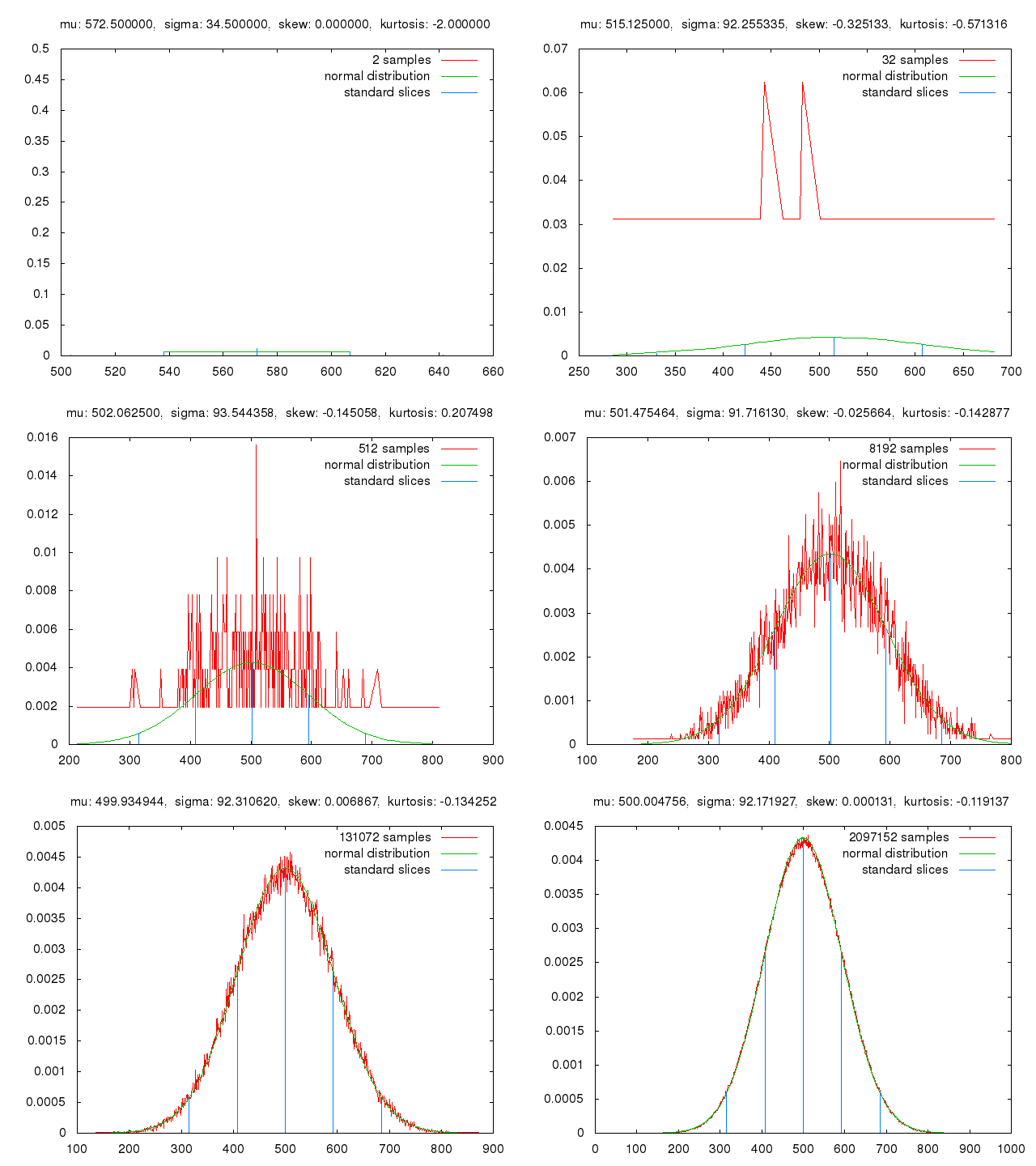
A Monte Carlo simulation forecasts outcomes by running thousands of 'what if' scenarios with random inputs. Use it to model complex systems like user growth with variable conversion rates.
WHY IT EXISTS: Simple forecasts often rely on single-point estimates for uncertain variables, making them brittle. A model like revenue = users * arpu breaks down when you don't know the exact values for users or arpu. Monte Carlo methods were created to embrace this uncertainty, modeling a full spectrum of possible outcomes instead of just one.
THE MENTAL MODEL: Think of a Monte Carlo simulation as a 'possibility engine.' Instead of plugging in one best-guess number for an unknown variable, you define a range of possibilities and their likelihoods (e.g., a normal distribution for user growth). The simulation then runs thousands of times, each time picking a random value from that distribution for each uncertain variable. The result isn't a single number, but a distribution of potential futures, showing you what's likely, what's possible, and what's a long shot.
HOW IT WORKS: The process involves four main steps. First, build a mathematical model of the system you want to forecast. Second, identify the key inputs that are uncertain. Third, for each of these uncertain inputs, define a probability distribution that represents its possible values based on historical data or expert judgment. For example, daily signups might follow a uniform distribution between 100 and 150. Fourth, run the simulation thousands of times. In each run, the computer draws a random value for each input from its defined distribution and calculates the model's output. After all runs are complete, you analyze the collection of outputs to understand the probability of different outcomes, like 'there's a 90% chance revenue will be above $50,000.'
WHEN TO USE IT: It's ideal for forecasting in complex systems where multiple variables are uncertain and interact with each other. Common applications include financial modeling (projecting profit and loss), project management (estimating timelines and costs), and growth projections where factors like virality, churn, and conversion rates are not fixed values.
WHEN NOT TO USE IT: Avoid it for simple problems that have a direct, deterministic analytical solution. More importantly, it's inappropriate when you have no reasonable basis for defining the input probability distributions. A model built on arbitrary or poorly researched input assumptions will produce garbage results that appear deceptively precise—the classic 'garbage in, garbage out' problem.
ONE CANONICAL EXAMPLE: A startup wants to forecast next quarter's revenue. The model is Revenue = (Traffic * ConversionRate) * AverageOrderValue. Instead of using single estimates, they define distributions: Traffic is a normal distribution centered at 100,000 visitors; Conversion Rate is a beta distribution between 1.5% and 2.5%; and Average Order Value is a log-normal distribution. The simulation runs 10,000 times, each time picking one random value from each of these distributions. The final output is a histogram of 10,000 possible revenue figures, from which they can conclude, 'We have an 80% probability of exceeding $250,000 in revenue.'
Read the original → en.wikipedia.org
Get five bites like this every day.
Tezvyn delivers a daily feed of 60-second tech bites with quizzes to lock in what you learn.