How would you script a concurrency analogy for junior developers?
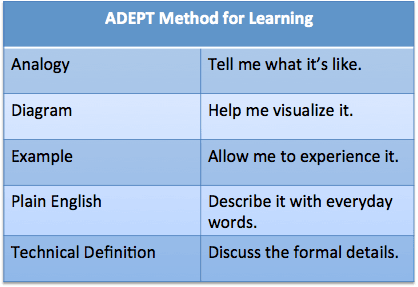
This tests scaffolding hard ideas via ADEPT. A strong answer sequences analogy, diagram, example, plain-English reasoning, and technical notation while flagging where metaphor breaks. A red flag is treating the analogy as proof or ignoring its failure modes.
What's really being asked
This question evaluates whether you can teach hard concepts to beginners without dumbing them down or leaving them confused. The interviewer wants to see the ADEPT framework and evidence that you know where analogies help versus hurt. Seniors must mentor juniors, so sequencing explanation layers and managing metaphor limitations is a core signal.
The full answer
First, introduce the analogy as a disposable raft, not a destination. For concurrency you might compare threads to chefs sharing a kitchen, but note this is only a starting point. Second, add a diagram because visual processing makes the abstract visceral. Third, provide an interactive example so juniors experience the idea rather than memorizing it, such as asking what happens when two chefs try to chop the same onion at once. Fourth, ask juniors to describe the pattern in plain English so they internalize the logic before seeing jargon. Fifth, layer in technical description, defining mutex, context switch, and race condition. Sixth, explicitly flag where the analogy breaks, noting that a real kitchen has physical space while threads share memory, or that preemption is unlike a chef voluntarily passing a knife.
The mistakes people make
A weak answer treats the analogy as the entire lesson and never transitions to rigor. Another red flag is choosing an analogy that maps to the happy path but collapses under edge cases, like comparing concurrency to highway lanes without explaining that threads can interleave unpredictably on a single core. Some candidates skip the interactive step and jump straight to formal definitions, turning the segment into a lecture. Finally, failing to acknowledge that analogies are fuzzy suggests you do not understand the concept deeply enough.
What usually comes next
The interviewer might ask how you would adapt the script for a junior with no systems background, or how you would handle a learner who insists the analogy is literally true. They may ask you to contrast concurrency with parallelism using the same framework, or to name a concept that should never be taught with an analogy. Be ready to discuss how you would measure success, such as by asking the junior to predict the output of a small race-condition snippet after the segment.
A concrete example
Using ADEPT for concurrency: Analogy is a single chef rapidly switching between boiling pasta and chopping vegetables, capturing interleaving on one core. Diagram is a timeline showing context switches. Example is a live demo where two increments of a shared counter lose an update. Plain English is the junior saying that when two threads read before either writes, the second write clobbers the first. Technical description introduces race condition and shows a mutex. You then break the analogy by noting that a chef has physical hands and cannot pause mid-slice without leaving the knife in the onion, whereas a thread can be preempted at any instruction boundary.
Interview question
When teaching concurrency to a junior developer, which approach best aligns with the ADEPT framework's view of analogies?
- a.Select an analogy that perfectly models every edge case so it can serve as the primary lesson
- b.Avoid analogies entirely because they risk oversimplifying preemption and shared memory
- c.Present the analogy after technical definitions to give the junior a mnemonic for jargon
- d.Use the analogy as a disposable starting point, then explicitly note where it diverges from actual thread behaviorCorrect
Why? this is the answer
ADEPT treats analogies as temporary scaffolding that must be dismantled by flagging where they diverge from reality, such as a thread being preempted unlike a chef. Option A is tempting but wrong because the framework explicitly warns that analogies collapse under edge cases and must not be treated as the lesson itself or as proof.
Just read this? Test yourself on what you have been reading.
Read the original → betterexplained.com
- #communication
- #mentorship
- #pedagogy
- #concurrency
- #adept
You just looked this up. Could you explain it out loud?
That is the part interviews actually test. Tezvyn takes questions like this one and gives you what the interviewer is really checking, the answer that lands, and the mistake that ends the conversation, in the four minutes before your next meeting.
The iPhone app is on the way
We are building it. Until it lands, nothing here is held back from you: every interview card, your saved cards, streaks and the job board all work in Safari, plus hundreds of free practice quizzes of thirty questions each. Sign in and it all carries over to the app the day it arrives.
Want it as an icon? Tap Share at the bottom of Safari, then Add to Home Screen. It opens full screen and the cards you have read stay available offline.
We are hiring for this. Open roles that interview on communication — each one lists the topics its interview covers.
See open roles