Issue Trees: Deconstruct Problems, Not Symptoms
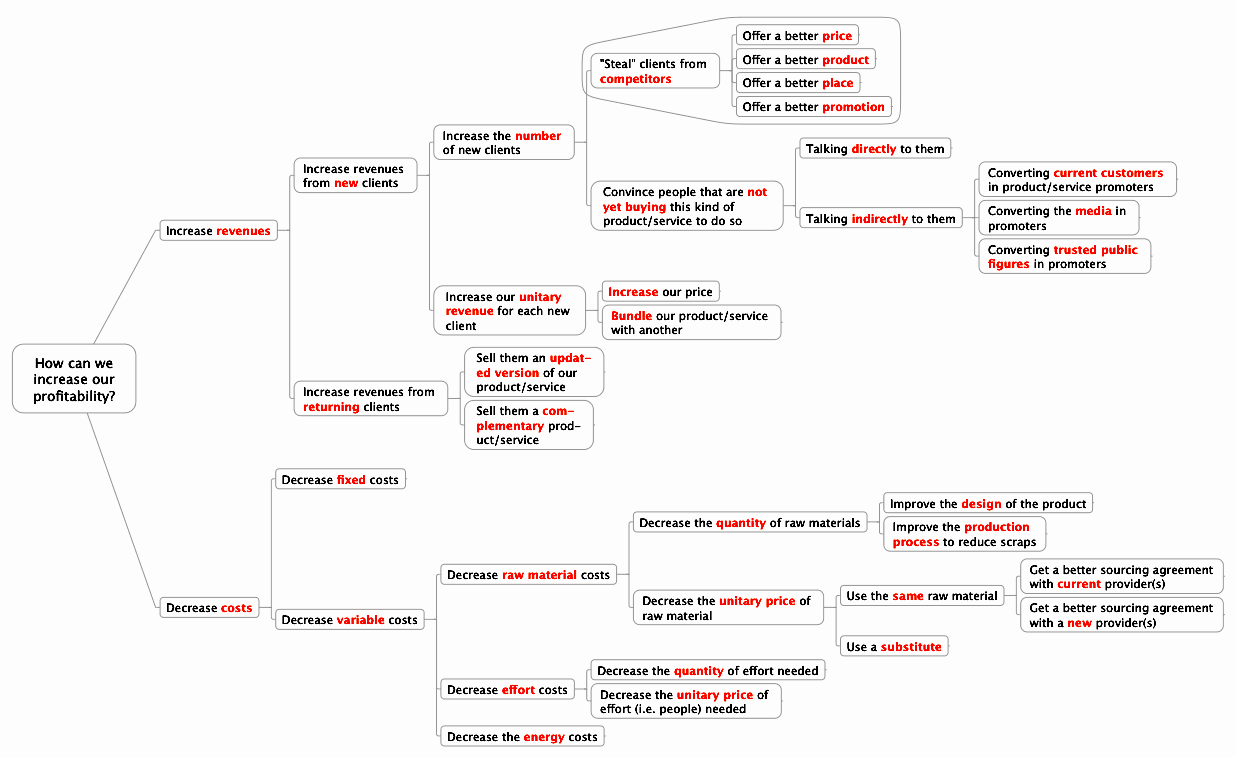
An issue tree maps a problem's potential root causes. It's used in consulting and debugging to break down vague questions like 'Why is revenue down?' into testable hypotheses.
WHY IT EXISTS Complex problems are often ambiguous. An issue tree provides a structured way to break them down into smaller, manageable pieces. It forces you to define the problem space rigorously before jumping into analysis, preventing wasted effort on symptoms or incorrect assumptions.
THE MENTAL MODEL Think of it as a decision tree in reverse. Instead of starting with a choice and mapping future outcomes, you start with an observed outcome (the problem) and map all the possible causal pathways that could have led to it. It's a blueprint for your investigation, ensuring no stone is left unturned.
HOW IT WORKS Start with the primary question on the left. Break it down into its first-level components. For example, "Declining Profit" breaks into "Revenue is down" OR "Costs are up". Each sub-problem is then broken down further, moving from left to right. The critical rule is that each level of breakdown must be MECE: Mutually Exclusive (the components are distinct and don't overlap) and Collectively Exhaustive (the components cover all possible options). This ensures your analysis is complete and efficient.
WHEN TO USE IT Use issue trees for complex, unstructured diagnostic problems. They are ideal for situations where the cause is unknown, such as figuring out why a key business metric has dropped, diagnosing a persistent software bug, or structuring a market entry strategy. It's a tool for hypothesis generation, not execution.
WHEN NOT TO USE IT Avoid issue trees for simple problems with clear causes or when you are in the execution phase of a project with a known plan. Applying this framework to a straightforward task is overkill and creates unnecessary bureaucracy. It's for finding the 'why', not managing the 'how'.
ONE CANONICAL EXAMPLE To diagnose "Why is our website's conversion rate dropping?", the first level might split into "Fewer visitors are starting the checkout process" AND "More visitors are abandoning checkout". The "abandoning checkout" branch could then be broken down into hypotheses like "Shipping costs are too high", "Payment options are insufficient", or "The checkout page has a new bug". Each final leaf is a specific, testable hypothesis.
Read the original → en.wikipedia.org
Get five bites like this every day.
Tezvyn delivers a daily feed of 60-second tech bites with quizzes to lock in what you learn.