Market Sizing: TAM, SAM, and SOM for Realistic Planning
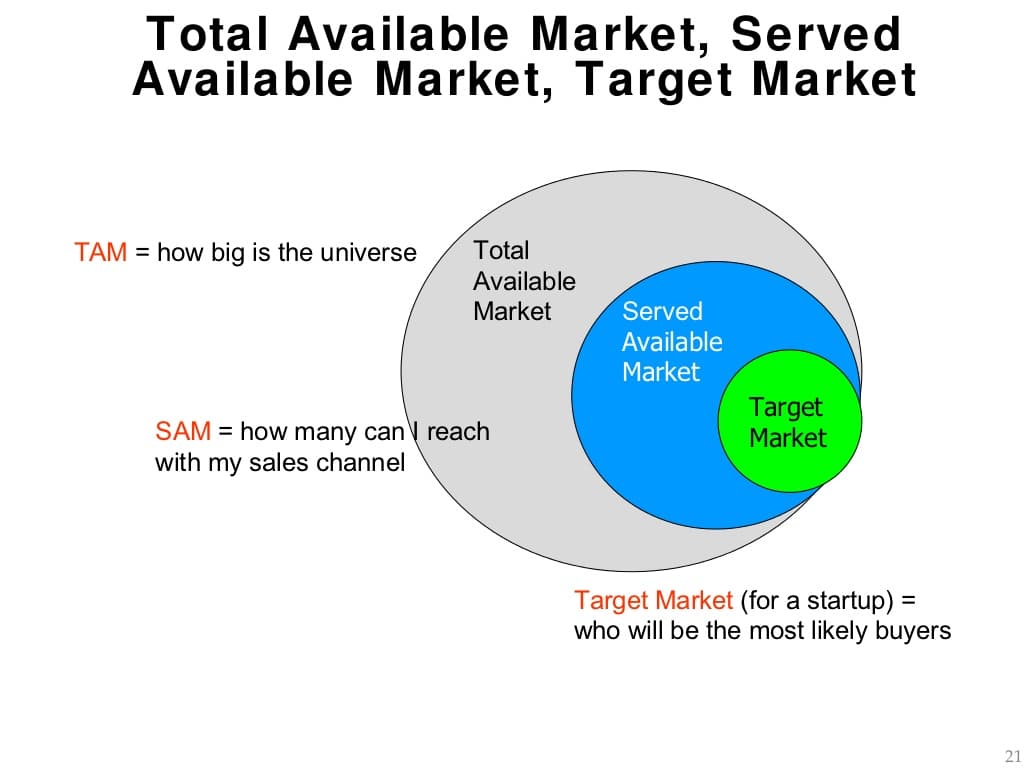
Market sizing is a funnel, not a single number. TAM is the total universe of customers, SAM is the segment you can reach, and SOM is who you can realistically win. It's crucial for business plans and investor pitches.
WHY IT EXISTS: To translate a vague sense of a large market into a concrete, defensible business plan. It forces founders and product managers to justify investment and focus their strategy by quantifying the revenue opportunity at different levels of ambition and realism.
THE MENTAL MODEL: Think of it as a set of Russian nesting dolls. The largest doll is the Total Addressable Market (TAM), representing the entire potential revenue opportunity for a product category. Inside that is the Serviceable Available Market (SAM), the portion you can actually target based on your product's focus, geography, and language. The smallest doll is the Serviceable Obtainable Market (SOM), the realistic piece of SAM you can capture in the near term, considering competition and resources.
HOW IT WORKS: Market sizing is a top-down process of filtering a large number into a believable target. First, you calculate TAM, the total revenue opportunity for a product or service category. Second, you determine SAM by narrowing TAM to the segment your business can actually serve. For example, if you only operate in Europe, your SAM is the European portion of the TAM. Third, you estimate SOM, the share of SAM you can realistically win in the next 1-3 years, accounting for your sales channels, marketing budget, and competitors.
WHEN TO USE IT: Use this framework when creating a business plan, pitching to investors, or making strategic decisions about market entry or product expansion. It demonstrates that you have a grounded understanding of the market and a specific go-to-market strategy, not just a big idea. It answers the question, "How big is the prize, and what's our plan to win a piece of it?"
WHEN NOT TO USE IT: Avoid using these figures as static, unchangeable facts; markets and your ability to serve them will evolve. The biggest misuse is presenting a massive, top-down TAM number without a credible, bottom-up plan for achieving your SOM. A huge market doesn't make a weak business plan viable. It's a planning tool, not a guarantee of revenue.
ONE CANONICAL EXAMPLE: Imagine launching a high-end, vegan-only meal delivery service. The TAM is the entire global market for restaurant and home-delivered food, a multi-trillion-dollar figure. The SAM is the portion of that market in the specific cities you launch in (e.g., London, Berlin) who are interested in premium meal delivery. The SOM is the revenue you project to capture from vegan customers in those cities in the first two years, given local competition and your marketing spend.
Read the original → en.wikipedia.org
Get five bites like this every day.
Tezvyn delivers a daily feed of 60-second tech bites with quizzes to lock in what you learn.