Parallel Coordinates Plot: Untangling High-Dimensional Data
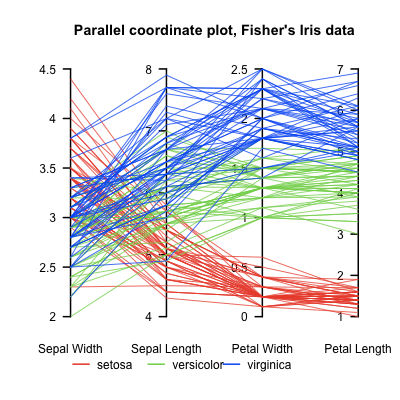
A parallel coordinates plot turns high-dimensional data into a 2D image by laying axes out in parallel. Each data point becomes a line weaving across them. It helps find clusters in multivariate data, but overplotting can make it unreadable with too many…
Why it exists
Our brains excel at interpreting 2D or 3D scatter plots, but real-world data often has dozens or hundreds of dimensions (variables). Parallel coordinates plots were invented to project this high-dimensional information onto a 2D plane we can actually interpret, allowing us to 'see' relationships that would otherwise be hidden in tables of numbers.
The mental model
Instead of the perpendicular X and Y axes of a standard chart, imagine taking every variable in your dataset and drawing its axis as a vertical line, all parallel to each other like strings on a harp. A single data point (like a customer or a car) is no longer a dot. It's a polyline that snakes across the plot, connecting its specific value on each of the parallel axes.
How it works
Each vertical line represents one attribute, scaled from its minimum value at the bottom to its maximum at the top. A single record from the dataset is then drawn as a series of connected line segments. For example, a data point for a car with attributes {mpg: 15, cylinders: 8, weight: 4500} would be a line that connects the '15' mark on the 'MPG' axis, the '8' mark on the 'Cylinders' axis, and the '4500' mark on the 'Weight' axis. By plotting many records this way, patterns emerge.
When to use it
Use this for exploratory data analysis on multivariate datasets. It's excellent for visually identifying clusters, where groups of lines follow similar paths. It can also reveal correlations between adjacent variables (e.g., if lines consistently go from high on axis A to low on axis B) and help spot outliers, which appear as lines with unique, erratic paths compared to the rest.
When not to use it
Avoid parallel coordinates plots for datasets with a very large number of records. The plot quickly becomes a solid, unreadable block of color due to 'overplotting', which obscures all patterns. The order of the axes also dramatically changes the visualization; finding the most insightful ordering can require trial and error. It is also less intuitive for purely categorical, unordered data.
One canonical example
Analyzing a dataset of cars with axes for 'MPG', 'Horsepower', 'Weight', and 'Cylinders'. You would likely see a thick bundle of lines representing American muscle cars from the 70s: low MPG, high horsepower, high weight, and high cylinder count. Another distinct cluster might be modern compact cars, with lines showing high MPG, low horsepower, low weight, and few cylinders. The plot makes these multi-attribute profiles instantly visible.
Interview question
When would a parallel coordinates plot most likely become unreadable and ineffective for identifying patterns?
- a.When the relationships between adjacent variables are highly complex.
- b.When there is a very large number of individual data records.Correct
- c.When the dataset contains only a few variables.
- d.When the variables being plotted are all categorical.
Why? this is the answer
The card explicitly states that parallel coordinates plots should be avoided for datasets with a very large number of records because 'The plot quickly becomes a solid, unreadable block of color due to 'overplotting', which obscures all patterns.' While categorical data can be less intuitive (option D), it doesn't render the plot unreadable in the same way overplotting does.
Just read this? Test yourself on what you have been reading.
Read the original → en.wikipedia.org
- #data visualization
- #data science
- #multivariate analysis
- #exploratory data analysis
Put your scrolling time to good use
Learn one idea, try a quiz and save useful cards for revision. Tezvyn makes it easy to learn and stay current in your tech field, a few minutes at a time.
The iPhone app is on the way
We are building it. Until it lands, nothing here is held back from you: every interview card, your saved cards, streaks and the job board all work in Safari, plus hundreds of free practice quizzes of thirty questions each. Sign in and it all carries over to the app the day it arrives.
Want it as an icon? Tap Share at the bottom of Safari, then Add to Home Screen. It opens full screen and the cards you have read stay available offline.
We are hiring for this. Open roles that interview on data visualization — each one lists the topics its interview covers.
See open roles