Transitive Dependencies: The Hidden Baggage in Your Code
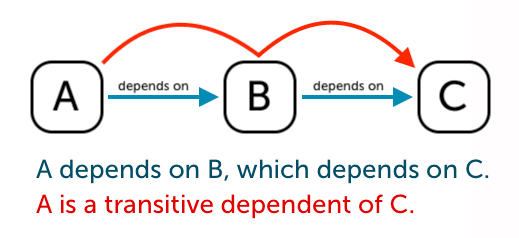
Think of transitive dependencies as your dependency's dependencies. You add one library, but it pulls in others you didn't explicitly ask for. This happens in any project using a package manager.
WHY IT EXISTS Modern software isn't built from scratch; it's assembled from existing libraries. This creates chains of reliance. Transitive dependencies are the natural, inevitable result of this composition: if your code depends on Library A, and Library A depends on Library B, your code now indirectly depends on Library B.
THE MENTAL MODEL Imagine you invite a friend to a party. That's a direct dependency. But your friend brings a plus-one you've never met. That's a transitive dependency. Your party's success (or failure) now depends on someone you didn't explicitly invite. You are responsible for their behavior, even though you don't know them.
HOW IT WORKS When you run a command like npm install or pip install, the package manager reads your project's manifest (e.g., package.json). For each direct dependency listed, it fetches that package and inspects its manifest. It then fetches that package's dependencies, and so on, recursively building a complete dependency tree. This tree contains both the direct dependencies you requested and the transitive dependencies they require to function.
WHEN TO USE IT This isn't a technique you choose to use; it's a phenomenon you must manage. Understanding transitive dependencies is critical for debugging mysterious version conflicts (so-called "dependency hell"), trimming application bloat, and, most importantly, securing your software supply chain. Tools like npm audit or Snyk exist specifically to scan this entire dependency tree for known vulnerabilities.
WHEN NOT TO USE IT While you can't avoid transitive dependencies entirely, you can control them. If a transitive dependency is causing a security issue or version conflict, your build tool may allow you to explicitly exclude it or pin it to a safer version. The goal is not to have zero transitive dependencies, but to have full visibility into what they are and to mitigate the risks they introduce.
ONE CANONICAL EXAMPLE Your Node.js application requires the express web framework, a direct dependency. When you run npm install express, the package manager also installs over 50 other packages like accepts, cookie-signature, and finalhandler. These are transitive dependencies. If a security flaw is found in cookie-signature, your application is now vulnerable, even though you never directly imported or used that package yourself.
Read the original → en.wikipedia.org
Get five bites like this every day.
Tezvyn delivers a daily feed of 60-second tech bites with quizzes to lock in what you learn.