VAEs: Generating New Data by Learning Its Essence
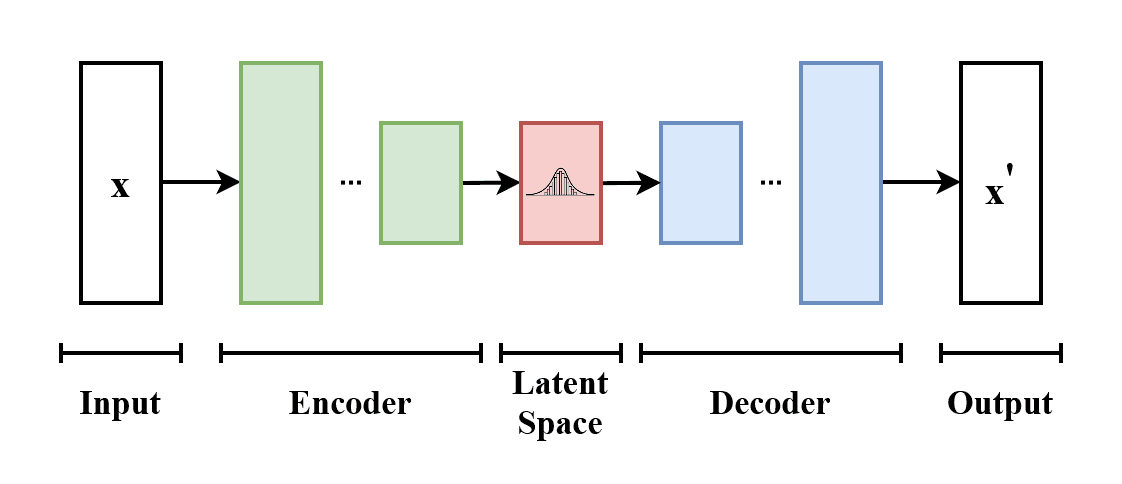
A Variational Autoencoder (VAE) learns the *essence* of data, not just how to copy it. Instead of compressing an input to a single point, it maps it to a fuzzy region in a "concept space," allowing you to generate new, similar data by sampling from that region. This is key for creating novel images or music. The footgun is expecting sharp outputs; VAEs often produce blurrier results than models like GANs.
### The Mental Model
Think of a Variational Autoencoder (VAE) not as a perfect photocopier, but as an artist who learns the *essence* of a subject. A standard autoencoder learns to compress and decompress an image, like a zip file. A VAE learns a continuous, structured "idea space" (the latent space) where it can blend concepts and generate entirely new, plausible creations that follow the rules of the original data.
### How It Works
A VAE consists of an encoder and a decoder, but with a probabilistic twist. Instead of the encoder mapping an input to a single point in the latent space, it outputs the parameters (mean and variance) of a probability distribution. A point is then randomly sampled from this distribution and fed to the decoder.
The model is trained to optimize two objectives simultaneously via its loss function:
1. **Reconstruction Loss**: This pushes the decoder to produce an output that accurately resembles the original input. It answers: "How good is the reconstruction?" 2. **Kullback–Leibler (KL) Divergence**: This is a regularization term that forces the distributions learned by the encoder to be close to a standard normal distribution (mean 0, variance 1). This organizes the latent space, preventing gaps and ensuring it's smooth and continuous, which is crucial for generation.
This dual-objective is what enables the VAE's generative power.
### When to Use It
* **Generative Tasks**: Creating novel, plausible data like images of faces, handwritten digits, or musical scores. * **Learning Smooth Representations**: When you need a meaningful latent space where you can interpolate between data points. For example, smoothly morphing an image of a '2' into a '7'. * **Data Imputation**: Filling in missing values in a dataset by finding a plausible latent representation and decoding it.
### When NOT to Use It
* **For Photorealistic Quality**: If you need razor-sharp, high-fidelity images, Generative Adversarial Networks (GANs) or Diffusion Models typically produce superior results, though they can be harder to train. * **For Simple Compression**: If your only goal is to compress and decompress data without generation, a standard autoencoder is a simpler and more direct tool for the job.
### One Canonical Example
When trained on the MNIST dataset of handwritten digits, a VAE learns a latent space where different digits occupy different regions. Because the KL divergence term enforces continuity, the space between the '1' cluster and the '8' cluster is also meaningful. If you sample a point from that intermediate space and pass it to the decoder, it will generate a novel image that looks like a '1' morphing into an '8', demonstrating its ability to understand and generate variations on learned concepts.
Read the original → en.wikipedia.org
Get five bites like this every day.
Tezvyn delivers a daily feed of 60-second tech bites with quizzes to lock in what you learn.