What analytical frameworks structure synthesis beyond thematic analysis?
Tests if you model problems structurally, not just code themes. Strong answers pair mental models to map user goals with JTBD to prioritize unmet needs by importance and satisfaction. Red flag: naming frameworks without explaining how they reshape synthesis.
What's really being asked
The interviewer wants to know if you move beyond surface-level thematic coding and use structural frameworks to model the problem space during synthesis. They are looking for strategic fluency: can you select a framework based on the decision you need to make, not just apply a template after data collection.
The full answer
First, name specific frameworks used during synthesis. Mental Model Diagrams, following Indi Young's approach, are built bottom-up by clustering individual findings into themes and then categories to illustrate the user's world and goals. This exposes how current offerings fit or fail to fit user cognition. Jobs-to-be-Done, particularly Tony Ulwick's Outcome-Driven Innovation, then prioritizes which jobs to solve by measuring importance against satisfaction to find unmet needs. Second, explain the sequencing. The mental model diagram comes first to map the landscape qualitatively. Desired outcome statements are derived directly from that diagram and fed into a quantitative survey to score importance and satisfaction. Third, explain selection logic. Use mental models when the problem space is poorly understood and you need to build empathy and alignment across stakeholders. Use JTBD when you need to filter opportunities and connect research directly to product development decisions. Use them together when you need both a holistic view and a rigorous prioritization lens.
The mistakes people make
Treating frameworks as interchangeable labels applied after coding is finished. Confusing JTBD as an interview technique rather than an analytical and prioritization lens. Failing to explain how a framework changes what you actually do during synthesis, such as how clustering for a mental model differs from standard thematic grouping. Naming frameworks like personas or journey maps without describing how they restructure raw data into decision-ready models.
What usually comes next
How do you handle data that does not fit the framework? When have you chosen a framework and later realized it was the wrong one? How do you socialize a mental model diagram with engineering teams who want feature lists? Can you walk me through how you derived a desired outcome statement from qualitative data?
A concrete example
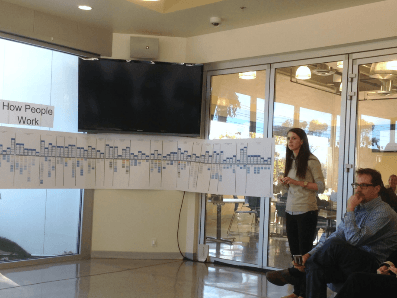
In the GoToMeeting project, the team conducted over forty contextual inquiries, producing nearly fifteen hundred pages of transcripts. They synthesized this into a mental model diagram of work collaboration by iteratively clustering jobs and themes. In a stakeholder workshop, they used the diagram to empathize with users and brainstorm future concepts. They then mapped current and future support to the diagram. Finally, they generated desired outcome statements from the model and launched a quantitative survey to plot importance versus satisfaction, identifying the high-opportunity unmet needs to guide development.
Interview question
In the described synthesis workflow, why is a Mental Model Diagram created before launching a quantitative Jobs-to-be-Done survey?
- a.It serves as a prioritization matrix that ranks unmet needs by importance and satisfaction before qualitative synthesis begins.
- b.It is a post-coding template applied after standard thematic analysis to label insights that the survey has already quantified.
- c.The survey must first validate individual transcripts so the diagram can accurately cluster findings into themes and categories.
- d.It qualitatively maps the user's world and goals, generating the desired outcome statements that the survey scores for importance and satisfaction.Correct
Why? this is the answer
The mental model diagram is built first to map the qualitative landscape, and desired outcome statements derived from it feed into the subsequent quantitative survey. Option A incorrectly assigns the survey's prioritization role to the diagram, while D reflects the common misconception that frameworks are merely labels applied after coding.
Just read this? Test yourself on what you have been reading.
Read the original → experiencinginformation.com
- #ux research
- #synthesis
- #jobs-to-be-done
- #mental models
- #framework selection
You just looked this up. Could you explain it out loud?
That is the part interviews actually test. Tezvyn takes questions like this one and gives you what the interviewer is really checking, the answer that lands, and the mistake that ends the conversation, in the four minutes before your next meeting.
The iPhone app is on the way
We are building it. Until it lands, nothing here is held back from you: every interview card, your saved cards, streaks and the job board all work in Safari, plus hundreds of free practice quizzes of thirty questions each. Sign in and it all carries over to the app the day it arrives.
Want it as an icon? Tap Share at the bottom of Safari, then Add to Home Screen. It opens full screen and the cards you have read stay available offline.
We are hiring for this. Open roles that interview on ux research — each one lists the topics its interview covers.
See open roles