What is the vanishing gradient problem and how do transformers avoid it?
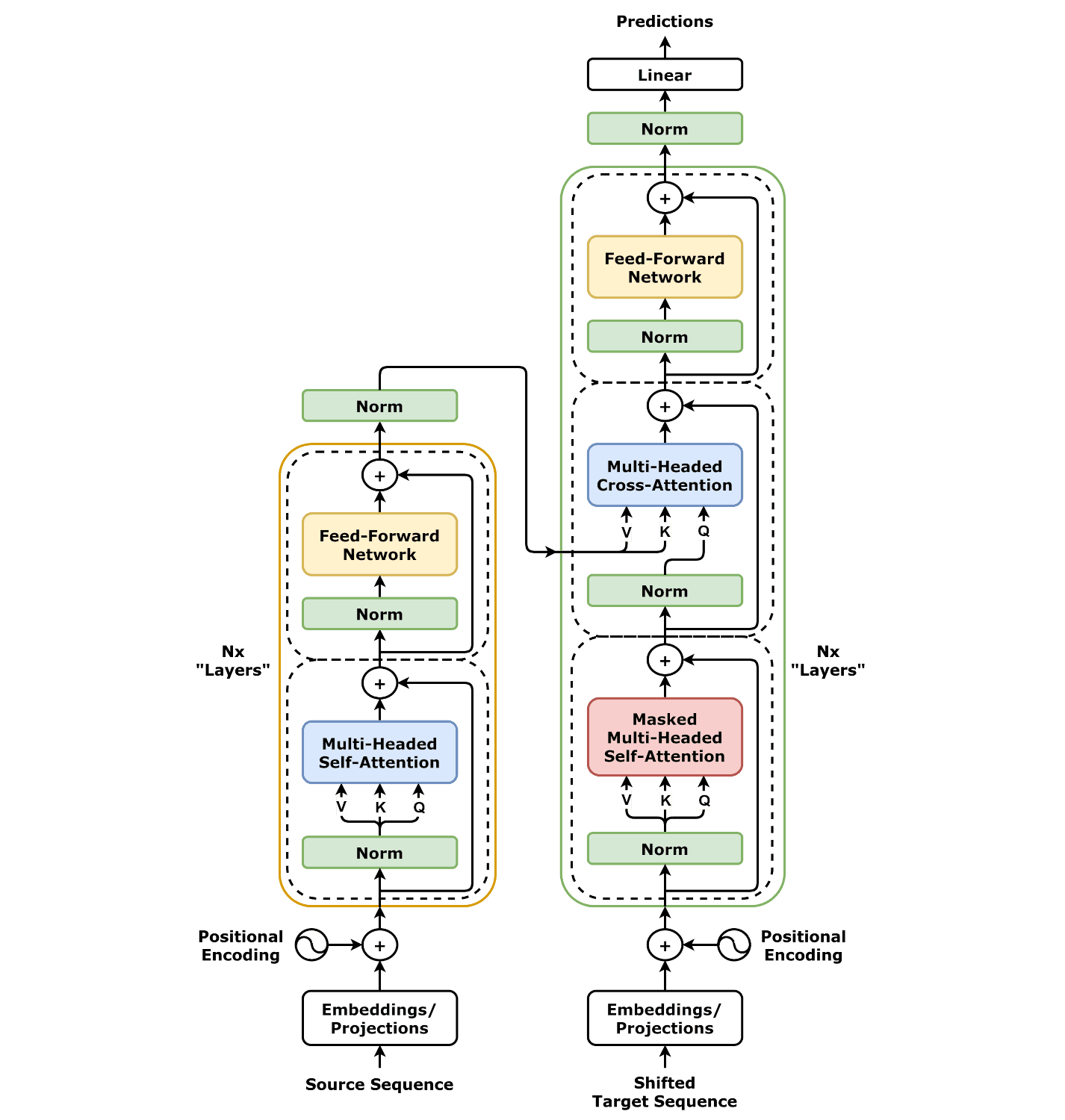
This tests your understanding of core deep learning training issues and the transformer's specific architectural solutions. A great answer defines vanishing gradients in sequential models, then explains how the transformer's parallel attention mechanism creates direct, short paths for gradients between any two tokens, regardless of distance. A red flag is vaguely mentioning 'attention' without explaining why its parallel nature is the key to solving the problem for long sequences.
### What this tests This question assesses your knowledge of core deep learning training instabilities and how specific architectural choices, like the transformer's attention mechanism, are designed to mitigate them. It separates candidates who just know *what* a transformer is from those who know *why* it works so well for sequential data.
### A good answer covers * **Define the Problem:** Start by explaining that the vanishing gradient problem occurs in deep networks, especially Recurrent Neural Networks (RNNs). Gradients shrink exponentially as they are backpropagated through many sequential steps (time), making it impossible for the model to learn dependencies between distant elements in a sequence. * **Introduce the Transformer's Solution:** Explain that transformers use a multi-head self-attention mechanism. The crucial insight is that this mechanism operates in *parallel* across all tokens in the sequence. * **Explain the 'Why':** The parallel attention creates a direct connection or path between any pair of tokens. This means the path length for gradient flow between any two tokens is effectively O(1), regardless of their separation distance in the sequence. * **Contrast with Sequential Models:** Briefly contrast this with an RNN, where the path for information and gradients between tokens separated by `N` steps is O(N) long. It is this long sequential path that causes gradients to vanish. The transformer's architecture removes this sequential bottleneck. * **Acknowledge a Prerequisite:** Note that because self-attention on its own is permutation-invariant (order doesn't matter), transformers must inject positional information via positional encodings so the model can use token order.
### Common wrong answers * **Vague 'Attention' Answer:** Simply stating "transformers use attention" without explaining that its parallel nature creates short gradient paths, which is the actual solution. * **Ignoring the 'Vanishing' Part:** Describing transformer components but failing to define what the vanishing gradient problem is or why it's a problem for other architectures. * **Confusing Sequence Length with Depth:** The attention mechanism solves the vanishing gradient problem with respect to sequence length. The problem can still occur in very *deep* transformers (many layers), which is why other components like residual connections are also used.
### Follow-up the interviewer might ask * "You mentioned the path length is O(1). What is the computational complexity of the self-attention mechanism with respect to sequence length?" * "Does this mean transformers are immune to vanishing gradients? What about with respect to network depth rather than sequence length?"
### One concrete example "Consider a sentence where a pronoun at the end refers to a noun at the beginning, 30 words apart. In an RNN, the gradient signal from the pronoun must travel sequentially back through 30 steps to update the noun's representation, likely shrinking to near-zero. In a transformer, the attention mechanism creates a direct link. The gradient can flow between them over a path of length 1, allowing the model to easily learn this long-range dependency."
Read the original → en.wikipedia.org
Get five bites like this every day.
Tezvyn delivers a daily feed of 60-second tech bites with quizzes to lock in what you learn.