Atlassian: DESIGN.md trades depth for portability
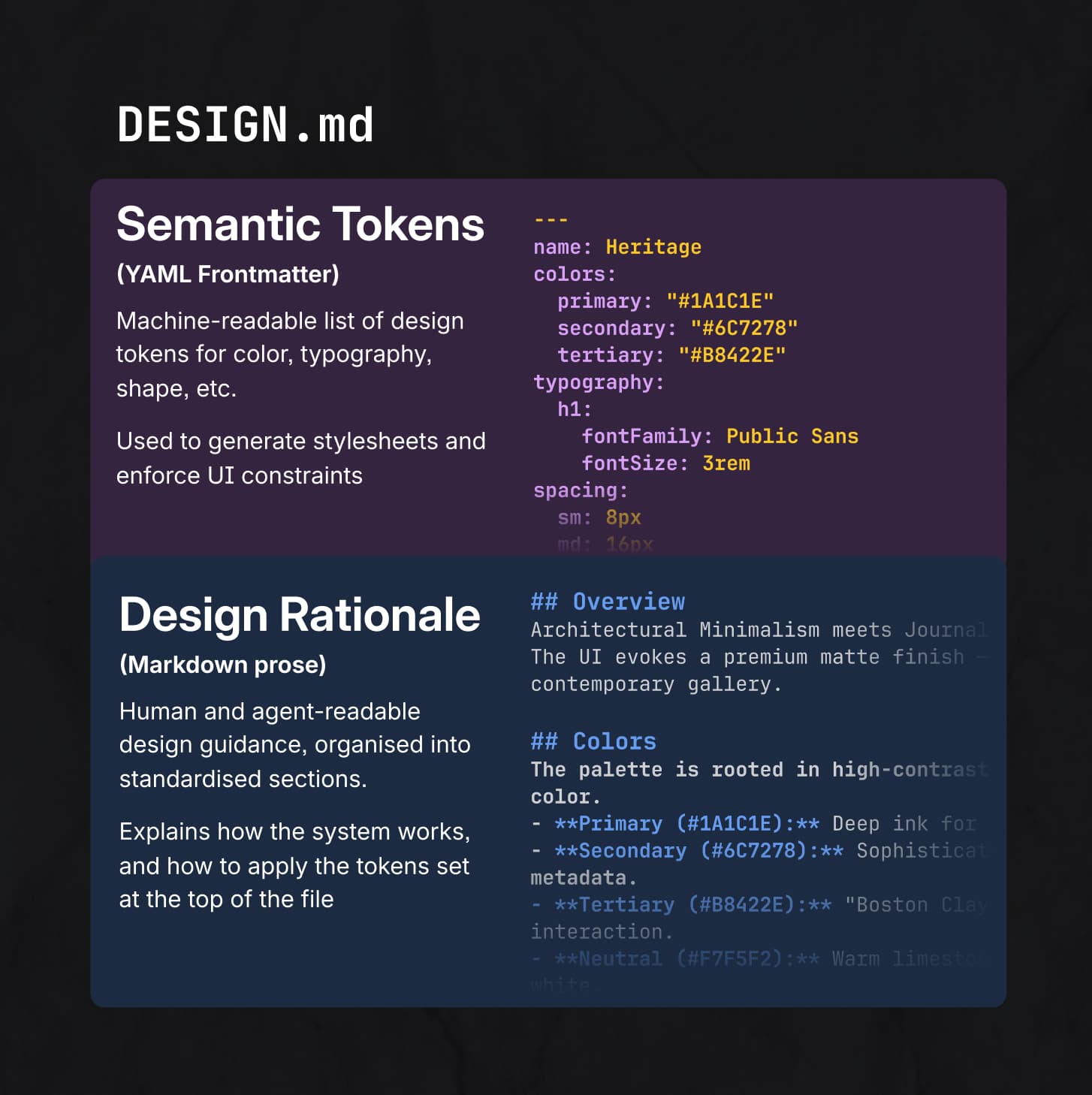
Google's DESIGN.md cuts AI slop by giving agents portable brand context, but Atlassian found portability costs token efficiency and sophistication versus structured models. Weigh portability against depth for AI design workflows.
WHY IT MATTERS: AI-generated interfaces default to generic gradients, all-caps headings, and card layouts because models lack brand context. Atlassian calls this output "slop" — technically functional but visually anonymous. As more engineering teams use AI agents to generate UI, the cost of generic output is brand erosion and extra design review cycles. The fix is giving agents structured design context, but teams now face a format decision between portable simplicity and structured depth. Getting this wrong means burning tokens on output that still needs heavy human rework.
WHAT CHANGED: Google released DESIGN.md, an open-source Markdown format for their Stitch design tool, that packs brand tokens and UI patterns into a single file you can drop into a prompt. Atlassian's design system team tested it against their existing stack, which includes an ADS MCP server and a structured content model encoding documentation for both humans and agents. They confirmed that DESIGN.md improves output over zero-context prompts and its portability makes adoption fast for small projects. However, they found the single-file approach sacrifices sophistication and raises token costs compared to their structured model. A flat Markdown file cannot carry the full depth of an enterprise design system with nested components and complex state logic, so teams hit limits when scaling beyond basic patterns.
WHAT TO WATCH: Expect a split in workflow patterns. Small teams and greenfield projects may adopt DESIGN.md for quick brand fidelity with minimal setup, while large organizations will likely invest in structured context engines or MCP servers that feed agents precise, token-efficient design data. Atlassian is continuing to refine its own context engine rather than migrating to DESIGN.md. Watch whether Google expands the spec to handle nested components and token references, or if the community builds converters between flat Markdown and structured models. The next six months will show which approach becomes the standard for agentic design generation.
Read the original → atlassian.com
Get five bites like this every day.
Tezvyn delivers a daily feed of 60-second tech bites with quizzes to lock in what you learn.