Everything in Agile & Scrum
Pushing back on a costly, low-value feature
Estimate cost in engineer-weeks, size the expected value, frame it as cost-per-unit-of-value, then propose a cheap experiment to test the hypothesis first.
Why the Sprint is a 'container' for empiricism
A steady cadence creates regular inspection points, the Sprint Goal stays fixed once committed, and Developers are shielded from scope churn.
Swap Velocity for PBI Count in Sprints
Scrum.org's Story Points Detox Plan swaps velocity for PBI count charts using existing sprint data. Teams often find item counts more stable for forecasting than story points.
Agile transformations die from dishonesty, not ceremonies
Agile transformations fail when teams perform perfect ceremonies while hiding hard truths in hallways, not from missing certifications. Leadership must make bad news safe to send upward. No framework fixes a culture that rewards appearances over outcomes.
UK digital ID plan ends online anonymity for adults
UK plan forces adults to verify social media access with passports or credit cards, ending online anonymity. Engineers must now design age-gating and digital ID systems amid institutional child protection failures and record-low 30% trust in traditional media.
DHH Backs Danish Drone Startup as Europe Rearms
Two-thirds of European investors blacklisted defense stocks under ESG rules as recently as 2018, starving the continent's drone makers. Denmark just committed 50 billion kroner to rearm as Ukraine proves software-first drones win wars.

Atlassian Defines the Knowledge Architect Role
Atlassian defines the Knowledge Architect role to structure context for AI, shifting success metrics from deployment volume to workforce transformation. When AI tools struggle with complex docs, the bottleneck is staffing. Expect this role on job boards.

Claude Agent for Jira Automates Ticket-to-PR Pipeline
Claude Agent for Jira assigns tickets to Anthropic's agent, which reads criteria and returns draft PRs from a sandbox. This closes the plan-to-code gap that has capped AI gains at 10-15%. Delegate routine bugs and refactors straight from your backlog.
Jira makes AI agents assignable teammates
Jira now lists AI agents as teammates, closing the orchestration gap that wastes the 10-15% productivity lift from AI tools. Agents pick up tickets, update fields, and transition issues with audit trails. Pilot this if your backlog has repetitive triage.

Design a system architecture optimized for rapid product discovery and iteration
Tests architecting for uncertainty via evolutionary principles. Answer: modular granularity, continuous delivery, and automated fitness functions guarding security and data. Red flag: rigid upfront design ignoring orthogonal dimensions or cross-cutting harm.
Which Scrum event best diagnoses systemic failure to deliver a usable Increment?
Tests whether you distinguish process inspection from product inspection. Answer: Sprint Retrospective, because it plans quality and effectiveness improvements and adapts the Definition of Done. Red flag: naming Sprint Review or calling it a blame session.
Trade-offs: product teams vs project teams and funding model impacts
This tests funding impact on architecture. Contrast temporary project teams funded by scope versus product teams funded by problems; tie rolling budgets to ownership and refactoring. Red flag: claiming agile ceremonies fix org design while ignoring funding.
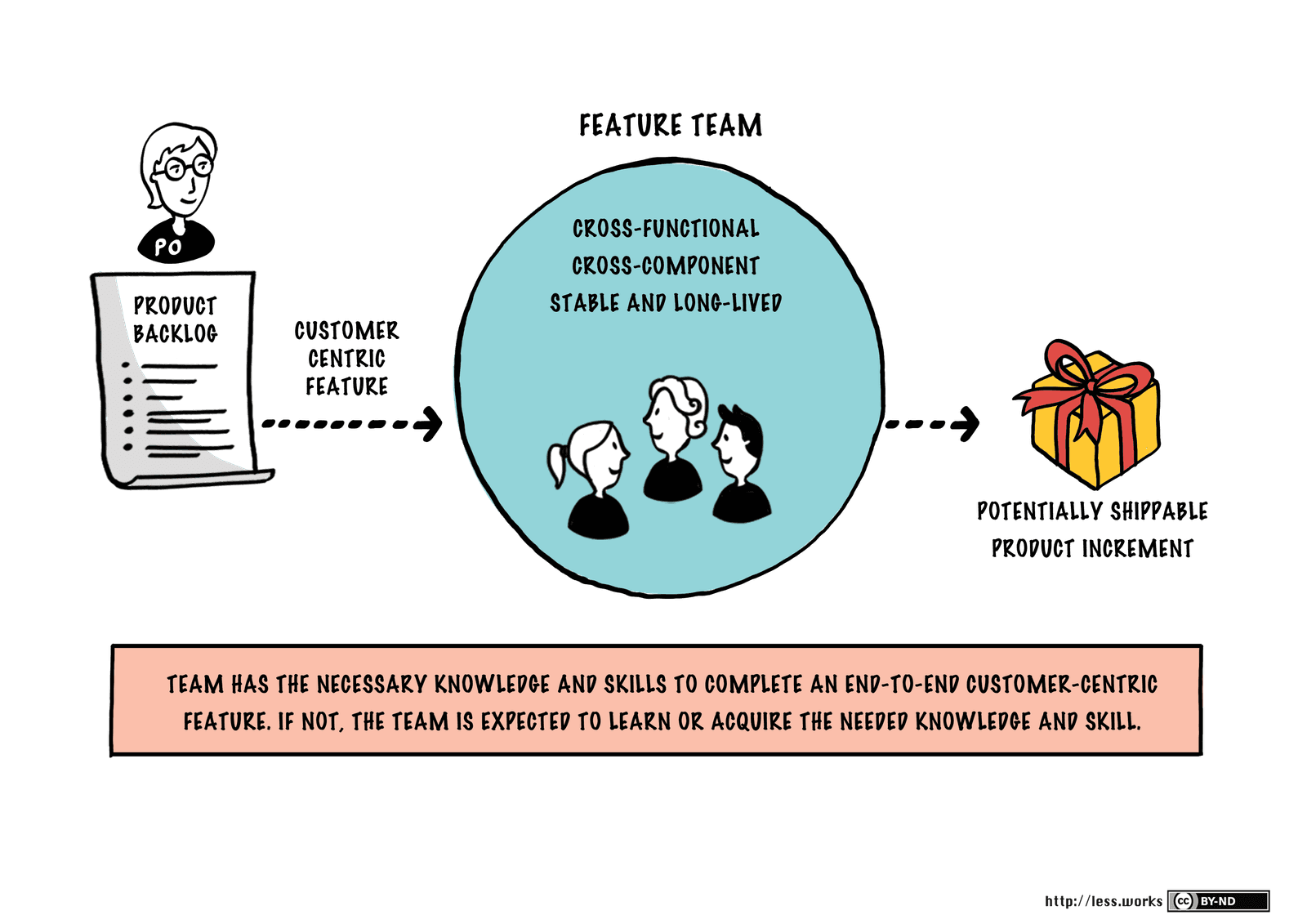
What codebase and CI/CD prerequisites enable LeSS feature teams?
Tests technical enablers for LeSS feature teams. Strong answers cover sub-10-minute CI, trunk-based development, comprehensive test automation, and decoupled architecture. Red flag: claiming coordination replaces shared ownership and continuous integration.
Purpose of a shared Definition of Done for multi-team products
This tests empirical transparency across teams building one Increment. A shared DoD forces cross-team integration and testing before Sprint end. Letting teams keep separate DoDs hides integration debt and breaks transparency.
Sprint velocity is highly variable. What technical root causes do you check?
Check scope stability via carryover, flow via cycle time, quality via rework, and estimation via point variance.
How do you adapt in-progress work when feedback invalidates a key assumption?
Alert the PO, renegotiate Backlog if the Goal is at risk, use feature flags to isolate invalidated logic.
Sprint Goals met but features don't solve stakeholder problems
Cite weak Product Goal alignment, shallow Review inspection, and missing outcome metrics.
A task takes longer than estimated, jeopardizing the Sprint Goal. Next steps?
This tests empirical adaptation when forecasts fail. Strong answer: inspect in the Daily Scrum, adapt scope with the Product Owner, and protect the Sprint Goal via self-management.
What strategy would you propose to fix an unmanageable backlog?
Expose bloat, inspect for value so the PO re-orders and trims waste, then inspect regularly.
How does a self-managing team resolve strong technical disagreements without escalation?
This tests if you see conflict as healthy creative tension. A strong answer covers timeboxed dialogue, multi-voting with reasoning, and the senior dev as neutral facilitator. A red flag is letting the senior dev dictate the answer or escalate to management.
We are hiring for this. Every open role lists the topics its interview covers, so you can prepare for the real thing rather than guessing.
See open roles