Canny Edge Detector: Finding True Edges
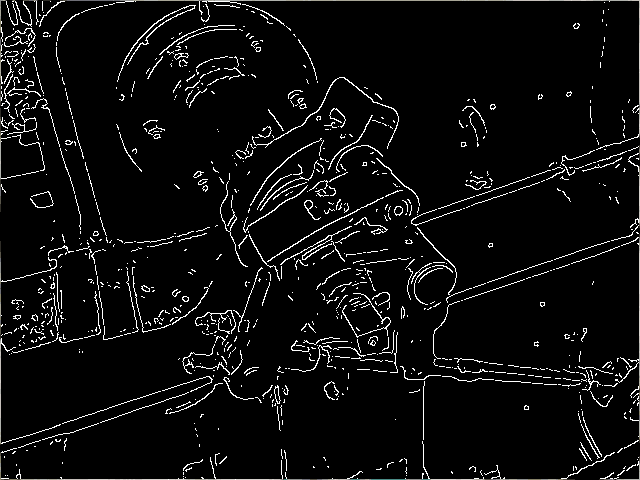
The Canny detector finds true edges by identifying sharp, connected intensity changes. It's used in object detection and feature extraction where clean edge maps are vital.
WHY IT EXISTS Simpler edge detectors, like the Sobel filter, are fast but noisy. They often mistake image texture or sensor noise for actual object boundaries. The Canny detector was designed to solve this by providing a more robust method that finds continuous, well-defined edges.
THE MENTAL MODEL Think of the Canny detector as a meticulous artist drawing an object's outline. First, the artist squints to blur out minor textures (Gaussian blur). Then, they sketch lightly wherever the brightness changes (gradient calculation). Next, they erase all but the sharpest, most defined parts of the sketch (non-maximum suppression). Finally, they trace over the definite strong lines and use them as a guide to connect to fainter, nearby lines (hysteresis thresholding).
HOW IT WORKS The algorithm is a multi-stage pipeline. First, it reduces noise in the image using a Gaussian filter. Second, it finds the intensity gradient (magnitude and direction) at each pixel, highlighting areas of rapid change. Third, it performs non-maximum suppression to thin the wide ridges of the gradient map down to single-pixel-width edges. Finally, it uses a double thresholding technique called hysteresis. Pixels with a gradient magnitude above a high threshold are marked as strong edges. Pixels between the high and a low threshold are weak edges, but are only included in the final output if they are connected to a strong edge. This allows it to trace edges through weaker sections without introducing noise.
WHEN TO USE IT Use the Canny detector whenever you need a clean, thin, and continuous edge map as a precursor to a higher-level computer vision task. It is a standard choice for feature extraction, object detection, image stitching, and medical imaging analysis where precision is critical.
WHEN NOT TO USE IT Avoid Canny if raw speed is the only priority and you can tolerate noisy, thick edges; a simpler Sobel filter might suffice. Its effectiveness is highly dependent on its parameters (blur size, high and low thresholds), which often require manual tuning for a given set of images. If you cannot tune these parameters, the results may be poor.
ONE CANONICAL EXAMPLE In an autonomous vehicle, the Canny detector can be used to identify lane markings. The camera feed is processed to suppress noise from road texture and shadows, producing a clean map of the white or yellow lines. This edge map is then fed into the car's path planning system to keep the vehicle centered in its lane.
Read the original → en.wikipedia.org
Get five bites like this every day.
Tezvyn delivers a daily feed of 60-second tech bites with quizzes to lock in what you learn.