Cluster Analysis: Finding Hidden Groups in Your Data
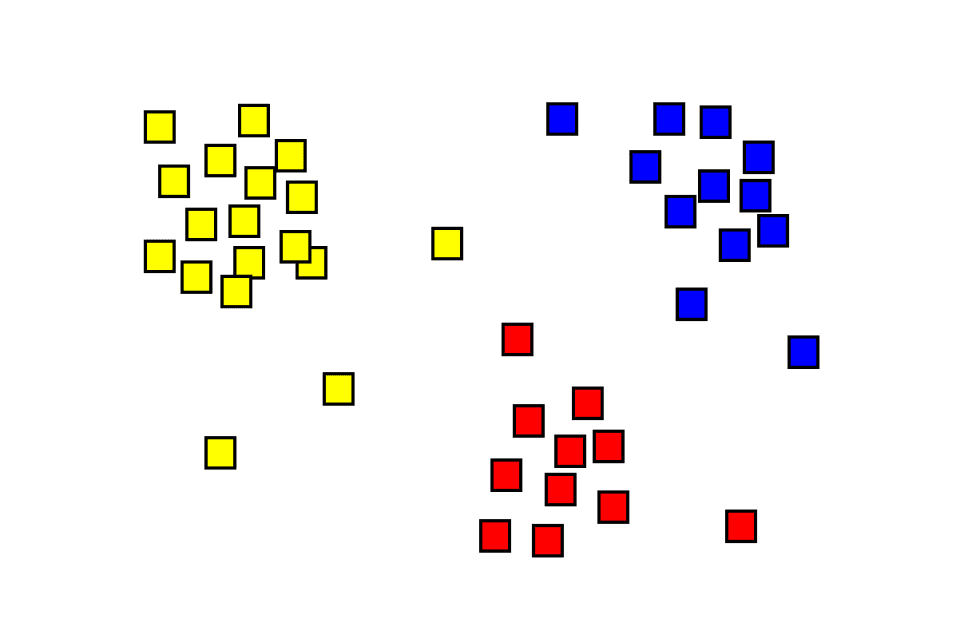
Cluster analysis automatically finds natural groupings in unlabeled data, like sorting a mixed bag of Legos without a manual. It's used for customer segmentation or anomaly detection.
THE MENTAL MODEL: Think of cluster analysis as an automated sorting machine for a dataset that has no labels. You pour in your data, and the machine groups similar items together into distinct piles or 'clusters'. The goal is to make the items within each pile as similar as possible, while making the piles themselves as different as possible. It's a technique for discovering structure, not for predicting a known outcome.
HOW IT WORKS: At its core, clustering relies on a definition of 'similarity' or 'distance'. An algorithm takes a set of data points and a distance function, which calculates how close or far apart any two points are. The algorithm then partitions the data, assigning each point to a cluster. Different algorithms use different strategies. Some, like K-Means, try to find the centers of a pre-specified number of clusters and assign points to the nearest center. Others, like DBSCAN, find dense regions of points and group them together. The output is not a prediction, but a new label for each data point indicating which cluster it belongs to.
WHEN TO USE IT: Cluster analysis is a primary tool for exploratory data analysis when you don't have labeled data. Three common use cases are: first, customer segmentation, to group customers with similar behaviors for targeted marketing; second, image analysis, to segment an image into distinct regions like sky, trees, and buildings; and third, anomaly detection, where items that do not fit well into any cluster can be identified as potential outliers or fraudulent activities.
WHEN NOT TO USE IT: Do not use clustering when you have labeled data and your goal is to predict those labels for new data; that's a job for supervised classification. It's also ineffective if you cannot define a meaningful distance metric for your data—if your similarity measure is flawed, your clusters will be meaningless. Finally, avoid using it with the expectation of finding one single 'true' grouping. Different algorithms and parameters will yield different clusters, and interpretation requires domain expertise.
ONE CANONICAL EXAMPLE: A streaming service wants to understand its user base. It can cluster users based on features like genres watched, time of day they watch, and session length. The analysis might reveal distinct clusters like 'Weekday Binge-Watchers', 'Weekend Movie Fans', and 'Morning News Watchers'. Instead of a one-size-fits-all homepage, the service can now personalize content recommendations for each group, improving user engagement.
Read the original → en.wikipedia.org
Get five bites like this every day.
Tezvyn delivers a daily feed of 60-second tech bites with quizzes to lock in what you learn.