Conjoint Analysis: What Features Do Users *Really* Value?
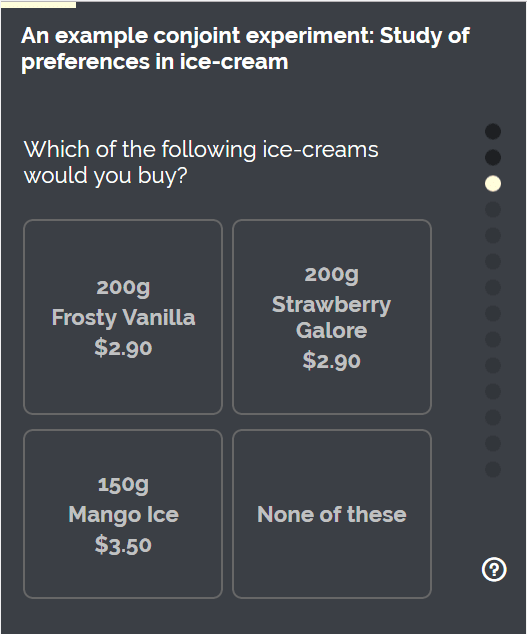
Stop asking users what they want; make them choose. Conjoint analysis reveals true priorities by forcing trade-offs between product features, like price vs. battery life. It's used for pricing and roadmapping.
WHY IT EXISTS: If you ask customers what features they want, they'll say 'yes' to everything—faster, bigger, and cheaper. This feedback is useless for making real-world engineering and business trade-offs. Conjoint analysis was created to solve this by forcing users to choose, revealing what they truly value.
THE MENTAL MODEL: Think of it as a simulated shopping trip. Instead of asking about features in isolation ('Do you want a better camera?'), you present customers with fully-formed, realistic product packages and ask them to pick their favorite. By analyzing patterns across many choices, you can statistically deconstruct their decisions to see how much 'value' they assign to each individual feature, price point, or brand.
HOW IT WORKS: It's a survey-based statistical technique. First, define the key attributes (e.g., for a phone: screen size, battery life, price). Second, define the levels for each attribute (e.g., battery life: 10 hours, 15 hours). Third, create a series of product profiles by combining these attributes and levels. Fourth, survey users by asking them to choose between different profiles. Finally, use statistical analysis to calculate the 'utility' or 'part-worth' of each attribute level, quantifying its importance to the customer.
WHEN TO USE IT: Use it when you need to make trade-offs for a product with multiple important attributes. It is ideal for setting pricing, designing product bundles, and prioritizing a feature roadmap where you can't build everything.
WHEN NOT TO USE IT: Avoid it for simple products with obvious trade-offs. It is also less effective for radically new products where customers have no frame of reference to value the attributes. The analysis assumes attributes are independent; if they are not (e.g., a 'premium' finish is only available on the most expensive model), the results can be misleading.
ONE CANONICAL EXAMPLE: A coffee shop wants to introduce a new latte and needs to set the price and size. The attributes are Size (12oz, 16oz) and Price (4.50, 5.50). They survey customers with four options: a 12oz latte for 4.50, a 16oz for 4.50, a 12oz for 5.50, and a 16oz for 5.50. By forcing a choice, they can calculate exactly how much more customers are willing to pay for the extra 4oz, allowing them to find the most profitable combination.
Read the original → en.wikipedia.org
Get five bites like this every day.
Tezvyn delivers a daily feed of 60-second tech bites with quizzes to lock in what you learn.