Corner Detection: Finding Stable Points in Images
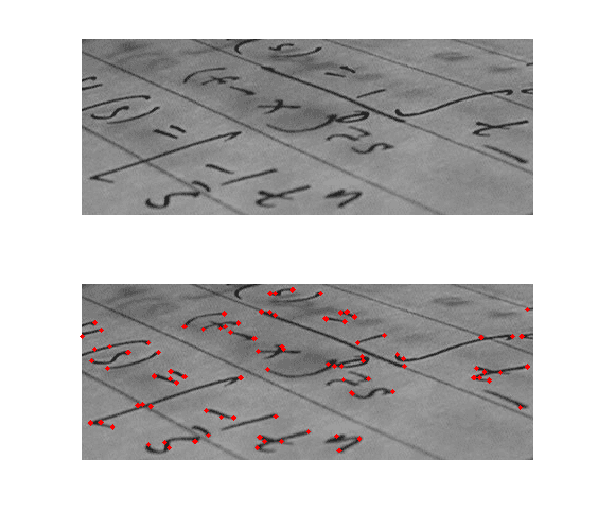
Corner detection finds stable reference points in an image by looking for areas where pixel intensity changes sharply in multiple directions. It's used to track objects in video, stitch panoramas, and recognize objects by their features.
WHY IT EXISTS To perform tasks like tracking or stitching, a computer needs to identify the same point in multiple images or video frames. A point on a blank wall is ambiguous, but a corner provides a stable, unique feature that can be reliably located again, even if the camera moves or the lighting changes slightly.
THE MENTAL MODEL Imagine looking at an image through a small square window. If you are over a flat area (like a clear sky), moving the window around doesn't change what you see. If you are on an edge (like the horizon), moving along the edge doesn't change the view, but moving across it does. If you are on a corner, moving the window in any direction causes a significant change. Corner detectors are algorithms that search for these points of high change in all directions.
HOW IT WORKS Corner detection algorithms typically work by analyzing a small patch of pixels around a point of interest. They compute a score based on how much the pixel intensities within that patch change when it's shifted by a small amount in various directions. If the score is high for shifts in all directions, the system flags that central point as a corner.
WHEN TO USE IT Corner detection is a foundational technique for many computer vision tasks. Use it for motion detection, tracking objects in video, registering different images to the same coordinate system, stitching photos into a panorama, 3D reconstruction from multiple images, and object recognition based on key features.
WHEN NOT TO USE IT Do not rely on corner detection alone when the features you need to track are not sharp corners. For example, identifying an animal by its spotted fur pattern or tracking a smooth, curved object may require texture analysis or blob detection methods instead. Simple corner detection can also be sensitive to image noise.
ONE CANONICAL EXAMPLE Creating a panorama on your phone. The software captures overlapping photos and runs a corner detector on each. It finds dozens of matching corners—the corner of a sign, a window on a building—in the overlapping regions. By aligning these corresponding points, it calculates the precise transformation needed to warp and blend the images into a single, seamless panoramic shot.
Read the original → en.wikipedia.org
Get five bites like this every day.
Tezvyn delivers a daily feed of 60-second tech bites with quizzes to lock in what you learn.