Data Lake: Store Raw Data Now, Analyze It Later
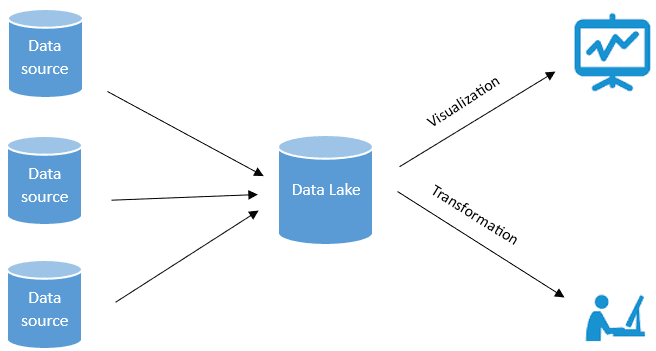
A data lake is a central repository that holds vast amounts of raw data in its native format. This "store now, structure later" approach is ideal for machine learning on original, unfiltered source data.
THE MENTAL MODEL: A data lake is a massive, single repository for data in its most natural, raw state. The guiding principle is "store everything now, figure out how to use it later." Unlike a traditional database where data must fit a predefined structure before being saved, a data lake accepts data as-is, whether it's structured, semi-structured, or completely unstructured.
HOW IT WORKS: Data from various sources—relational databases, sensor logs, social media feeds, binary files—is loaded into a large, low-cost storage system, typically as object blobs or files. The data remains in its native format. Structure is not imposed when the data is written. Instead, tools for reporting, visualization, or machine learning apply a schema as they read the data (a concept known as schema-on-read). This provides maximum flexibility for future analysis, as the original data is always preserved.
WHEN TO USE IT: Data lakes are ideal for big data analytics and machine learning workloads. Use one when you need to combine diverse data types and you don't know all the business questions you'll need to answer in the future. It empowers data scientists to perform exploratory analysis and feature engineering on the full, unaltered dataset, which can lead to more powerful insights and models.
WHEN NOT TO USE IT: A data lake is not a replacement for a traditional data warehouse for standard business reporting. If your primary need is fast, consistent queries on clean, structured data, a data lake's schema-on-read approach can be slow and inefficient. The biggest risk is creating a "data swamp": without strong data governance, cataloging, and metadata management, the lake can become a messy, undocumented, and untrustworthy mess where data is impossible to find or use.
ONE CANONICAL EXAMPLE: A retail company wants to analyze customer behavior. It ingests raw data from multiple sources into its cloud data lake: structured sales records, semi-structured web server logs of user clicks, and unstructured text from product reviews. A data science team can then query this single repository to join all three data types, building a machine learning model to predict which customers are likely to churn without being constrained by a pre-built schema.
Read the original → en.wikipedia.org
Get five bites like this every day.
Tezvyn delivers a daily feed of 60-second tech bites with quizzes to lock in what you learn.