Focus Stacking: Combining Focal Planes for Ultimate Sharpness
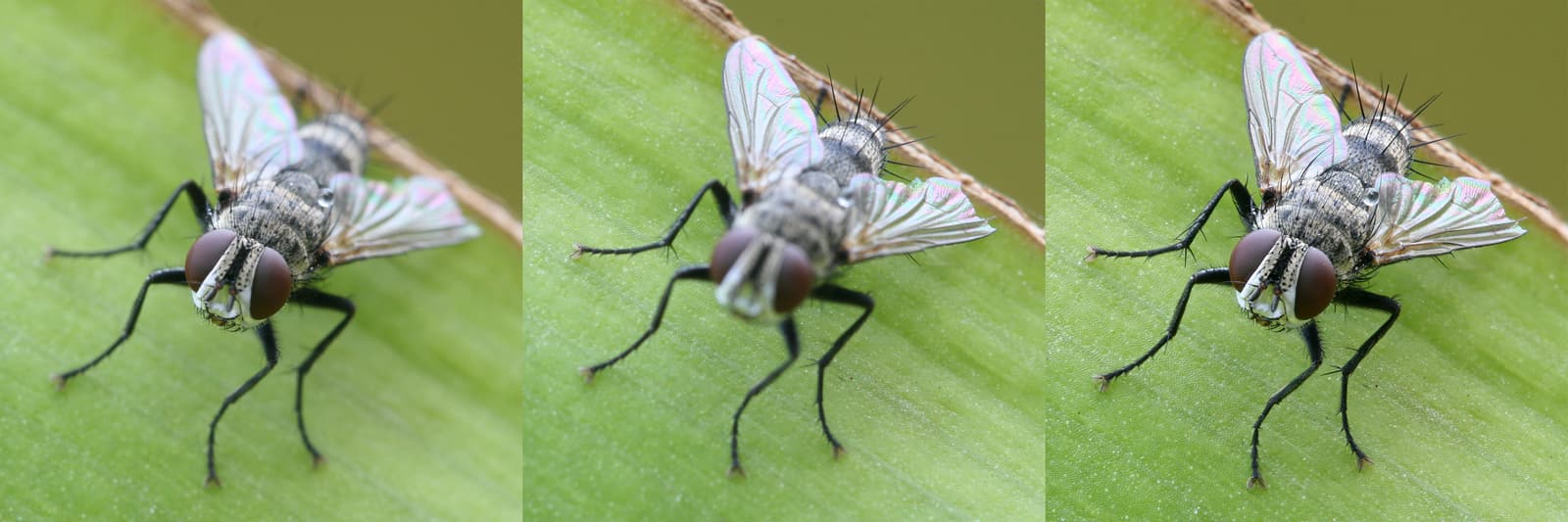
Focus stacking creates an image with impossible depth of field by combining the sharpest parts of multiple photos. It's essential for macro, landscape, and microscopy where one shot can't keep everything sharp.
WHY IT EXISTS Physical lenses have a limited depth of field—the zone that appears acceptably sharp. In situations like macro photography or microscopy, this zone can be paper-thin, making it impossible to capture an entire subject in focus with a single shot. Focus stacking was invented to digitally overcome this physical limitation.
THE MENTAL MODEL Think of focus stacking like creating a collage from the sharpest parts of many photos. You take a series of pictures of the same scene, each focused on a different sliver. Software then cuts out the in-focus part from each photo and stitches them together into one final image where everything is perfectly sharp.
HOW IT WORKS The technique, also called z-stacking, involves capturing a sequence of images of a static subject. The camera must not move, but the focal plane is shifted for each shot, moving progressively from the nearest part of the scene to the farthest. An algorithm then analyzes this stack of images, identifies the sharpest pixels from each frame, and composites them into a single resulting image with a greater depth of field than any of the individual source images.
WHEN TO USE IT Use focus stacking for any static scene where you need more depth of field than your lens can provide. It is a standard technique in three main areas: first, macro photography, to get an entire insect or flower sharp; second, optical microscopy, to view a whole specimen in focus; and third, landscape photography, to ensure both a close foreground object and the distant background are crisp.
WHEN NOT TO USE IT Avoid focus stacking for scenes with movement. If the subject (like a living insect) or elements in the scene (like wind-blown leaves) move between shots, the final composite will have ghosting and ugly artifacts. It is impractical for action or candid photography. A tripod is almost always mandatory to prevent camera shake from ruining the alignment.
ONE CANONICAL EXAMPLE A close-up photo of a honeybee is a classic case. With a single shot, a macro lens might only get its eyes in focus, leaving the wings and body blurry. By taking a stack of 10-20 photos, each focused slightly further back—from eyes to head to thorax to wings—a photographer can blend them into one image where the entire bee is tack sharp.
Read the original → en.wikipedia.org
Get five bites like this every day.
Tezvyn delivers a daily feed of 60-second tech bites with quizzes to lock in what you learn.