Lean Portfolio Management (LPM): Connecting Strategy to Execution
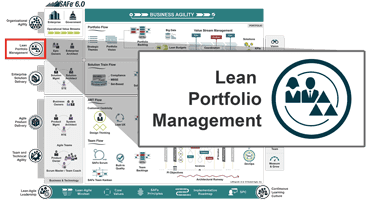
LPM connects strategy to execution by applying Lean thinking to funding and governance. It manages a portfolio of development value streams—like an e-commerce site—to ensure work aligns with business goals.
WHY IT EXISTS: Traditional portfolio management was designed for a slower, more predictable era and is ill-suited for the modern digital age. Enterprises now face higher uncertainty and must deliver innovative software-driven solutions much faster. Legacy practices often create bottlenecks, hindering the very agility that development teams are trying to achieve. LPM was created to modernize portfolio management and align it with Lean-Agile principles.
THE MENTAL MODEL: Think of LPM as the central nervous system connecting an enterprise's strategic brain to its operational muscles. It shifts the focus from managing a collection of disconnected projects to funding and nurturing a portfolio of value streams. The goal is to ensure that every team's effort directly contributes to a clear, shared strategic objective, eliminating the common problem where executives have wildly different ideas about the company's direction.
HOW IT WORKS: LPM functions across three main areas. First, Strategy and Investment Funding applies Lean thinking to financial decisions, moving away from rigid annual budgets towards more dynamic funding of value streams based on strategic importance. Second, Agile Portfolio Operations coordinates the various Development Value Streams within the portfolio, ensuring they work in concert to deliver solutions. Third, Governance provides lightweight oversight to align teams with strategic intent and measure performance without creating bureaucratic delays.
WHEN TO USE IT: LPM is designed for large enterprises that need to coordinate multiple Development Value Streams within a business domain. It is most valuable when an organization has adopted Agile at the team level but still struggles with a disconnect between high-level strategy and day-to-day execution. It provides the structure to achieve business agility at scale.
WHEN NOT TO USE IT: The formal structure of LPM is likely overkill for smaller organizations or startups with a single product. In these environments, strategic alignment is often achieved through direct, constant communication, and the overhead of a formal portfolio management function would outweigh its benefits. It is a solution for complexity at scale.
ONE CANONICAL EXAMPLE: Consider a large enterprise developing a new e-commerce website. The website is a solution delivered to customers. The portfolio consists of the set of Development Value Streams that build and maintain this site. LPM provides the framework to align all work with the strategy, such as "capture 15% of the market in two years." It funds initiatives like "new mobile checkout flow" and governs their execution to ensure they deliver on the strategic promise.
Read the original → framework.scaledagile.com
Get five bites like this every day.
Tezvyn delivers a daily feed of 60-second tech bites with quizzes to lock in what you learn.