Monte Carlo Forecasting: Probabilities, Not Promises
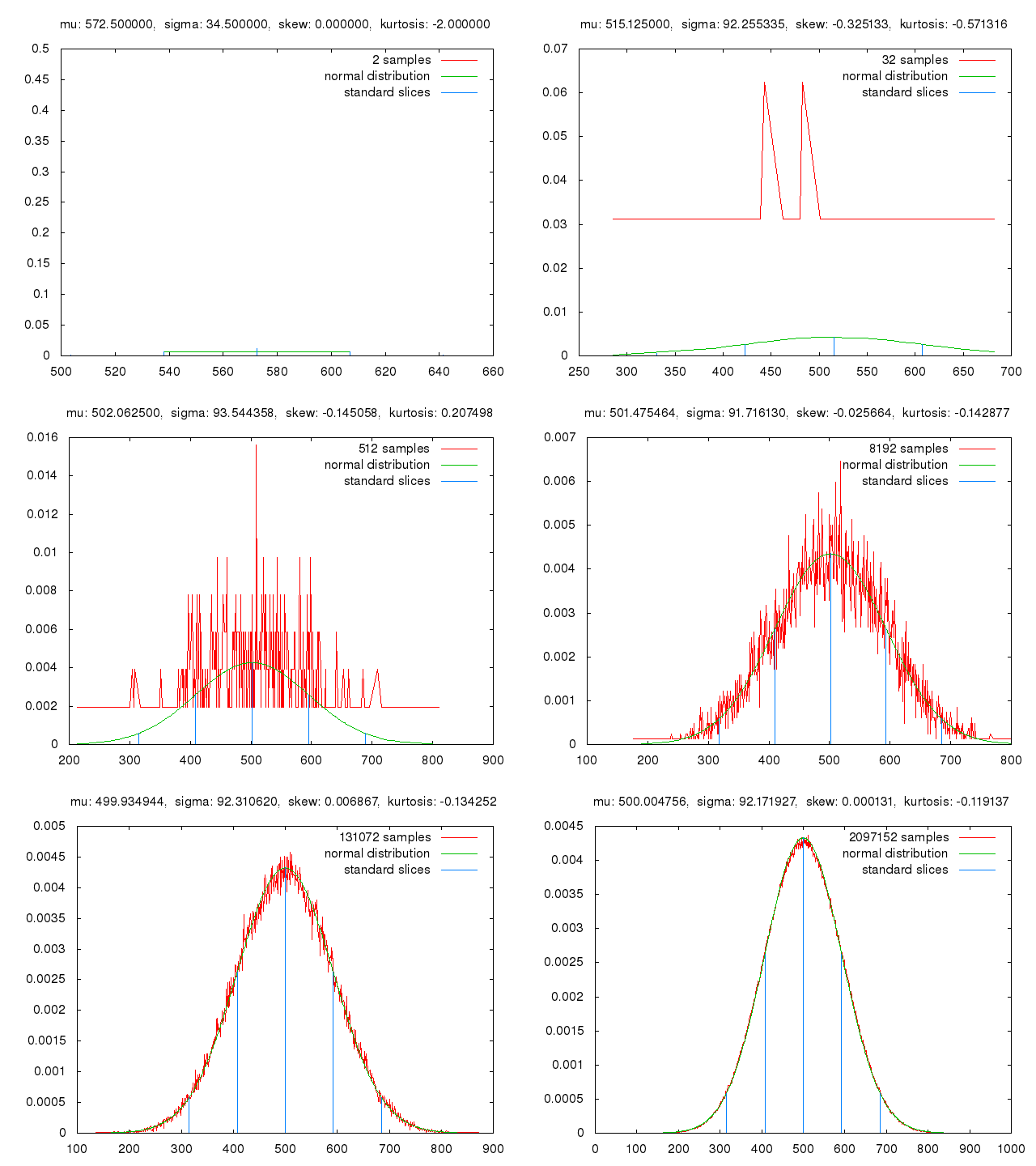
Monte Carlo forecasting trades a single due date for a set of probabilities. By running thousands of random simulations based on past performance, it generates a range of likely completion dates, not a single guess.
THE MENTAL MODEL: Instead of giving a single, fragile 'due date', Monte Carlo forecasting answers 'When will it be done?' with a range of probabilities. It acknowledges that the future is uncertain by using randomness to model thousands of possible outcomes. The output is not a date, but a distribution, such as 'There is an 85% chance this project will be finished by July 1st'. It shifts the conversation from deterministic promises to probabilistic planning.
HOW IT WORKS: The method uses repeated random sampling to get its results. For project forecasting, this involves three steps. First, you gather historical data on your team's throughput (e.g., the number of tasks completed each week for the last 20 weeks). Second, you define the remaining work (e.g., 100 tasks). Third, you run the simulation. A computer program 'simulates' a future week by randomly picking a throughput value from your historical data and subtracting it from the remaining work. It repeats this until the work is done, recording the simulated completion date. By running this simulation thousands of times, you generate a distribution of possible completion dates.
WHEN TO USE IT: Use this method when you need to provide a forecast for a large body of work and stakeholders are willing to engage with probabilities instead of demanding a single date. It is excellent for forecasting the completion of epics, releases, or entire projects, especially in an Agile context where work items are roughly similar in size and you have reliable historical throughput data. It is a powerful tool for managing expectations and making risk-informed decisions.
WHEN NOT TO USE IT: Monte Carlo forecasting is ineffective for teams with no historical data, as the simulation has nothing to sample from. It also performs poorly if the nature of the work is changing dramatically or if the team itself is unstable, as past performance is no longer a reliable predictor of future performance. Avoid it for single, unique, large tasks that have no historical precedent.
ONE CANONICAL EXAMPLE: A team has 80 stories left in a backlog. Their historical data shows they complete between 5 and 12 stories per week. A Monte Carlo simulation will run thousands of trials. Trial 1 might randomly sample '7 stories' for week 1, '10 stories' for week 2, '5 stories' for week 3, and so on, until the 80 stories are complete. Trial 2 starts over with new random samples. After 10,000 trials, the results might show that the project finished in 9 weeks or less in 50% of simulations, and in 11 weeks or less in 85% of simulations. This gives the team a confident range to communicate.
Read the original → en.wikipedia.org
Get five bites like this every day.
Tezvyn delivers a daily feed of 60-second tech bites with quizzes to lock in what you learn.