OODA Loop: Winning the Incident Response Race
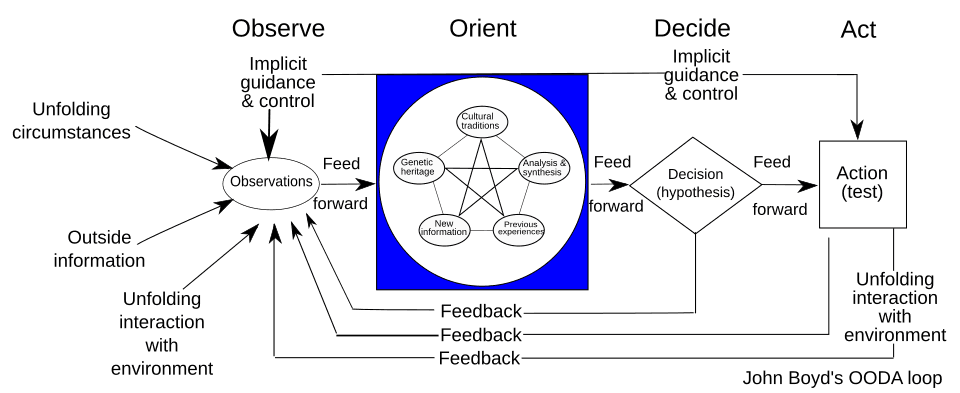
The OODA loop (Observe, Orient, Decide, Act) is a model for making fast decisions under pressure. During an incident, the team that cycles fastest wins. It's used for triaging alerts and debugging live outages.
WHY IT EXISTS: In a crisis, like a production outage, the team that can process information and act effectively faster than the problem is escalating will resolve it. The OODA loop was created to formalize this process of rapid, adaptive decision-making under pressure. It's about operating at a higher tempo than the failure itself.
THE MENTAL MODEL: Think of an incident as a race against a cascading failure. The OODA loop is your team's decision-making engine. You Observe the system's behavior, Orient by forming a shared understanding, Decide on a course of action, and Act to implement it. The goal is to 'get inside' the incident's loop, making effective changes faster than the system can break in new ways.
HOW IT WORKS: The loop has four stages. First, Observe: Gather raw data from dashboards, logs, and alerts. What is the system doing? Second, Orient: This is the most critical step. Synthesize observations with your mental models of the system, past experiences, and team knowledge to form a coherent picture and hypothesis. What is happening and why? Third, Decide: Based on your orientation, choose a specific action. What is our best move right now? Fourth, Act: Execute the decision. This could be a rollback, scaling a service, or running a diagnostic. The result of this action feeds back into a new Observe phase, starting the loop again.
WHEN TO USE IT: The OODA loop is the default operating model for high-severity incident response. It's invaluable for structuring the chaos of a live outage, ensuring the team moves in a coordinated way. It's also useful for security incident response, where you are dealing with an active adversary.
WHEN NOT TO USE IT: For routine, low-stakes tasks with established playbooks, the full loop is overkill. If a problem is well-understood and has a pre-approved, automated fix, you don't need to deliberate; you just execute the plan. The OODA loop is for navigating uncertainty, not for following a checklist.
ONE CANONICAL EXAMPLE: An alert fires for 500 errors on the checkout service. Observe: Latency is up, error count is spiking, CPU on the database is at 100%. Orient: The team convenes. Someone remembers a recent schema migration. The hypothesis is that a new, inefficient query is hammering the database. Decide: The Incident Commander decides to roll back the migration code path. Act: The on-call engineer executes the rollback. The team then re-Observes the metrics to see if the action was successful, starting a new loop.
Read the original → en.wikipedia.org
Get five bites like this every day.
Tezvyn delivers a daily feed of 60-second tech bites with quizzes to lock in what you learn.