Ray AI Runtime (AIR): A Unified ML Toolkit
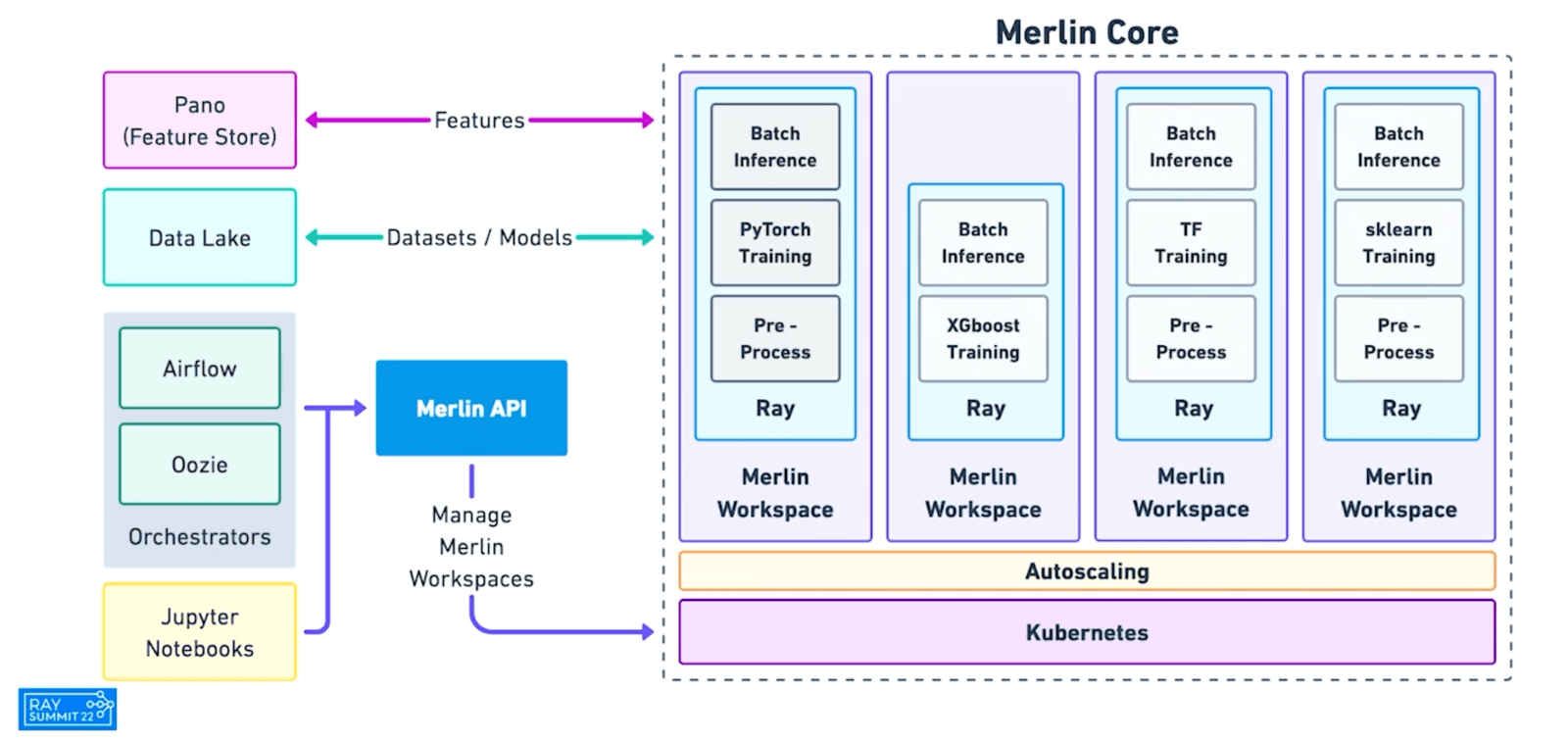
Ray AIR is a unified toolbox for the ML lifecycle, bundling libraries for data, training, tuning, and serving. It's for scaling end-to-end ML workflows on one distributed platform.
WHY IT EXISTS: ML development involves disconnected stages: data prep, training, tuning, and serving. Each often requires different tools and infrastructure, creating friction and complexity when moving from one stage to the next. Ray AIR was created to solve this by providing a single, unified compute layer and a set of integrated libraries to handle the entire ML lifecycle.
THE MENTAL MODEL: Ray AIR is an integrated development kit for distributed ML, not a single application. It's like a carpenter's full workshop (saw for cutting, drill for holes, sander for finishing) rather than just a multi-tool. It provides specialized, high-performance libraries (Ray Data, Train, Tune, Serve) that are designed to work together seamlessly on the same underlying distributed compute engine, Ray Core.
HOW IT WORKS: Ray AIR isn't a separate piece of software you install. It's the collective name for using Ray's ML libraries together. You use Ray Data to create a distributed data pipeline. You pass that data to Ray Train for distributed model training. You use Ray Tune to find the best hyperparameters for your training job. Finally, you take the trained model and deploy it for scalable inference using Ray Serve. All these operations run on the same Ray cluster, eliminating the need to move data or reconfigure environments between steps.
WHEN TO USE IT: Use Ray AIR when you're building a complete ML system that needs to scale beyond a single machine. It's ideal for complex workflows like distributed training of large models, large-scale batch inference on massive datasets, or building scalable online serving systems where the preprocessing logic and model serving need to be tightly coupled.
WHEN NOT TO USE IT: If your project is small and fits on a single machine, Ray AIR is overkill. The overhead of setting up and managing a distributed Ray cluster isn't justified for simple scripts or small datasets. Similarly, if you only need to solve one part of the ML lifecycle (e.g., just model training) and already have a satisfactory tool, adopting the entire AIR ecosystem might be unnecessary complexity.
ONE CANONICAL EXAMPLE: A common use case is training and serving a model. You would start by using Ray Data to ingest and preprocess terabytes of data from cloud storage. Then, you'd feed this data directly into a Ray Train job to train a model like XGBoost or a deep learning model across multiple GPUs. After training, you could use Ray Serve to deploy the trained model as a scalable web endpoint, all within the same Python code and on the same Ray cluster.
Read the original → docs.ray.io
Get five bites like this every day.
Tezvyn delivers a daily feed of 60-second tech bites with quizzes to lock in what you learn.