Single Point of Failure: Your System's Achilles' Heel
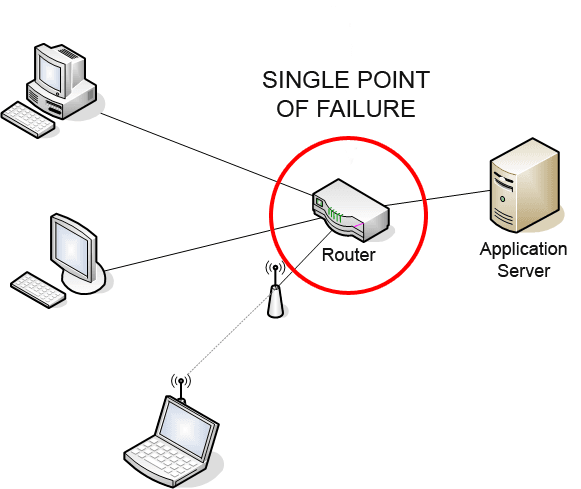
A single point of failure (SPOF) is your system's Achilles' heel—one component whose failure causes a total outage. This is critical in high-availability design, like ensuring a website survives a server crash. The footgun is missing implicit SPOFs.
WHY IT EXISTS The concept of a SPOF exists to help engineers reason about system reliability. By identifying the single components that could cause a total outage, we can prioritize adding redundancy and resilience, moving from a fragile system to a robust one. It provides a formal framework for risk analysis in system design.
THE MENTAL MODEL Think of a chain. It is only as strong as its weakest link. A single point of failure is that weakest link. If it breaks, the entire chain is broken, and the system it supports comes crashing down. The goal of SPOF analysis is to find every single link and ensure it either has a backup (redundancy) or is so incredibly strong it's guaranteed not to fail, which is rare in practice.
HOW IT WORKS SPOF analysis is a process of auditing a system's architecture. You trace dependencies from the user request down to the hardware. For each component—server, database, API, load balancer, network cable, power supply—you ask: "If this component vanished right now, would the system continue to function?" If the answer is "no," you have found a SPOF. The solution is usually to introduce redundancy, like adding a second server, replicating a database, or using multiple cloud providers.
WHEN TO USE IT Use SPOF analysis during the design phase of any new system to build in reliability from the start. It should also be performed periodically on existing systems as part of a reliability audit, especially after new features are added. It is a fundamental practice for Site Reliability Engineering (SRE) and any work involving high-availability or fault-tolerant systems.
WHEN NOT TO USE IT While the analysis is always useful, implementing the fixes is a trade-off between cost and risk. For a non-critical internal tool or a personal project, the engineering cost of eliminating every SPOF (e.g., setting up a multi-region, replicated database) might not be worth the benefit. The key is to make a conscious decision based on the system's required uptime and the impact of an outage.
ONE CANONICAL EXAMPLE A single load balancer in front of a fleet of web servers. The web servers themselves are redundant; if one fails, the others can handle the traffic. But if the single load balancer that directs traffic to them fails, no user can reach any of the servers, and the entire website goes down. It is the single point of failure, even though the components behind it are fault-tolerant.
Read the original → en.wikipedia.org
Get five bites like this every day.
Tezvyn delivers a daily feed of 60-second tech bites with quizzes to lock in what you learn.