System Dynamics: Modeling with Stocks, Flows, and Feedback
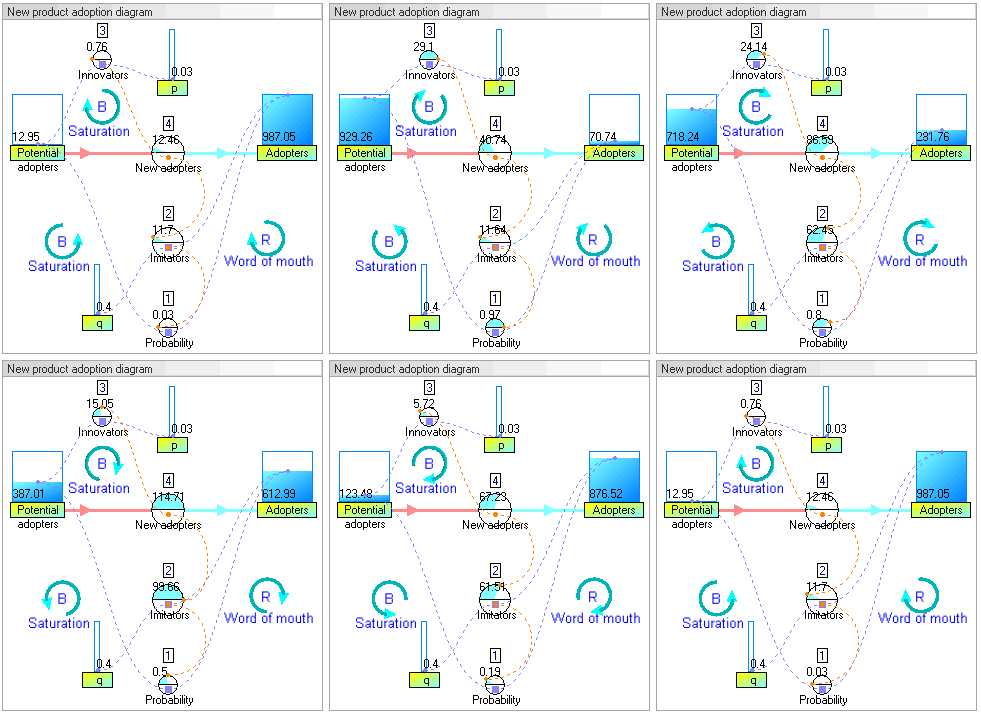
System Dynamics models the world as interconnected stocks (like users) and flows (like signups), governed by feedback loops. Use it to understand why growth stalls or why hiring lags behind need.
WHY IT EXISTS To move beyond simple, linear cause-and-effect explanations for complex problems. Many systems, from user growth to supply chains, don't respond predictably to inputs because their internal structure—feedback loops and delays—creates non-linear, often counter-intuitive behavior over time. System Dynamics was created to map and simulate these structures to understand their emergent behavior.
THE MENTAL MODEL Think of a system as a bathtub. The amount of water is a "stock." The water coming from the faucet is an "inflow," and water leaving through the drain is an "outflow." System Dynamics connects these parts with feedback. For example, what if the water level (the stock) controlled the faucet's handle (the inflow)? A higher level might partially close the faucet, creating a "balancing feedback loop." Real-world systems are full of these interconnected loops and delays that determine their behavior.
HOW IT WORKS A System Dynamics model is a simulation built from a few core components. First, you identify the key "stocks," which are accumulations of things over time (e.g., number of users, cash in the bank). Second, you define the "flows," which are the rates that increase or decrease those stocks (e.g., new signups per day, monthly expenses). The critical step is connecting these with "feedback loops," where the state of a stock influences a flow. For example, more users (stock) leads to more word-of-mouth, increasing new signups (flow). You also model "time delays," like the lag between a marketing campaign and its effect on sales. The model is then run as a simulation to see how the stocks change over time.
WHEN TO USE IT Use System Dynamics when you need to understand the behavior over time of a complex system, not just a static snapshot. It's ideal for problems where feedback and delays are significant. Examples include: modeling the viral growth of a product, understanding oscillations in a supply chain (the bullwhip effect), or projecting the long-term impact of a policy change on a company's culture.
WHEN NOT TO USE IT Don't use it for simple, linear problems where cause and effect are direct and immediate. It's also overkill for problems that don't change significantly over time or lack important feedback mechanisms. The model's quality is entirely dependent on correctly identifying the system's structure; if you can't map the loops and delays accurately, the simulation will be misleading.
ONE CANONICAL EXAMPLE A classic example is modeling a new product's adoption. The "stock" is the number of adopters. The "inflow" is the adoption rate. Initially, adoption is driven by marketing. But soon, a reinforcing feedback loop kicks in: more adopters (stock) lead to more word-of-mouth, which increases the adoption rate (inflow). At the same time, a balancing loop emerges: as the pool of potential customers shrinks, it becomes harder to find new adopters, slowing the adoption rate. Simulating this shows the classic S-shaped growth curve, a non-linear outcome from simple rules.
Read the original → en.wikipedia.org
Get five bites like this every day.
Tezvyn delivers a daily feed of 60-second tech bites with quizzes to lock in what you learn.