Team Charter: Shared Agreements for Collaboration
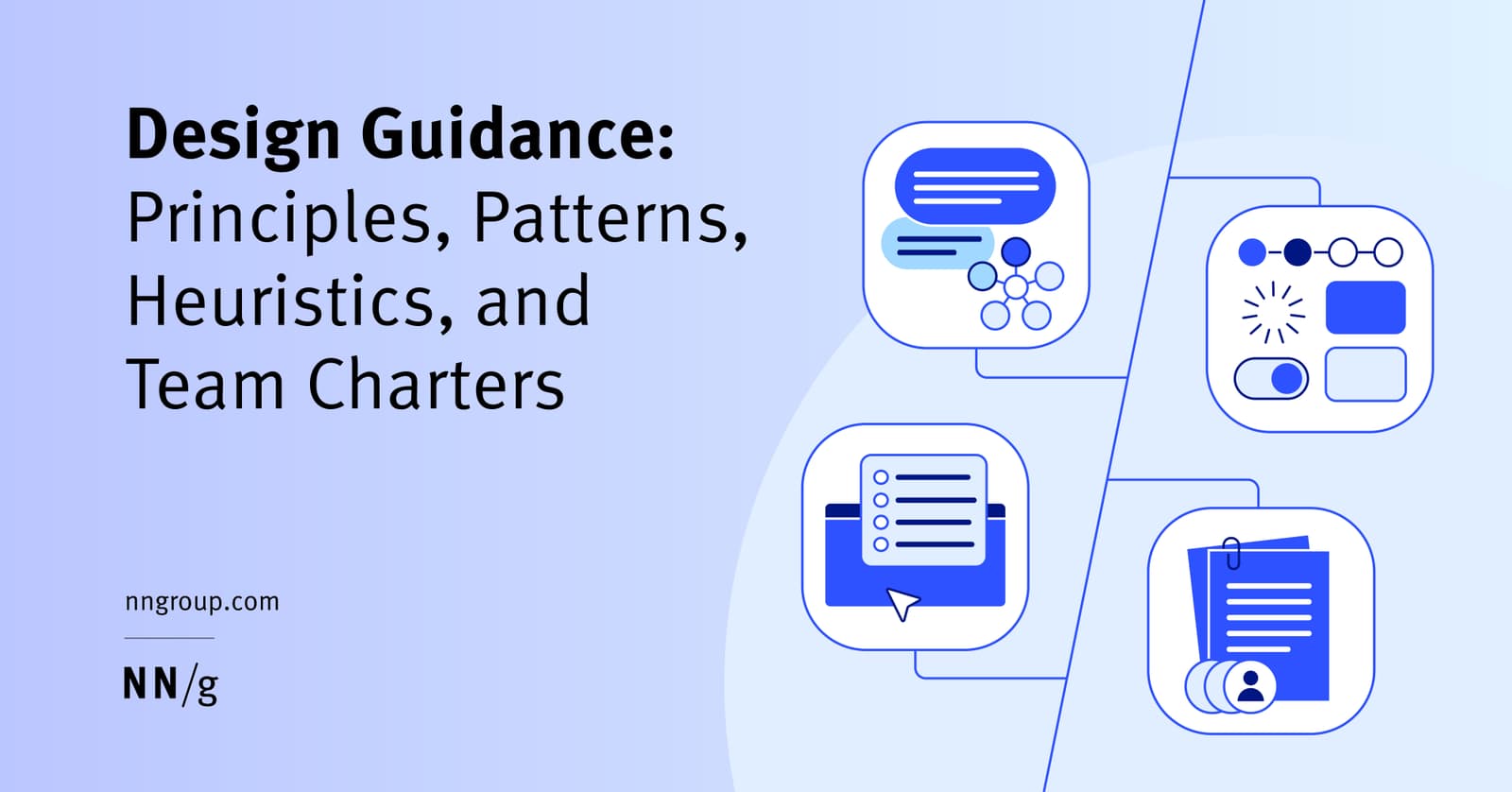
A team charter is the operating agreement that keeps collaboration aligned, distinct from the design rules the team produces. Teams use it to establish shared norms alongside principles and heuristics.
WHY IT EXISTS: Design teams rely on multiple forms of guidance to maintain consistency, advocate for usability, and find efficiency. The source identifies four distinct types: design principles, usability heuristics, design patterns, and team charters. While principles, heuristics, and patterns address what to build and how to evaluate it, charters address the coordination required to do the work. Without shared agreements on how teams work together, even strong design guidance can fail during execution due to misalignment.
THE MENTAL MODEL: Think of a charter as the operating system for team collaboration, while principles are the strategy, heuristics are the quality checks, and patterns are the reusable components. A charter does not dictate which button to place where; it defines how the team makes decisions, communicates, and resolves disagreements.
HOW IT WORKS: The source defines team charters as shared agreements on how teams work together. They sit alongside three other guidance types. Design principles are high-level value statements that frame design decisions and align teams to a shared vision. Usability heuristics are universal research-backed rules of thumb for evaluating interface usability. Design patterns are standardized reusable solutions for common design problems. Charters differ because they target team dynamics and process rather than interface attributes. Where principles guide design choices and heuristics provide an objective framework for critique, charters establish the ground rules for collaboration itself.
WHEN TO USE IT: Teams should use charters when they need explicit shared agreements about their working relationships. The source notes that teams benefit from leveraging all four types of design guidance together, suggesting charters are most valuable when integrated with principles, heuristics, and patterns rather than used in isolation.
WHEN NOT TO USE IT: Charters are not a substitute for design principles, heuristics, or patterns. The source emphasizes that each type has a unique role in the design process. Using a charter to dictate specific design solutions or evaluate interface usability would be a category error; those jobs belong to patterns, principles, and heuristics respectively.
ONE CANONICAL EXAMPLE: The source describes a design team relying on a combination of principles, patterns, heuristics, and charters to create consistent and usable experiences in a collaborative way. In this context, the charter functions as the agreement that enables the other three guidance types to be applied effectively across the team.
Read the original → nngroup.com
Get five bites like this every day.
Tezvyn delivers a daily feed of 60-second tech bites with quizzes to lock in what you learn.