The 80/20 Rule: Find the Vital Few
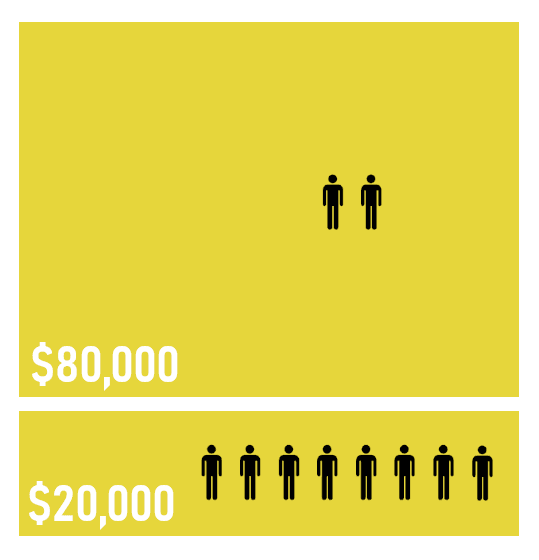
The 80/20 rule states that most outcomes (80%) come from a few causes (20%). It's used to find high-impact work, like fixing the few bugs causing most crashes. The footgun is treating 80/20 as a precise law instead of a general heuristic.
WHY IT EXISTS: The Pareto Principle exists to combat the false assumption that all efforts yield similar results. It provides a framework for allocating limited resources—like time, money, or engineering effort—by focusing on the inputs that produce the greatest outputs, rather than treating all tasks as equally important.
THE MENTAL MODEL: Think of the 80/20 rule not as a strict mathematical law, but as a powerful heuristic for spotting imbalance. The core idea is that in many complex systems, a small number of causes (the "vital few") are responsible for a large majority of the effects. The numbers 80 and 20 are just placeholders for this lopsided relationship; the actual split could be 90/10 or 70/30. The key is to recognize that outcomes are rarely distributed evenly.
HOW IT WORKS: The principle is an observation, not a formula you apply. To use it, you gather data and look for the pattern. For example, to prioritize bug fixes, you would list all known bugs and count the number of user complaints or crashes associated with each. When you sort this list, you will likely find that a small handful of bugs account for the vast majority of user pain. This is the 80/20 rule in action, telling you which fixes will provide the most value.
WHEN TO USE IT: Use the Pareto Principle for prioritization under constraints. It's invaluable for bug triage (fixing the 20% of bugs causing 80% of crashes), performance optimization (profiling to find the 20% of code consuming 80% of CPU), and product strategy (identifying the 20% of features driving 80% of engagement or revenue). It helps you answer the question, "Where can I apply a small amount of effort to get a large return?"
WHEN NOT TO USE IT: The principle is a poor tool for justifying neglect. The "trivial many" (the 80% of causes) can still be important. For example, a feature used by only a few users might be a contractual obligation for a major client, or an obscure bug might represent a critical security vulnerability. It is a heuristic for focus, not a license to ignore the long tail.
ONE CANONICAL EXAMPLE: In software performance engineering, a profiler is often used to analyze where a program spends its time. A typical profiling report reveals that the majority of CPU cycles—often 80% or more—are spent inside a very small percentage of the system's functions. This immediately tells engineers not to waste time optimizing code that is rarely executed, but to focus their efforts on that critical 20% to achieve the largest performance gains.
Read the original → en.wikipedia.org
Get five bites like this every day.
Tezvyn delivers a daily feed of 60-second tech bites with quizzes to lock in what you learn.