Variational Autoencoders: Learning to Generate Data
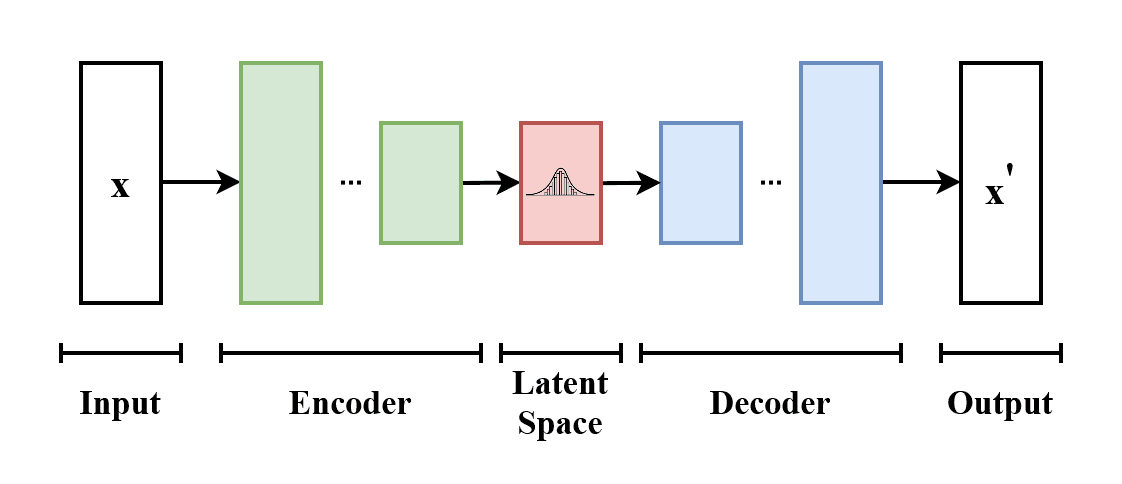
A VAE learns to create new data by compressing examples into a "latent space" of core features and then decoding from it. It's used for generative art and data augmentation, but its outputs can be blurrier than those from other models like GANs.
WHY IT EXISTS: Generative models aim to create new data that resembles an existing dataset—for example, creating new faces after training on a database of photos. VAEs are a specific approach that learns a smooth, continuous representation of the data's underlying features, making the generation process more structured and controllable.
THE MENTAL MODEL: Imagine an artist learning to draw cats. Instead of memorizing every cat photo, they develop an abstract concept of "cat-ness"—a combination of features like pointy ears and whiskers. A VAE's encoder does this by compressing real images into a small set of numbers representing their core features in a "latent space". The decoder then learns to take a point from this latent space and draw a plausible cat. The "variational" aspect ensures this space is smooth, so you can pick a point near "cat" and get another valid-looking cat, not garbage.
HOW IT WORKS: A VAE has two neural networks: an encoder and a decoder. The encoder takes an input and maps it to a probability distribution (a mean and variance) in the latent space. A point is then sampled from this distribution and fed to the decoder, which tries to reconstruct the original input. The VAE is trained on two goals at once. First, a reconstruction loss, which pushes the decoder to create faithful outputs. Second, a regularization loss (the KL divergence), which forces the latent space to be well-organized and continuous. This regularization is the key: it prevents simple memorization and enables the model to generate novel, yet plausible, variations.
WHEN TO USE IT: VAEs excel when you need a smooth, continuous latent space. This is useful for generating diverse new data like images or music, data augmentation for other ML models, and anomaly detection, since inputs that are hard to reconstruct are likely anomalies. They are also used in reinforcement learning to build models of the world.
WHEN NOT TO USE IT: If your main goal is generating photorealistic, sharp images, models like Generative Adversarial Networks (GANs) or Diffusion Models often produce superior results. The VAE's objective function tends to average over possibilities, which can lead to blurrier, more "average" looking outputs. They are also more complex to implement than a standard autoencoder.
ONE CANONICAL EXAMPLE: A classic VAE application is generating new handwritten digits from the MNIST dataset. After training on thousands of digit images, you can sample a random point from the latent space and pass it to the decoder. It will generate a new, unique image of a digit that wasn't in the original training set. You can also interpolate between the latent codes for a '1' and a '7' to see a smooth visual transformation from one digit to the other.
Read the original → en.wikipedia.org
Get five bites like this every day.
Tezvyn delivers a daily feed of 60-second tech bites with quizzes to lock in what you learn.