Visual Odometry: Estimating Motion from Pixels
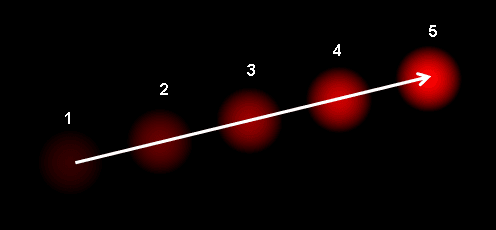
Visual odometry is dead reckoning with a camera. It estimates movement by tracking how features shift between images, without GPS or maps. It's used in robotics and AR, but its biggest footgun is that small errors accumulate, causing it to drift over time.
WHY IT EXISTS Systems often need to know where they are and how they're oriented, especially when GPS is unavailable (indoors, on Mars) or not precise enough. Visual odometry provides a way to estimate this "pose" using only a camera, a relatively cheap and common sensor.
THE MENTAL MODEL Think of walking through an unfamiliar room with only a flashlight. You can't see the whole room, but you can guess your path by watching how furniture shifts in your beam of light. If a chair moves from the center of your view to the left, you know you've moved forward and to the right. Visual odometry does the same thing, but with pixels and algorithms.
HOW IT WORKS The core idea is to compare consecutive images to deduce motion. The system first detects salient features (like corners or distinct textures) in an image. Then, in the next image, it finds those same features. By measuring how these features have moved between the two frames, the system can calculate the camera's translation and rotation. This incremental motion estimate is then chained together over many frames to build up a complete path.
WHEN TO USE IT Use visual odometry for real-time motion tracking in GPS-denied environments. It's ideal for robotics in unknown areas (planetary exploration, underwater, indoors), for virtual and augmented reality headsets tracking user movement, and for autonomous drones navigating complex spaces.
WHEN NOT TO USE IT Avoid relying solely on visual odometry for long-duration tasks where absolute accuracy is critical, as it suffers from accumulating error, or "drift." It also fails in visually-degraded environments, like a textureless white wall, a dark room, or scenes with fast motion blur, because it cannot find or track features. It is often fused with other sensors (like IMUs) to correct for drift.
ONE CANONICAL EXAMPLE The Mars Exploration Rovers used visual odometry to navigate the Martian surface. By analyzing images, they could estimate the actual distance traveled after each wheel command, correcting for wheel slippage on sandy terrain and enabling them to traverse much farther than would have been possible with wheel encoders alone.
Read the original → en.wikipedia.org
Get five bites like this every day.
Tezvyn delivers a daily feed of 60-second tech bites with quizzes to lock in what you learn.