Watershed Algorithm: Segmenting by Topography
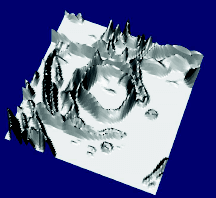
The watershed algorithm treats an image as a landscape where pixel brightness is height. It finds the 'ridges' separating distinct 'valleys,' effectively segmenting touching objects. Its main footgun is extreme sensitivity to noise, causing over-segmentation.
WHY IT EXISTS Simple image segmentation methods, like thresholding, often fail when objects of interest are touching or overlapping. They merge into a single, indistinguishable blob. The watershed algorithm was developed to solve this specific problem: finding the boundaries between connected components.
THE MENTAL MODEL Imagine your grayscale image is a 3D topographic map, where a pixel's brightness value represents its height. The algorithm finds the 'watersheds' or 'ridgelines' that separate the different 'drainage basins' or 'valleys'. A more procedural analogy is to imagine flooding this landscape from its lowest points (local minima). Wherever water from two different sources is about to merge, you build a dam. These dams form the final segmentation boundaries.
HOW IT WORKS Typically, the algorithm works on the gradient of an image, so that high-gradient areas (object edges) are the 'ridges' and low-gradient areas (object interiors) are the 'basins'. The process identifies local minima in the image, which act as seeds for the basins. Then, in an iterative process, pixels with progressively higher intensity values are added to these basins, simulating the rising water. When two expanding basins meet, a boundary pixel is placed between them to prevent merging. This continues until every pixel in the image has been assigned to a basin.
WHEN TO USE IT Use the watershed algorithm when you need to separate touching objects. It's a go-to technique in biomedical imaging for separating cells, in materials science for analyzing grain structures, or for any task involving counting clustered items. It works best when the objects have relatively uniform interiors and are surrounded by distinct, connected boundaries.
WHEN NOT TO USE IT Avoid using the classic watershed algorithm on noisy images without pre-processing. Its primary footgun is severe over-segmentation: every tiny local minimum caused by noise will create its own unwanted basin, resulting in a massively fragmented image. If object boundaries are weak or broken, it will also fail. For simple cases with non-touching objects, basic thresholding is far more efficient.
ONE CANONICAL EXAMPLE To count individual cells in a microscope image where they form clumps, a simple brightness cut-off would merge them. Instead, you can apply the watershed algorithm. The center of each cell is identified as a 'basin' (often using a distance transform). The algorithm then 'floods' outwards from each cell's center. Where the 'water' from two adjacent cells meets, it draws a line, successfully separating the clump into individual cells for counting.
Read the original → en.wikipedia.org
Get five bites like this every day.
Tezvyn delivers a daily feed of 60-second tech bites with quizzes to lock in what you learn.