Why is RGB Euclidean distance a poor measure of perceptual color difference?
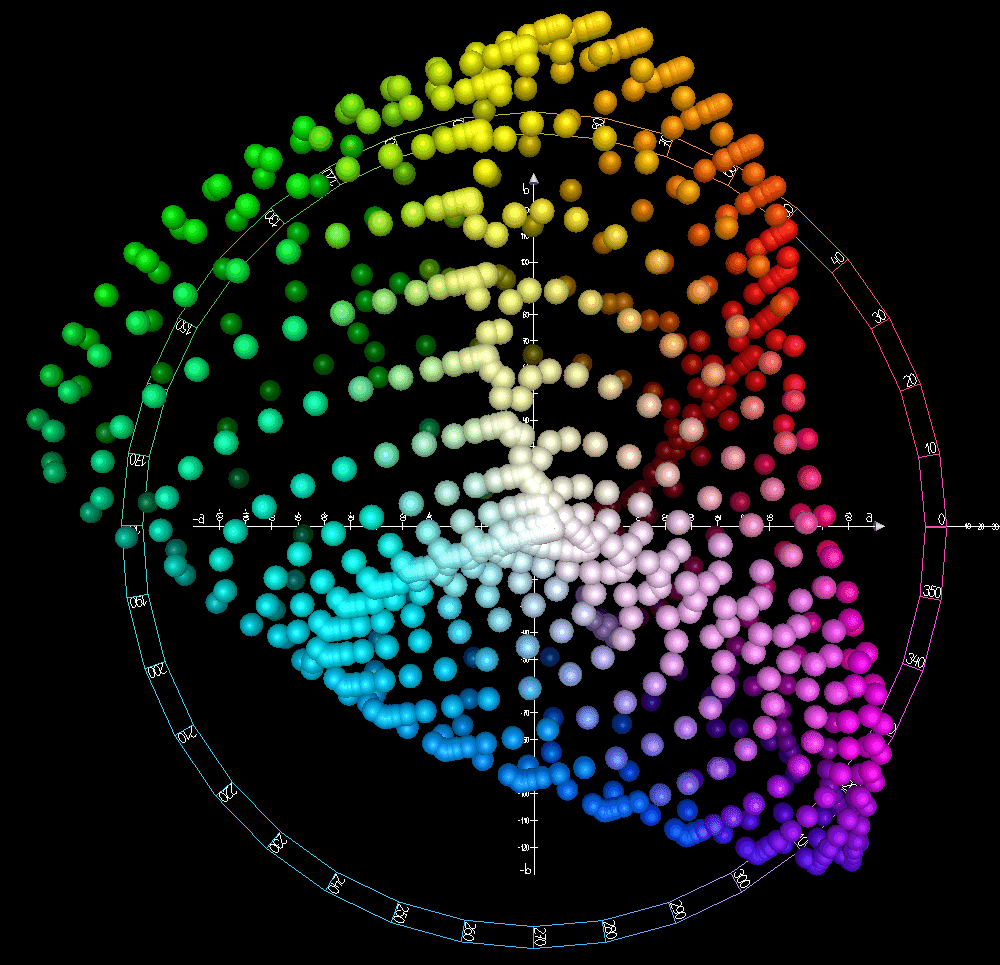
This tests perceptual uniformity. A good answer explains that RGB distance does not match human vision, then describes CIELAB as a space where deltas approximate perceived differences, making segmentation align with human vision.
What's really being asked
This question probes whether you understand that RGB is a device-oriented encoding rather than a model of human vision. Interviewers want to see that you know perceptual uniformity matters when algorithms must align with human judgment, and that you can name and justify a color space designed for that purpose.
The full answer
First, explain that RGB is linear with respect to light intensity but not with respect to human perception, so a Euclidean distance of ten units in a dark blue region can look like a huge shift while the same distance in a bright green region looks nearly invisible. Second, introduce CIELAB explicitly, noting that L encodes perceptual lightness and a and b encode opponent red-green and blue-yellow axes. Third, state that CIELAB was designed to be perceptually uniform, meaning a given numerical delta corresponds to a roughly similar perceived change across the space, even though it is not perfectly uniform. Fourth, connect this to segmentation by noting that clustering algorithms like k-means or threshold-based edge detection rely on distance metrics, and using LAB makes those distances correlate with actual visual boundaries rather than arbitrary hardware values.
The mistakes people make
A major red flag is saying RGB distance is fine because it works for simple computer graphics tasks. Another is describing HSV or HSL as perceptually uniform; they are cylindrical transforms of RGB and are not designed for uniform perceptual deltas. A third is claiming CIELAB is just a nonlinear RGB without explaining the opponent color model or the goal of perceptual uniformity. Confusing LAB with the older Hunter Lab or with CMYK also signals shallow knowledge.
What usually comes next
An interviewer might ask how you would compute a perceptual distance metric like Delta E in practice, or why LAB is still not perfectly uniform and what newer spaces like CIECAM02 or IPT address. They might also ask how gamma correction in sRGB relates to the problem, or whether you would convert to LAB for a neural network loss function.
A concrete example
Imagine segmenting a medical image where subtle color shifts indicate tissue boundaries. In RGB, a small numerical change near black might be exaggerated while a large change near white is compressed, causing the algorithm to miss a critical boundary. By converting to CIELAB first, a fixed clustering threshold of five units means roughly the same visual difference whether the region is light or dark, so the segmentation mask aligns with what a clinician actually sees.
Interview question
Why does a fixed Euclidean distance threshold in RGB fail to produce consistent perceptual segmentation across light and dark image regions?
- a.The same numerical RGB delta can correspond to a huge perceived shift in one region while being nearly invisible in anotherCorrect
- b.HSV would solve the inconsistency because its cylindrical coordinates decouple luminance from hue
- c.RGB encodes opponent red-green and blue-yellow channels that are not normalized to human contrast sensitivity
- d.CIELAB is required because it linearly maps physical light intensity to numerical differences
Why? this is the answer
RGB is linear with respect to light intensity but not human perception, so identical Euclidean deltas can look huge in one region and nearly invisible in another. HSV is a cylindrical transform of RGB and is not perceptually uniform, while CIELAB is designed for perceptual uniformity rather than linear physical intensity.
Just read this? Test yourself on what you have been reading.
Read the original → en.wikipedia.org
- #computer vision
- #color spaces
- #perceptual uniformity
- #segmentation
- #cielab
You just looked this up. Could you explain it out loud?
That is the part interviews actually test. Tezvyn takes questions like this one and gives you what the interviewer is really checking, the answer that lands, and the mistake that ends the conversation, in the four minutes before your next meeting.
The iPhone app is on the way
We are building it. Until it lands, nothing here is held back from you: every interview card, your saved cards, streaks and the job board all work in Safari, plus hundreds of free practice quizzes of thirty questions each. Sign in and it all carries over to the app the day it arrives.
Want it as an icon? Tap Share at the bottom of Safari, then Add to Home Screen. It opens full screen and the cards you have read stay available offline.
We are hiring for this. Open roles that interview on computer vision — each one lists the topics its interview covers.
See open roles