Continuous Integration: Catching Bugs Early
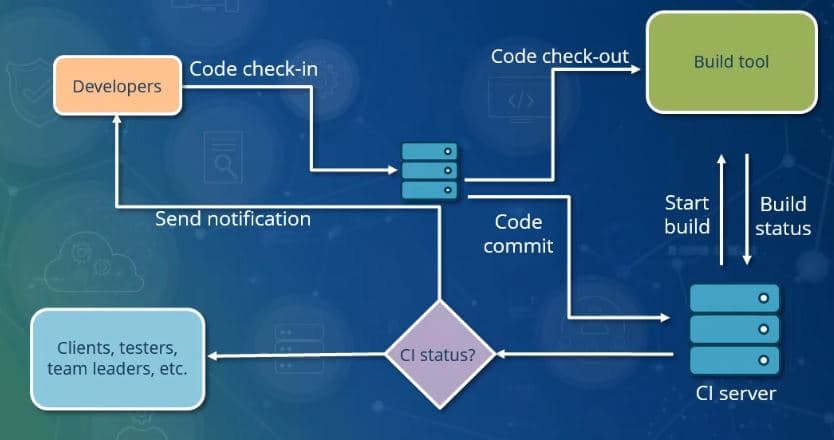
Continuous Integration (CI) treats code merging like a continuous stream, not a big-bang event, to keep the main codebase stable. On every commit, an automated system builds and tests the software to catch issues immediately.
THE MENTAL MODEL: CI's core idea is to make integration a frequent, low-drama, automated event instead of a rare, high-stakes, manual one. Before CI, teams would work on separate features for weeks or months. The final "merge day" was a painful, unpredictable process of resolving massive conflicts. CI flips this by enforcing that all code changes are integrated into a shared codebase very frequently—often multiple times per day. This ensures the main codebase is always in a workable state and that integration issues are found and fixed immediately, when they are small and easy to solve.
HOW IT WORKS: The process is a simple loop that runs continuously. First, a developer commits a small, logical change and merges it into the main integration branch. This action automatically triggers the CI system. The system then performs a fresh build of the entire software application from the newly integrated code. If the build completes successfully, the system proceeds to run a suite of automated tests against it to verify that the new change hasn't broken any existing functionality. The result is binary: either the integrated codebase is proven to be in a workable state, or it is not, and the team gets immediate feedback.
WHEN TO USE IT: CI is essential for any software project involving more than one developer working on a shared codebase. Its value increases with the size of the team and the complexity of the project. The practice helps prevent integration problems, allows teams to develop faster with more confidence, and ensures there is always a stable version of the software available. It is a foundational practice for modern, agile software development.
WHEN NOT TO USE IT: While broadly applicable, the overhead of setting up a CI system might not be justified for very small, short-lived projects managed by a single person, like a simple script or a throwaway prototype. In these cases, the risk of integration conflicts is zero, and manual building and testing may be sufficient. For any project intended to be maintained or collaborated on, CI quickly becomes indispensable.
ONE CANONICAL EXAMPLE: A developer on a team finishes fixing a bug and commits their code. Upon merging this change to the main integration branch, the CI system automatically detects the new commit. It builds the application from the latest source. The build is successful. Next, it runs the automated test suite. One test fails. The CI system immediately marks the build as 'failed' and notifies the team. The developer can see exactly which commit broke the tests and can fix the issue immediately, preventing the broken code from affecting the rest of the team.
Read the original → en.wikipedia.org
Get five bites like this every day.
Tezvyn delivers a daily feed of 60-second tech bites with quizzes to lock in what you learn.