Data Lakehouse: The 'Lake' Foundation
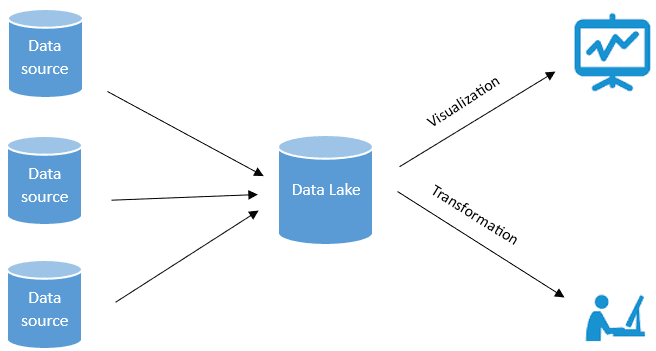
A data lake is a central repository that stores all your data—structured or raw—in its original format. It's used to hold raw source system copies, sensor data, and social feeds for later analysis, but can become a messy "data swamp" without governance.
THE MENTAL MODEL: A data lake is a system for storing massive quantities of data in its native format. Imagine a real lake fed by many streams (source systems, sensors, user activity). The lake holds all this water (data) in its raw, unfiltered state before it's processed for any specific use, like drinking water (reporting) or hydroelectric power (machine learning).
HOW IT WORKS: A data lake acts as a single store for all enterprise data. It ingests data without forcing it into a predefined schema. This includes structured data from relational databases, semi-structured data like JSON, unstructured text, and binary data like images. The data is typically stored as files or object blobs in a large, low-cost storage system, which can be on-premises or in the cloud.
WHEN TO USE IT: Use a data lake when you need to capture and store diverse data types at a large scale without losing the original fidelity. It's the ideal foundation for tasks that require access to raw data, such as exploratory data science, machine learning model training, and building downstream analytics pipelines that transform the data for specific business intelligence needs.
WHEN NOT TO USE IT: A data lake by itself is not a database. It does not offer the high-performance, structured querying or transactional guarantees of a traditional data warehouse. If your primary need is running fast, complex SQL queries on clean, structured data for business reporting, a raw data lake alone is insufficient.
ONE CANONICAL EXAMPLE: A media company might establish a data lake to store raw clickstream logs from its website as JSON files, video viewership data from its streaming app, social media mentions as text files, and relational data from its subscriber database. Data science teams can then access this raw data to build recommendation engines or analyze user behavior patterns.
Read the original → en.wikipedia.org
Get five bites like this every day.
Tezvyn delivers a daily feed of 60-second tech bites with quizzes to lock in what you learn.