The Ansoff Matrix: Four Paths to Business Growth
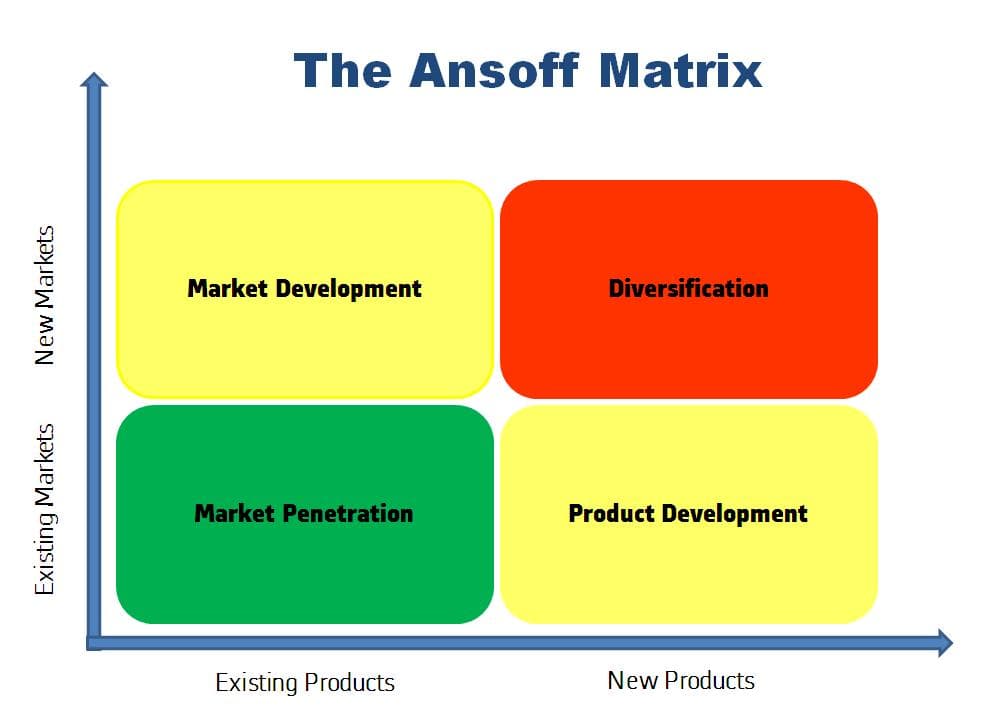
The Ansoff Matrix maps growth strategy onto a 2x2 grid of products (new vs. existing) and markets (new vs. existing). It helps you decide whether to sell more of what you have or invent something new. The footgun is underestimating the risk of new ventures.
WHY IT EXISTS: Businesses need a structured way to think about growth. Without a framework, strategic planning can be chaotic, leading to scattered efforts and missed opportunities. The Ansoff Matrix was created to provide a simple, clear model for evaluating different avenues for increasing revenue.
THE MENTAL MODEL: Think of the Ansoff Matrix as a compass for growth. It has two axes: one for your products (from existing to new) and one for your markets (from existing to new). The intersection of these axes gives you four distinct strategic directions to consider, each with a different level of risk.
HOW IT WORKS: The matrix presents four growth strategies. First, Market Penetration: selling more of your existing products to your existing market (lowest risk). Second, Market Development: taking your existing products to a new market (e.g., a new country or demographic). Third, Product Development: creating new products for your existing market. Fourth, Diversification: creating new products for a new market (highest risk). You plot your options on this grid to clarify your strategic choices and their associated risk levels.
WHEN TO USE IT: Use the Ansoff Matrix during high-level strategic planning to decide on the overall direction of the business. It's ideal for annual planning cycles or when considering major investments in new initiatives. It helps leadership teams align on a growth hypothesis and its associated risks.
WHEN NOT TO USE IT: The matrix is not a tool for detailed operational planning or for businesses in survival mode that lack resources for growth. It's a high-level guide, and applying it without solid market research and an honest assessment of your company's capabilities is a recipe for failure. Don't use it to justify a pet project; use it to evaluate options objectively.
ONE CANONICAL EXAMPLE: Apple demonstrates all four paths. Market Penetration: selling more iPhones to existing customers. Market Development: expanding iPhone sales into India and other new geographical markets. Product Development: launching AirPods and Apple Watch for its existing customer base. Diversification: developing the Apple Vision Pro, a new product for the new market of spatial computing.
Read the original → en.wikipedia.org
Get five bites like this every day.
Tezvyn delivers a daily feed of 60-second tech bites with quizzes to lock in what you learn.