YOLO: Real-Time Object Detection in a Single Pass
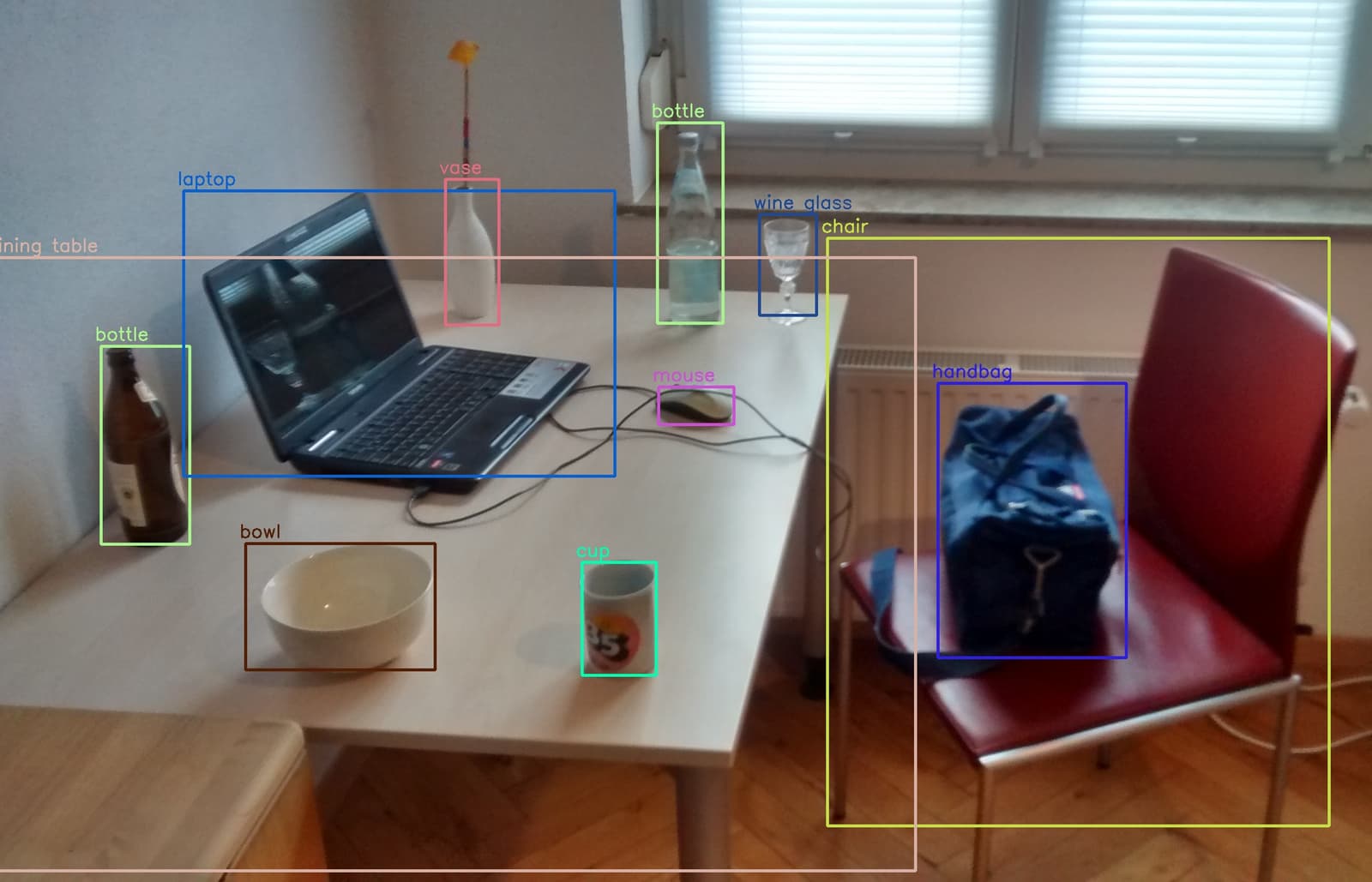
YOLO treats object detection as a single regression problem, looking at an image once to predict all bounding boxes and classes. This makes it extremely fast, perfect for real-time video analysis.
WHY IT EXISTS: Prior object detection systems used a two-stage process: first, propose thousands of potential object regions, and second, run a classifier on each one. This was accurate but far too slow for real-time video. YOLO was created to unify these steps into a single, fast network to make live object detection practical.
THE MENTAL MODEL: Imagine glancing at a busy street and instantly identifying the cars, pedestrians, and traffic lights. That's the "You Only Look Once" idea. Instead of scanning the scene multiple times, YOLO takes a single look. It overlays a grid on the image and has each grid cell predict the objects within it, all at the same time.
HOW IT WORKS: An input image is fed through a single convolutional neural network (CNN). This network divides the image into a grid (e.g., 7x7). If an object's center falls within a grid cell, that cell is responsible for detecting it. Each cell predicts several bounding boxes, a confidence score for each box (how likely it contains an object), and the class probabilities (e.g., 80% car, 15% truck). This all happens in one forward pass through the network, which is why it's so fast.
WHEN TO USE IT: Use YOLO when speed is your top priority. It's the standard for applications processing live video streams where immediate results are critical, such as in autonomous vehicles, security systems, and robotics. If you can trade a small amount of accuracy for a massive gain in speed, YOLO is the right tool.
WHEN NOT TO USE IT: Avoid YOLO when your application requires the absolute highest detection accuracy and latency is not a concern. Two-stage detectors (like Faster R-CNN) often achieve better performance, especially for small or overlapping objects, because they spend more computational effort analyzing specific regions of interest.
ONE CANONICAL EXAMPLE: A self-driving car's perception system. The camera feeds video frames to a YOLO model, which runs in real-time to identify and draw bounding boxes around other cars, pedestrians, and traffic signs. This speed allows the car's planning system to react instantly to its environment.
Read the original → en.wikipedia.org
Get five bites like this every day.
Tezvyn delivers a daily feed of 60-second tech bites with quizzes to lock in what you learn.