More in Product Management — page 12
What technical steps would you take to investigate a user's workflow frustration?
Tests if you can turn qualitative user pain into structured technical investigation. Strong answer: reproduce the exact workflow, then inspect logs and traces for errors or latency spikes, and segment by the user's environment.

How do user personas and stories inform technical design and edge cases?
Tests if you translate product requirements into technical constraints and failure modes. Strong answers map persona pain points to architecture, derive unhappy paths from preconditions, and validate edge cases through vertical slices.

How do you frame monolith vs microservices trade-offs under market uncertainty?
WHAT IT TESTS: Connecting architecture to business strategy under uncertainty. Strong answers say monoliths offer cheap optionality when markets are unknown, but winner-take-all makes speed existential; microservices are a post-PMF scaling tax.

How would you use telemetry and logs to refine SAM calculation?
Tests bridging telemetry to SAM. A strong answer maps API usage and feature flags to fit, uses performance logs to expose delivery limits, and rebuilds SAM from qualified accounts. Red flag: calling all logs demand without checking constraints.

How do you analyze a major technology trend for product impact?
This tests strategic discernment. A strong answer frames a time-boxed analysis across feasibility, user-value, cost, and risk, separating hype from capability. Red flag: jumping to build or dismiss without structured criteria or user evidence.

How would you estimate user base for a new feature before coding?
WHAT IT TESTS: Sizing an opportunity with proxy data before coding. A strong answer defines the behavioral profile, then triangulates internal segments, competitor analogs, and market data to bound the estimate with stated assumptions.

Critique the statement that product strategy should be fixed for two years
It tests adaptive strategy versus rigid roadmaps. A great answer notes short-term architecture stability, then details systemic risks: feature factories, wasted talent, telemetry blindness, and lock-in.

How would you validate strategic assumptions through shipped software?
Tests whether you embed validation into engineering delivery rather than treating it as pre-work. Strong answers cover assumption mapping, instrumented MVPs, tiered rollouts, kill criteria, and product-engineering feedback loops.

How do you assess architecture impact during a corporate pivot?
Tests business-technical alignment under strategic uncertainty. Strong answers map new outcomes to capability gaps, assess debt and migration cost, then co-own replanning with product. Red flag: proposing a full rewrite before understanding limits or ROI.
How would you frame a major refactoring proposal using product strategy?
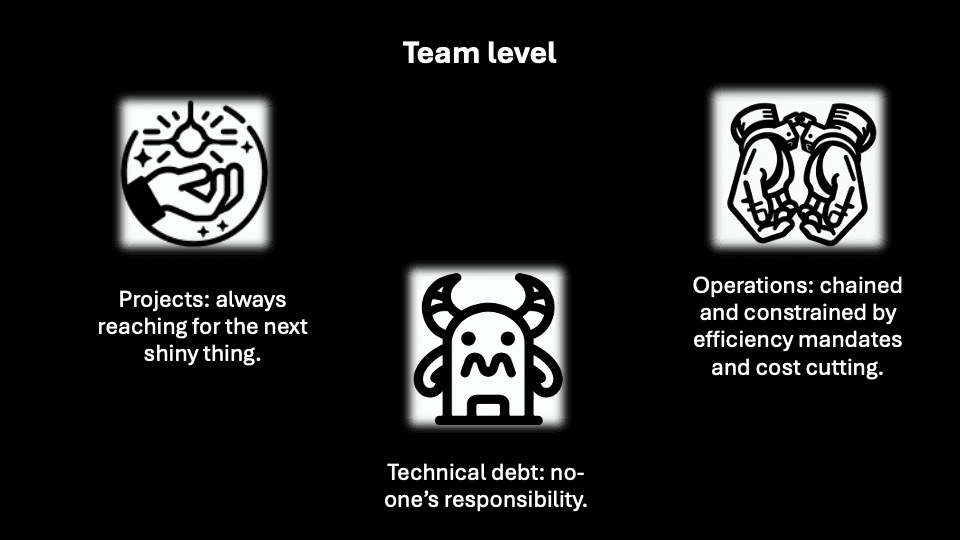
WHAT IT TESTS: reframing tech debt as delivery risk, not engineering chore. Tie refactoring to velocity loss and firefighting; shift accountability from dev-vs-ops fights to product ownership. RED FLAG: treating debt as hygiene needing blind business funding.
What are the risks of a roadmap without product strategy?
WHAT IT TESTS: Whether you see roadmaps without strategy misalign execution. ANSWER OUTLINE: Risks include building wrong things fast, orphaned features, and tradeoff paralysis. RED FLAG: Blaming PMs rather than showing engineering can surface strategic gaps.
Minto Pyramid Principle: Answer First
Start with the answer, then stack the proof beneath it. Use it when executives will cut you off if you don't reach the point in 30 seconds. The footgun is messy buckets: overlapping supporting arguments collapse the pyramid and make correct answers look…
The Platform Chicken-and-Egg Trap
A platform is worthless until both sides show up, yet neither arrives first without the other. Marketplaces and payment networks face this coordination trap. Growing both sides at once starves the platform because neither reaches critical mass.
Three Horizons: Core, Growth, Future
Three Horizons splits energy across core defense, scaling winners, future bets at once. Use it when your roadmap is only incremental tweaks with no long-term bets. The footgun is seeing horizons as sequential stages, not parallel portfolios needing fuel today.
Sales-Led Growth: High-Touch Revenue Motion
Sales-led growth uses human reps as the primary engine, not self-serve signup. It fits complex, high-price products with procurement hurdles. The footgun is hiring sellers before repeatable messaging exists, burning cash on custom pitches that never scale.
Now-Next-Later Roadmaps: Commitment Over Calendar Dates
Now-Next-Later buckets work by commitment, not dates, keeping priorities visible without false precision. Use it when teams need alignment more than Gantt charts. The fatal mistake is letting stakeholders map buckets to quarters, recreating the deadline trap.
Vision Storytelling: Turn Roadmaps Into Shared Futures
Vision storytelling makes strategy tangible by narrating the future your team is building. Use it when roadmaps explain what but not why. The footgun is confusing slogans for stories; without a user, conflict, and resolution, you get branding, not alignment.
Product Vision: The User's Future, Not Yours
A product vision is a shared picture of the future your product creates for users, not a feature list. It aligns distributed teams when data is ambiguous. Teams often mistake it for a mission statement or roadmap, producing vague slogans, not a useful filter.

MRR and ARR: Two Lenses on Recurring Revenue
MRR and ARR are two lenses on recurring revenue. MRR tracks short-term movement and immediate performance while ARR shows long-term scale. SaaS companies need both to guide present tactics and future strategy.
KPI Tree: Linking Product Changes to Business Outcomes
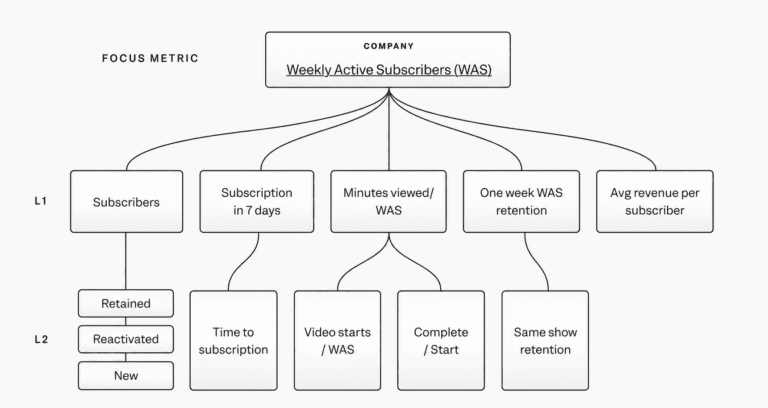
A KPI tree traces how changes ladder up to outcomes, giving metrics connective tissue. Build one when dashboards and experiments conflict and you need a defensible line from features to impact. Let it stay static and it becomes disconnected.