How would you frame a major refactoring proposal using product strategy?
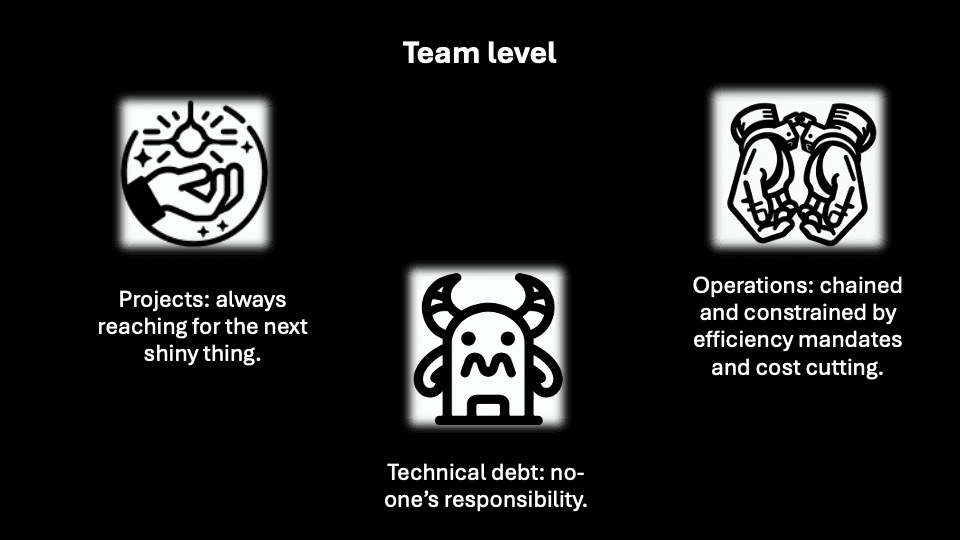
reframing tech debt as delivery risk, not engineering chore. Tie refactoring to velocity loss and firefighting; shift accountability from dev-vs-ops fights to product ownership.
treating debt as hygiene needing blind business funding.
What's really being asked
The interviewer wants to see if you can escape the classic trap where technical debt is treated as an engineering hygiene issue that the business grudgingly funds. They are looking for product-thinking: can you reframe infrastructure health as a delivery risk and propose an organizational model that prevents debt from falling into the cracks between development and operations.
The full answer
First, quantify the business impact in product terms. You should explain how technical debt slows feature velocity, increases incident volume, and forces operations teams to fight fires instead of improving systems. Second, diagnose the structural cause. Cite that debt often arises between project funding for innovation and constrained operational budgets, leaving neither dev nor ops with clear accountability. Third, propose the product model as the fix. Advocate for durable cross-functional product teams that own both feature delivery and technical health, eliminating dev-vs-ops politicking over who pays. Fourth, define outcome-based milestones. Instead of promising cleaner code, commit to measurable results like reducing deployment lead time by thirty percent or cutting critical incidents by half within two quarters.
The mistakes people make
A major red flag is framing refactoring as a purely technical necessity that leadership should trust engineering to fund without business justification. Another is proposing a big-bang IT transformation; Forrester notes these are notorious for failing when used to pay down debt. Avoid suggesting that operations should absorb migration costs out of existing efficiency budgets, as this perpetuates the crack where debt grows.
What usually comes next
The interviewer may ask how you would prioritize which debt to pay first when product wants new features. They might also probe how you would handle a business leader who says the system works fine as-is. Be ready to discuss specific metrics you would track and how you would structure team incentives so that reliability and velocity are not treated as opposing goals.
A concrete example
Imagine your platform runs on end-of-life middleware that requires millions in migration costs to maintain the status quo. Instead of asking for a standalone infrastructure project, you frame the proposal as a product initiative: the current stack is delaying a new customer-facing API by three sprints and causing two production outages per month. You request a dedicated product squad with engineering, ops, and product management ownership, funded for one quarter to modernize the middleware. Success is measured not by lines of code rewritten but by API launch date moved up and incident count dropping to zero.
Interview question
When proposing a major refactoring initiative, which approach best secures investment and prevents accountability gaps between development and operations?
- a.Quantify the business impact as delivery risk using velocity and incident data, assign a durable cross-functional product team, and set outcome-based milestones.Correct
- b.Request a standalone infrastructure project led by engineering, with operations absorbing migration costs from existing budgets to protect delivery timelines.
- c.Launch a big-bang IT transformation funded by the operations efficiency budget so product roadmaps are not disrupted.
- d.Frame the work as necessary engineering hygiene that leadership should trust and fund without detailed business justification or product ownership.
Why? this is the answer
This aligns with reframing technical debt as delivery risk owned by cross-functional product teams with measurable outcomes rather than code cleanliness. Option D is a tempting distractor because framing debt as hygiene is common, but the card flags it as a red flag that avoids business accountability.
Just read this? Test yourself on what you have been reading.
Read the original → forrester.com
- #product strategy
- #technical debt
- #organizational design
- #engineering leadership
- #product model
You just looked this up. Could you explain it out loud?
That is the part interviews actually test. Tezvyn takes questions like this one and gives you what the interviewer is really checking, the answer that lands, and the mistake that ends the conversation, in the four minutes before your next meeting.
The iPhone app is on the way
We are building it. Until it lands, nothing here is held back from you: every interview card, your saved cards, streaks and the job board all work in Safari, plus hundreds of free practice quizzes of thirty questions each. Sign in and it all carries over to the app the day it arrives.
Want it as an icon? Tap Share at the bottom of Safari, then Add to Home Screen. It opens full screen and the cards you have read stay available offline.
We are hiring for this. Open roles that interview on product strategy — each one lists the topics its interview covers.
See open roles