All bites
The whole library, newest first. Filter by what you are here for, or pick a topic if you already know.
4330 bites
Page 66

How would you enforce a 3-project freemium limit and handle upgrades?
Tests entitlement and growth tradeoffs. Strong answers use API-level enforcement, atomic checks to prevent concurrent overages, soft upsell prompts preserving context, and async billing webhooks. Red flag: UI checks or limits in the projects table.

Walk me through a magic link login system and its security considerations
Tests auth architecture and threat modeling for passwordless flows. Strong answers map request-token-email-verify-session, then harden with short expiry, single-use tokens, rate limits, and device binding.

Design a multivariate experimentation platform with collision-free concurrent bucketing and cross-device consistency
Tests orthogonal layers and cross-session assignment persistence. Cover: deterministic hashing per layer, a user profile service for sticky bucketing, and stable ID resolution across devices. Red flag: random bucketing or local storage breaking consistency.

Architect real-time usage-based billing for a PLG company
This tests event-driven metering, idempotent aggregation, and pricing decoupling at scale. A strong answer outlines real-time ingestion, stream processing for micro-events, a rules-based pricing engine, and dashboards with reconciliation.

What data pipelines and infrastructure feed a viral user acquisition model?
Tests causal attribution architecture. Great answers cover invite instrumentation with identity resolution, streaming pipelines that split organic and viral signups, and feature stores for network-state features.

What data and approach for a simple 30-day DAU forecast?
Tests forecasting from sessionized logs without overengineering. Cite timestamped events, a 30 min session rule, and a regression baseline with day-of-week, recent totals, scored with MAE. Red flag: deep learning before a baseline or ignoring privacy hashing.

Why is extrapolating 5% weekly growth naive for annual forecasting?
This tests knowledge of extrapolation limits. A strong answer cites market saturation, seasonality, and channel exhaustion as invalidating factors, and notes that compounding 5% over 52 weeks magnifies error.

What differentiates leading and lagging indicators for subscriptions?
Leading indicators forecast; lagging indicators confirm. Subscriptions: activation rate leads, MRR lags.

How would you model a 10% Day-1 retention improvement's impact on LTV?
Tests whether you model retention as a survival curve, not a single point. A strong answer builds a cohort curve, propagates D1 lift to D30/D90 via decay, and sums revenue. Red flag: claiming 10% D1 gain equals 10% LTV growth without curve assumptions.

How would you incorporate external events into a time-series forecast?
This tests exogenous regressor design. A strong answer proposes binary or continuous regressors for holidays and campaigns in Prophet or ARIMA, then validates lift via backtesting. A red flag is dropping outlier days or applying post-hoc manual adjustments.
Communicate forecast uncertainty with prediction intervals
A point estimate hides risk; produce a prediction interval via model error, simulation, or scenarios, and state assumptions.
How would you adapt a growth model for network effects and k-factor?
Define K as invites x conversion; K over 1.0 explodes, yet K over 0.7 with fast cycle time still compounds; anchor at peak delight.
Describe a strategy for reconciling different forecasts into one robust prediction
Tests synthesis of heterogeneous models into a consensus forecast. Strong answers diagnose divergence drivers first, then weight by track record or uncertainty, and output a distribution. Red flag: blind averaging without understanding why models disagree.
Trace an event from click to analysis
Client SDK captures and batches, a collection endpoint ingests, a stream and ETL enrich and load into a warehouse for analysis.

How would you implement a simple feature flag system?
Tests runtime config separation and distributed hygiene. Outline: control service, datastore, API, SDK, and update mechanism; local evaluation with cached state; short-lived flags. Red flag: static config files requiring redeployment are not feature flags.
Why consistent user IDs matter in experiments
The user id seeds deterministic bucketing and ties events to one person across devices; achieve it via authenticated ids and anonymous-to-known stitching.

Design an assignment service for an experimentation platform
This tests deterministic hashing and independence in randomization. A strong answer lists user ID, experiment salt, and allocations; uses salted hash for consistency; and warns that separate exposure and bucket hashes with mod can cause sample ratio mismatch.
Should we build or buy an A/B testing platform?
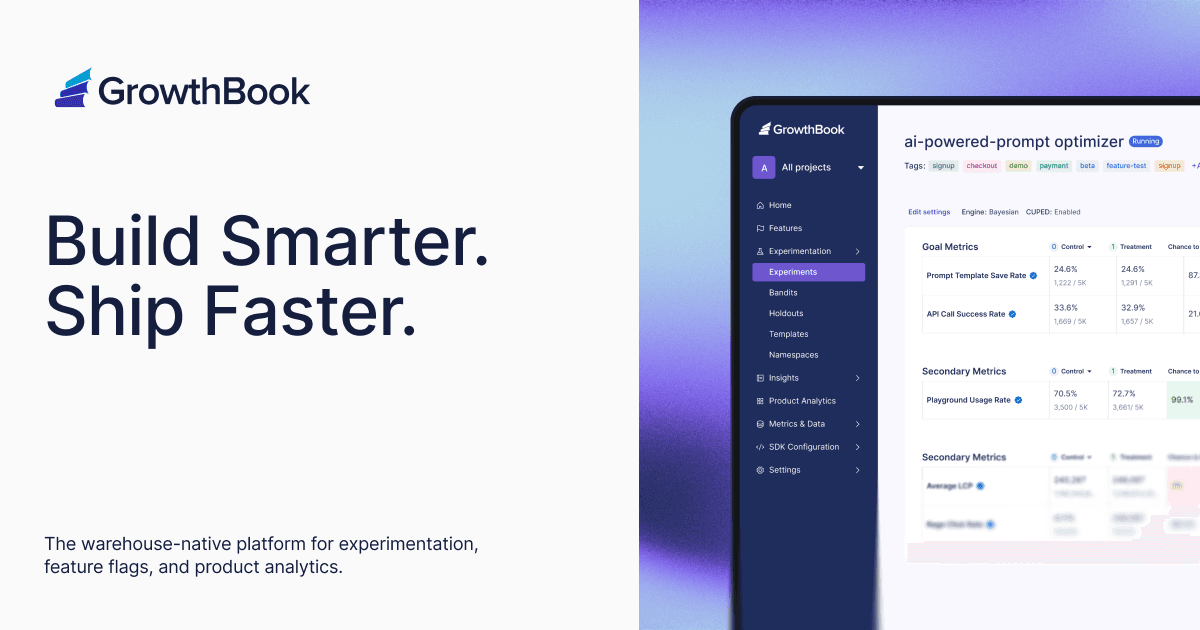
This tests build-vs-buy judgment for experimentation infrastructure. Strong answers cover build for warehouse metrics and cache control; buy for proven stats and front-end speed. Red flag: answering with cost alone or assuming in-house is always superior.
Compare PostgreSQL versus a columnar warehouse for raw event data
Contrast row vs column storage, compression, and scan speed; note Postgres suits OLTP and point lookups while columnar stores excel at aggregations.
Design a system to reduce large client-side experiment payload size
Tests edge evaluation and payload compression. Use server-side pre-evaluation or edge nodes sending only assigned variants; compact bucketing indexes or Bloom filters; lazy-load noncritical experiments. Never do full client-side evaluation of every flag rule.