Appium: Test Your React Native App Like a Real User
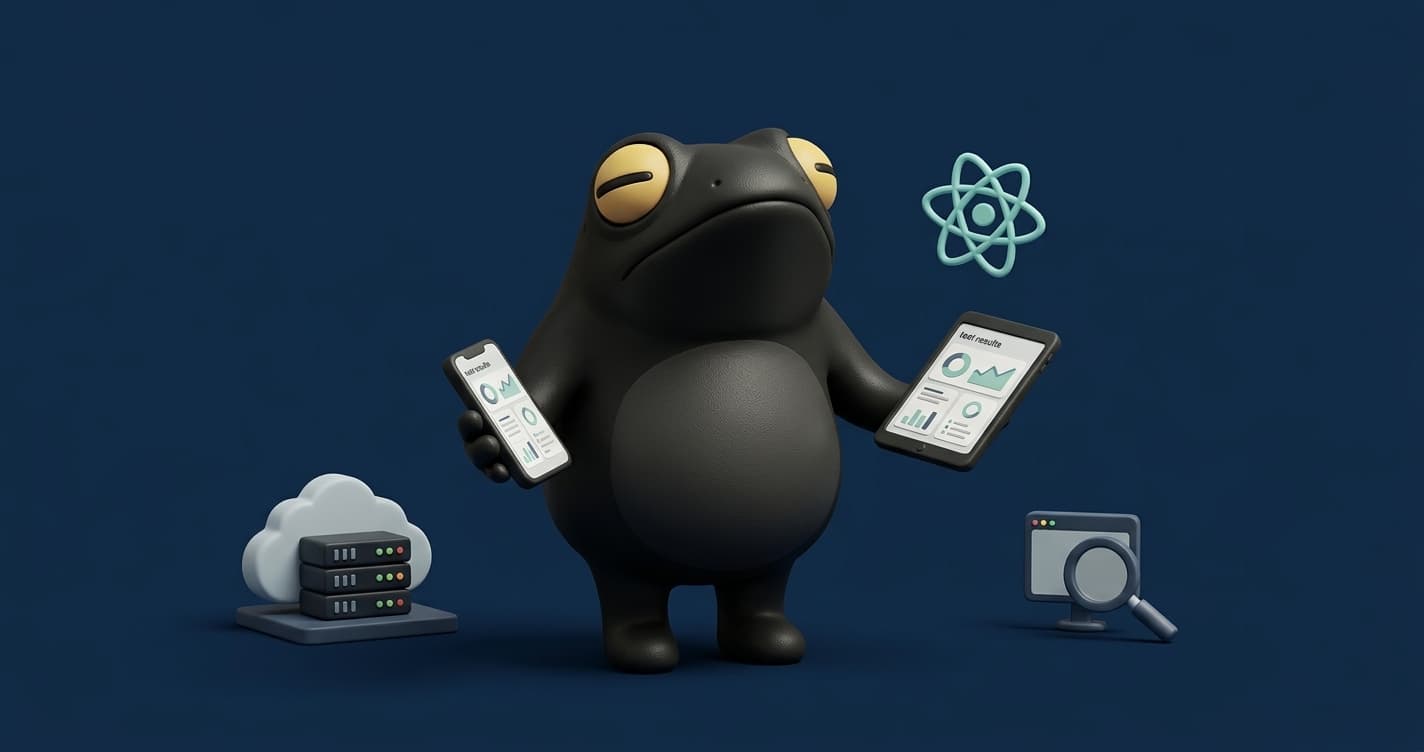
Appium tests your app like a real user, tapping and scrolling on actual devices to catch bugs your unit tests miss. It's for verifying full user flows across iOS and Android. The footgun: relying only on unit tests gives a false sense of security.
Why it exists
Your Jest component tests pass, but users report that login hangs on a Samsung phone and checkout crashes on an older iPhone. This happens because unit tests run in a sterile Node.js environment, not on a real device with its own OS, native modules, and hardware quirks. End-to-end (E2E) testing with Appium was created to bridge this gap between development and real-world user experience.
The mental model
Think of Appium as a robot user. While unit tests check if a single gear works on a workbench, Appium assembles the entire machine (your app), puts it on the factory floor (a real device or simulator), and runs it through its paces. It interacts with the final product from the outside, just like a customer, to see if it actually works.
How it works
Appium uses the standard WebDriver protocol to send commands to your app. Your test script sends a command like "find element with testID 'login-button' and tap it." An Appium server translates this into a platform-specific command for iOS (via XCUITest) or Android (via UiAutomator2) and executes it on the device. Because it uses this external protocol, it requires no changes to your app's code.
When to use it
Use Appium to gain confidence that your app works from end to end. It's ideal for testing critical user flows like login, registration, and checkout. It excels at catching platform-specific integration bugs, testing navigation, and verifying interactions with native modules like the camera or AsyncStorage that unit tests cannot touch. You need both: unit tests for speed, Appium for confidence.
When not to use it
Don't use Appium for testing individual component logic; unit tests with Jest and React Native Testing Library are much faster for that. For React Native-only projects where speed is critical, Detox is a strong alternative. Detox runs inside your app's JavaScript context, making it faster, but it's less versatile than Appium, which can test any mobile app (native, Flutter, hybrid).
One canonical example
A component test shows your "Pay Now" button's onPress handler works. But in production, a user reports a crash. An Appium test would have caught this. The test would automate launching the app, navigating to the checkout screen, tapping "Pay Now," and asserting that the next screen appears. It would discover the crash is caused by an interaction between the navigation library and a native payment module—a bug only visible when the entire system runs together on a real device.
Interview question
Which critical type of bug is Appium uniquely designed to catch in a mobile application, unlike typical unit tests?
- a.Crashes or unexpected behavior stemming from interactions between native modules and the device OS during a full user flow.Correct
- b.Incorrect data validation rules applied to user input fields.
- c.Logic errors within individual JavaScript functions or React components.
- d.Performance bottlenecks in the application's rendering pipeline or data processing.
Why? this is the answer
Appium excels at finding bugs that arise from the interaction of the entire app with a real device's OS and native modules, which unit tests in a sterile environment cannot simulate. While option C describes a valid bug type, it is precisely what unit tests are designed to catch efficiently.
Just read this? Test yourself on what you have been reading.
Read the original → getautonoma.com
- #react-native
- #testing
- #e2e
- #appium
You just looked this up. Could you explain it out loud?
That is the part interviews actually test. Tezvyn takes questions like this one and gives you what the interviewer is really checking, the answer that lands, and the mistake that ends the conversation, in the four minutes before your next meeting.
The iPhone app is on the way
We are building it. Until it lands, nothing here is held back from you: every interview card, your saved cards, streaks and the job board all work in Safari, plus hundreds of free practice quizzes of thirty questions each. Sign in and it all carries over to the app the day it arrives.
Want it as an icon? Tap Share at the bottom of Safari, then Add to Home Screen. It opens full screen and the cards you have read stay available offline.
We are hiring for this. Open roles that interview on react-native — each one lists the topics its interview covers.
See open roles