AWS DMS: Automating Database Migrations
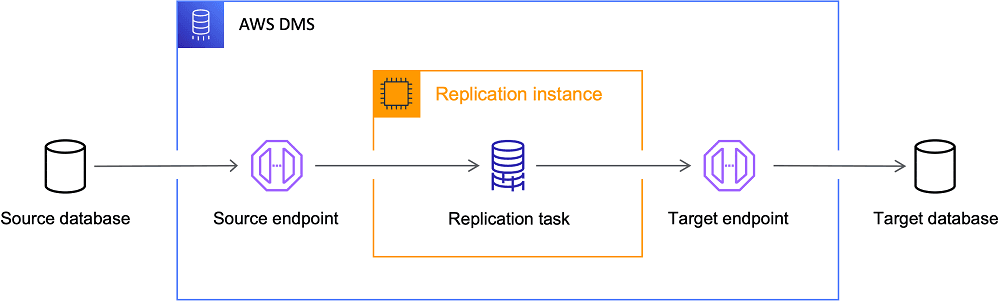
AWS DMS automates moving data between databases, not just as a simple data pump. Use it for one-time migrations to the cloud or for continuous replication. The footgun is assuming DMS also converts your schema; for different engines, you must use the Schema…
Why it exists
Traditional database migrations are complex, requiring manual capacity planning, hardware procurement, software installation, and administration. This process is slow, error-prone, and expensive. DMS was created to automate this heavy lifting, replacing manual effort with a managed cloud service.
The mental model
Think of AWS DMS as a managed replication server, not just a data copy tool. You provide the source and target connection details, and DMS handles the server provisioning, software patching, monitoring, and failover needed to move your data reliably. It's the transport layer for your data migration.
How it works
The core of DMS is a replication instance—a managed server in the AWS cloud. You define source and target endpoints, which tell DMS where to extract data from and where to load it. Then, you create a migration task. This task can be a one-time full load or a full load followed by continuous replication of ongoing changes (Change Data Capture or CDC). For migrations between different database engines (e.g., Oracle to PostgreSQL), a separate tool called AWS Schema Conversion Tool (SCT) must be used first to convert the schema, views, and stored procedures.
When to use it
Use DMS for migrating on-premises databases to the AWS cloud, moving between different AWS database services (like RDS to Aurora), or setting up continuous replication for analytics or disaster recovery. It excels at minimizing downtime during migration by using CDC to keep the target in sync with the source until you are ready to cut over.
When not to use it
DMS is not a magic bullet for incompatible data types or complex application logic embedded in the database. The Schema Conversion Tool can only automate so much; significant manual effort may still be required for very complex heterogeneous migrations. It is a data migration tool, not an application refactoring tool.
One canonical example
A company wants to migrate its on-premises SQL Server database to Amazon Aurora PostgreSQL to reduce licensing costs. They first use the AWS Schema Conversion Tool (SCT) to analyze the SQL Server schema and convert it to PostgreSQL format. After applying the converted schema to the new Aurora instance, they use DMS to perform a full data load and then enable continuous replication. This keeps Aurora in sync with the live SQL Server database, allowing for a cutover with minimal downtime.
Interview question
A developer is migrating an on-premises Oracle database to Amazon Aurora PostgreSQL. What crucial step must be completed before using AWS DMS for data transfer?
- a.Ensure all data types are natively supported by PostgreSQL to avoid data loss.
- b.Use AWS Schema Conversion Tool (SCT) to convert the Oracle schema to PostgreSQL.Correct
- c.Manually rewrite all stored procedures and triggers for PostgreSQL compatibility.
- d.Provision a replication instance with sufficient capacity to handle the data volume.
Why? this is the answer
AWS DMS is a data migration tool, not a schema conversion tool for heterogeneous migrations. The card explicitly states that for migrations between different database engines, AWS Schema Conversion Tool (SCT) must be used first to convert the schema. Provisioning a replication instance (Option D) is a step within configuring DMS, but the schema conversion must precede it for heterogeneous migrations.
Just read this? Test yourself on what you have been reading.
Read the original → docs.aws.amazon.com
Put your scrolling time to good use
Learn one idea, try a quiz and save useful cards for revision. Tezvyn makes it easy to learn and stay current in your tech field, a few minutes at a time.
The iPhone app is on the way
We are building it. Until it lands, nothing here is held back from you: every interview card, your saved cards, streaks and the job board all work in Safari, plus hundreds of free practice quizzes of thirty questions each. Sign in and it all carries over to the app the day it arrives.
Want it as an icon? Tap Share at the bottom of Safari, then Add to Home Screen. It opens full screen and the cards you have read stay available offline.
We are hiring for this. Open roles that interview on aws — each one lists the topics its interview covers.
See open roles