Cython: Static Typing for Faster Python
Cython speeds up Python by compiling it to C, especially when you add static types to bypass Python's dynamic overhead. Use it for CPU-bound bottlenecks like tight loops in numerical code.
Why it exists
Python is famously easy to write but can be slow for CPU-intensive tasks due to its dynamic typing and interpreter overhead. Cython exists to bridge this gap, allowing developers to get C-level performance for critical code sections without leaving the Python ecosystem.
The mental model
Think of Cython as a Python-to-C translator with a special dialect. You write Python-like code, but you can give the translator hints—static types—for variables and functions. With these hints, Cython can generate highly efficient C code that operates on raw data types instead of slow Python objects.
How it works
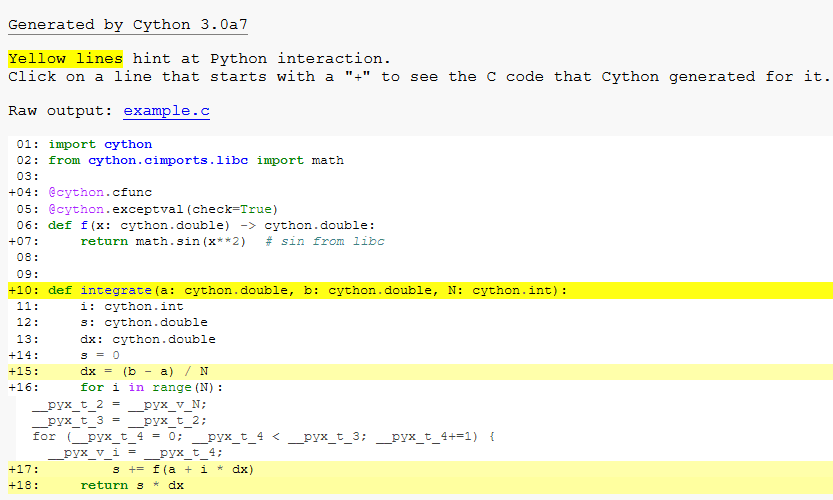
Cython compiles .py or .pyx files into C code, which is then compiled into a Python extension module. Simply compiling pure Python code gives a moderate speedup. The major performance gains come from static typing. By declaring a variable as cdef int i or i: cython.int, you tell Cython to use a native C integer for i instead of a Python int object. This is especially powerful inside loops, as the loop can be translated into pure C without any Python interaction. Similarly, you can declare C-style functions (cdef or @cfunc) to eliminate the overhead of Python function calls for internal, performance-critical routines.
When to use it
Use Cython for CPU-bound code, not I/O-bound code. It's ideal for accelerating numerical algorithms, tight loops in data processing, and any part of your application where a profiler shows significant time spent in pure Python execution. It's a great alternative to rewriting a performance-critical library in C from scratch.
When not to use it
Avoid using Cython for your entire application. Its main purpose is optimization, not general development. Adding static types makes the code more verbose and less "Pythonic." If your code is I/O-bound (e.g., waiting for network requests or disk reads), Cython will provide no benefit. Don't use it without profiling first to identify a clear bottleneck.
One canonical example
Consider a simple numerical integration function that calls another function f(x) inside a loop. In pure Python, every call and every arithmetic operation involves slow Python objects. By compiling with Cython and adding static types (x: cython.double, i: cython.int), the loop and the arithmetic within it can be converted to pure C. Further optimizing by declaring f(x) as a C-style function (@cython.cfunc) removes the Python function call overhead, leading to speedups that can be orders of magnitude over the original Python code.
Interview question
What is the primary mechanism by which adding static types in Cython achieves significant performance gains?
- a.It allows Cython to automatically parallelize loops across multiple CPU cores.
- b.It enables the generated C code to operate directly on native C data types, avoiding Python object overhead.Correct
- c.It instructs the Python interpreter to use a more optimized execution path for the typed code.
- d.It reduces the overall memory footprint of the application by eliminating Python's dynamic memory allocation.
Why? this is the answer
The card states that static types allow Cython to "generate highly efficient C code that operates on raw data types instead of slow Python objects," which eliminates the overhead associated with Python's dynamic typing. Option C is wrong because Cython generates C code that bypasses the Python interpreter for performance-critical sections, rather than optimizing the interpreter's path.
Just read this? Test yourself on what you have been reading.
Read the original → cython.readthedocs.io
- #python
- #performance
- #cython
- #compilers
You just looked this up. Could you explain it out loud?
That is the part interviews actually test. Tezvyn takes questions like this one and gives you what the interviewer is really checking, the answer that lands, and the mistake that ends the conversation, in the four minutes before your next meeting.
The iPhone app is on the way
We are building it. Until it lands, nothing here is held back from you: every interview card, your saved cards, streaks and the job board all work in Safari, plus hundreds of free practice quizzes of thirty questions each. Sign in and it all carries over to the app the day it arrives.
Want it as an icon? Tap Share at the bottom of Safari, then Add to Home Screen. It opens full screen and the cards you have read stay available offline.
We are hiring for this. Open roles that interview on python — each one lists the topics its interview covers.
See open roles