Data Mesh: From Central Data Lake to Distributed Ownership
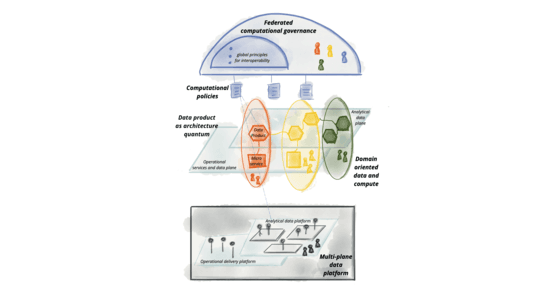
Data Mesh decentralizes data ownership, moving it from a central team to the business domains that create it. This approach, like microservices for data, is for orgs where a monolithic data lake has become a bottleneck.
Why it exists
Traditional data architecture creates a divide between operational data (powering apps) and analytical data (for insights). Centralizing all analytical data into a monolithic lake or warehouse creates a bottleneck. A single data team can't keep up with the proliferation of data sources, diverse use cases, and the speed of change, leading to fragile, constantly failing ETL pipelines.
The mental model
Think of Data Mesh as applying microservice principles to data. Instead of one giant, centrally-owned data monolith, you have a distributed network of discoverable and trustworthy data "products". Ownership and responsibility shift from a central data team to the business domains that are closest to the data itself.
How it works
Data Mesh is founded on four principles. First, Domain Ownership: data is owned and managed by the business domains that generate it. Second, Data as a Product: each domain must treat its data as a first-class product, with clear interfaces, documentation, and quality guarantees for its consumers. Third, Self-Serve Data Platform: a central platform team provides the tools and infrastructure for domains to easily build, deploy, and manage their data products. Fourth, Federated Computational Governance: a global set of rules for interoperability, security, and quality is automated and enforced across the mesh, ensuring cohesion without central control.
When to use it
Data Mesh is for large, complex organizations where a centralized data model is failing to scale. It's a fit when you have multiple autonomous business domains and a need to empower teams to innovate with data quickly, without being blocked by a central data team.
When not to use it
It is likely overkill for smaller organizations or those with a simple, stable data landscape. If a central team can effectively manage your data needs, the significant organizational overhead and cultural shift required for Data Mesh are unnecessary.
One canonical example
A large retail company has domains like 'Orders' and 'Logistics'. In a data mesh, the 'Orders' team owns and publishes a "Completed Orders" data product with a guaranteed schema and quality metrics. The 'Logistics' team can then directly consume this product to build analytics for delivery optimization, without waiting for a central ETL team to process the data for them.
Interview question
Which scenario best indicates an organization would benefit from adopting a Data Mesh architecture?
- a.A startup needing to quickly build its first data analytics platform with minimal overhead.
- b.A small company with a simple data landscape seeking to centralize all data processing.
- c.A large enterprise experiencing bottlenecks due to a monolithic data lake and diverse, rapidly evolving data needs.Correct
- d.An organization aiming to reduce its data infrastructure costs by consolidating all data storage into a single cloud provider.
Why? this is the answer
Option C accurately describes the conditions (large enterprise, bottlenecks from monolithic data, diverse/evolving needs) under which Data Mesh is designed to provide benefits, as stated in the card. Option B describes a scenario where Data Mesh would be overkill, emphasizing centralization and a simple landscape, which are contrary to its principles.
Just read this? Test yourself on what you have been reading.
Read the original → martinfowler.com
- #data mesh
- #data architecture
- #distributed systems
- #socio-technical
You just looked this up. Could you explain it out loud?
That is the part interviews actually test. Tezvyn takes questions like this one and gives you what the interviewer is really checking, the answer that lands, and the mistake that ends the conversation, in the four minutes before your next meeting.
The iPhone app is on the way
We are building it. Until it lands, nothing here is held back from you: every interview card, your saved cards, streaks and the job board all work in Safari, plus hundreds of free practice quizzes of thirty questions each. Sign in and it all carries over to the app the day it arrives.
Want it as an icon? Tap Share at the bottom of Safari, then Add to Home Screen. It opens full screen and the cards you have read stay available offline.
We are hiring for this. Every open role lists the topics its interview covers, so you can prepare for the real thing rather than guessing.
See open roles