Design a clickstream pipeline from ingestion to data warehouse
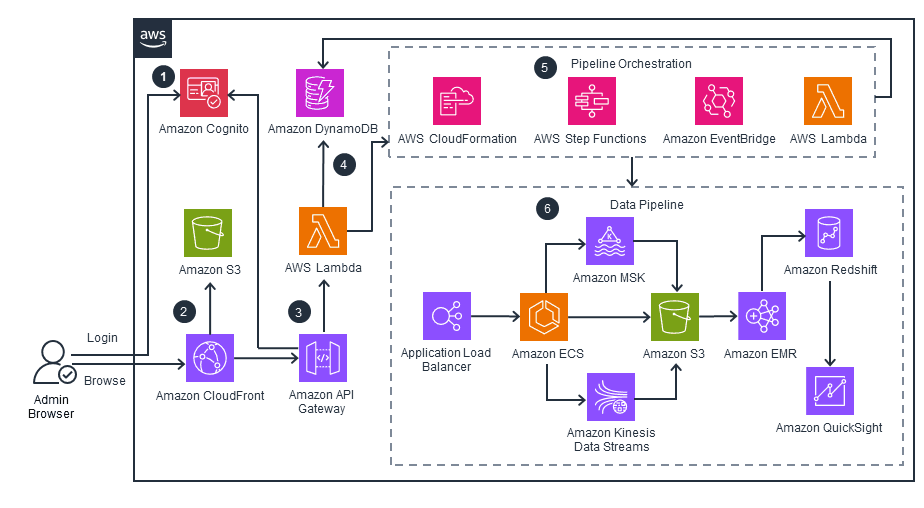
Tests data pipeline design under load: buffering, idempotent transform, and warehouse modeling. A strong answer orders ingestion via Kinesis or MSK, Spark EMR sessionization, and Redshift star schemas. Red flag: no buffer and direct warehouse writes.
What's really being asked
This question evaluates your ability to design a production-grade data pipeline that handles high-velocity, high-volume events with durability, scalability, and clear separation of concerns. Interviewers care about your reasoning around backpressure, buffering strategies, exactly-once or at-least-once semantics, cost-aware technology choices, and how you model data for analytical queries rather than just listing AWS services.
The full answer
First, ingestion architecture: a load-balanced fleet on ECS behind an ALB or Global Accelerator to accept HTTP events, with a buffer such as Amazon Kinesis Data Streams or Amazon MSK to decouple producers from processors and absorb traffic spikes. Second, processing: a scheduled or event-driven Spark job on EMR Serverless that reads raw batches from S3, deduplicates, enriches, and sessionizes clicks into structured events, sinking results back to S3. Third, loading and modeling: an EventBridge rule triggering a Step Functions workflow that loads processed data into Amazon Redshift, using a star or flat schema optimized for session metrics and funnel analysis. Fourth, justification: Kinesis for low-latency buffering, MSK for Kafka ecosystem compatibility, EMR Serverless for auto-scaling batch ETL without cluster management, and Redshift for columnar aggregation performance.
The mistakes people make
Proposing direct writes from web servers into Redshift or a relational database, which ignores backpressure and will fail under load. Suggesting a single monolithic service that both ingests and transforms, blurring failure domains. Ignoring late-arriving events or duplicate clicks, which corrupts session metrics. Choosing streaming for everything without acknowledging that clickstream analytics is often batch or micro-batch friendly and cheaper to process that way.
What usually comes next
How would you handle late-arriving events after the daily batch has run? How do you guarantee exactly-once semantics when the same click may be retried by the client? What is your retention and replay strategy if a bug corrupts three days of processed data? How would you scale the ingestion layer independently if traffic grows tenfold?
A concrete example
A retail site generates fifty thousand events per second during flash sales. The ingestion module uses an ALB distributing to an ECS fleet that sinks into Kinesis Data Streams. A Lambda consumer batches events into S3. Every fifteen minutes, EventBridge triggers an EMR Serverless Spark job that reads the new S3 partition, joins clicks with a user dimension table, assigns session IDs using a thirty-minute inactivity gap, and writes parquet to a processed bucket. An Object Created event in that bucket triggers Step Functions to run a Redshift COPY command, loading a sessions fact table and a devices dimension table. Analysts query session duration and conversion funnels in Redshift with sub-second aggregation response times.
Interview question
Which pipeline design best prevents backpressure during flash sales while enabling cost-efficient sessionization and warehouse loading?
- a.Real-time MSK ingestion into Flink for immediate sessionization with continuous Redshift streaming inserts
- b.ECS ingestion to Kinesis, S3 batches, EMR Serverless Spark sessionization, and Redshift COPY via Step FunctionsCorrect
- c.A single auto-scaling ECS service that enriches clicks, assigns session IDs, and streams into Redshift
- d.Direct writes from an ECS fleet to Redshift using connection pooling and table partitioning
Why? this is the answer
The correct answer decouples producers from processors with a buffer and uses batch-friendly EMR Serverless for sessionization before bulk-loading to Redshift. Distractor D is tempting because MSK is a valid buffer, but streaming everything into Redshift ignores that clickstream analytics is typically cheaper and more efficient as batch or micro-batch.
Just read this? Test yourself on what you have been reading.
Read the original → docs.aws.amazon.com
- #data engineering
- #system design
- #aws
- #clickstream
- #etl
You just looked this up. Could you explain it out loud?
That is the part interviews actually test. Tezvyn takes questions like this one and gives you what the interviewer is really checking, the answer that lands, and the mistake that ends the conversation, in the four minutes before your next meeting.
The iPhone app is on the way
We are building it. Until it lands, nothing here is held back from you: every interview card, your saved cards, streaks and the job board all work in Safari, plus hundreds of free practice quizzes of thirty questions each. Sign in and it all carries over to the app the day it arrives.
Want it as an icon? Tap Share at the bottom of Safari, then Add to Home Screen. It opens full screen and the cards you have read stay available offline.
We are hiring for this. Open roles that interview on data engineering — each one lists the topics its interview covers.
See open roles