Design a dynamic, risk-based quality gate system
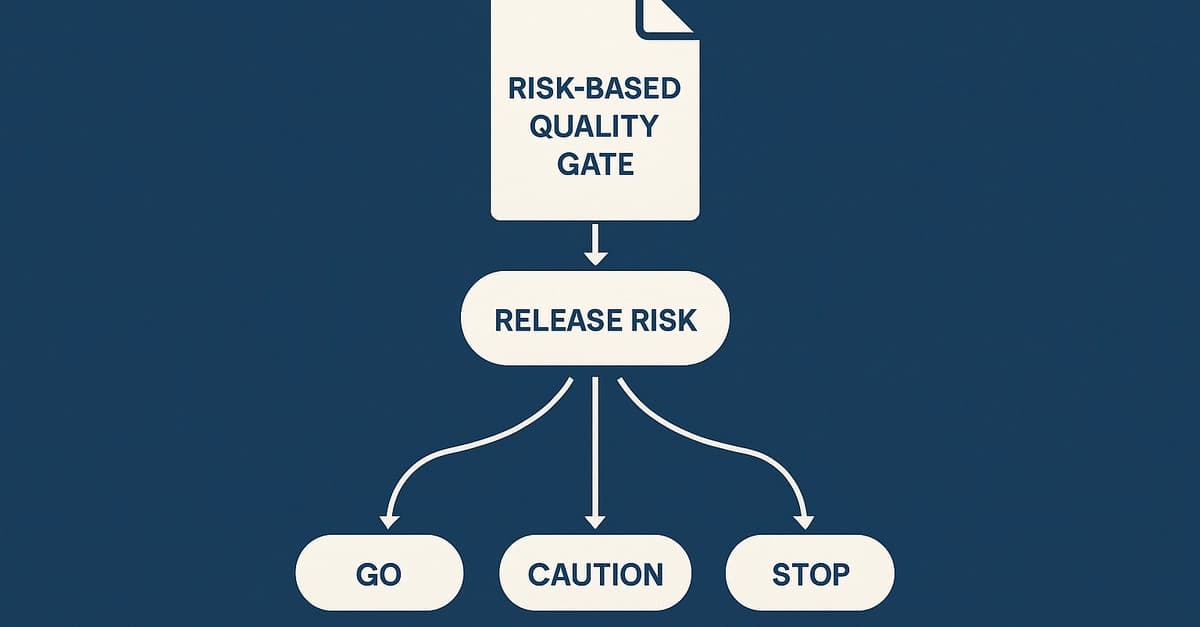
Tests if you can move CI/CD from binary pass/fail to contextual risk scoring. Strong answers define criticality tiers, weight signals by severity and blast radius, and emit GO/CAUTION/STOP states.
What's really being asked
This question tests whether you understand that binary pass/fail CI/CD gates break down at scale because they treat all failures as equal. The interviewer wants to see if you can model risk contextually, aggregate multiple quality signals, and build an explainable decision system rather than a rigid checklist. Senior engineers are expected to reason about blast radius, regulatory impact, and service criticality, then automate that reasoning.
The full answer
First, define a criticality taxonomy for services, such as critical, standard, and low, mapped from ownership metadata or service catalogs. Second, collect heterogeneous signals beyond simple test pass rates, including unit test failures, integration test results, static analysis severity scores, dependency vulnerability counts, and blast radius metrics like lines changed or downstream consumer count. Third, apply weighted scoring where a critical service failure in a payment flow carries higher penalty weight than a linting issue in a static UI page. Fourth, implement tiered outcomes such as GO for acceptable risk, CAUTION for elevated risk requiring human review, and STOP for unacceptable risk that blocks the release. Fifth, ensure the system is auditable by logging the signal inputs, weights applied, and the final risk score so teams can understand why a decision was made.
The mistakes people make
A common red flag is proposing only stricter coverage thresholds or longer test suites for critical services without explaining how the pipeline evaluates the concentration or severity of actual failures. Another mistake is suggesting manual approval gates for every critical change, which ignores the goal of automation and scalability. Some candidates also conflate this with feature flags or canary deployments, which are release strategies rather than quality evaluation frameworks. Failing to mention explainability or auditability is also weak because regulated environments require traceable decisions.
What usually comes next
The interviewer may ask how you would prevent gaming of the criticality taxonomy, such as teams downgrading their service to avoid scrutiny. They might ask how you handle a critical service with high technical debt that constantly triggers STOP states, or how you integrate this with existing tools like SonarQube, JUnit, or container scanners. Another follow-up is how you would make the gate fast enough to not destroy pipeline velocity, perhaps through incremental risk scoring on changed paths only.
A concrete example
Imagine a payments microservice and a static marketing page both have failing tests. The payments service is tagged as critical and has a downstream blast radius of 12 consumers. Its test failure is weighted at 10 points. The marketing page is tagged as low criticality with 0 downstream consumers, and its failure is weighted at 1 point. The pipeline aggregates these into a risk score of 10 for payments, emitting CAUTION and routing to an on-call review, while the marketing page scores 1 and emits GO because the actual business risk is negligible.
Interview question
Which design best captures the core principle of a dynamic, risk-based quality gate system?
- a.Enforce stricter code coverage thresholds and longer test suites for critical services while treating all failures with equal penalty weights.
- b.Replace pre-deployment quality checks with canary releases and feature flags to minimize the impact of defects in production.
- c.Require manual approval for every change to critical services and automatically deploy low-criticality changes without quality scoring.
- d.Weight failures by service criticality and blast radius, aggregate heterogeneous signals into an explainable risk score, and emit tiered outcomes like GO, CAUTION, or STOP.Correct
Why? this is the answer
The correct answer reflects the card's core idea of contextual risk scoring using heterogeneous signals and tiered outcomes. Option A represents the common mistake of only tightening thresholds without contextual weighting, while B and D reflect misconceptions of manual-only gating and conflating quality evaluation with release strategies.
Just read this? Test yourself on what you have been reading.
Read the original → dev.to
- #cicd
- #devops
- #quality-gates
- #systems-design
- #automation
You just looked this up. Could you explain it out loud?
That is the part interviews actually test. Tezvyn takes questions like this one and gives you what the interviewer is really checking, the answer that lands, and the mistake that ends the conversation, in the four minutes before your next meeting.
The iPhone app is on the way
We are building it. Until it lands, nothing here is held back from you: every interview card, your saved cards, streaks and the job board all work in Safari, plus hundreds of free practice quizzes of thirty questions each. Sign in and it all carries over to the app the day it arrives.
Want it as an icon? Tap Share at the bottom of Safari, then Add to Home Screen. It opens full screen and the cards you have read stay available offline.
We are hiring for this. Open roles that interview on cicd — each one lists the topics its interview covers.
See open roles