Dimensional Modeling: Facts vs. Dimensions
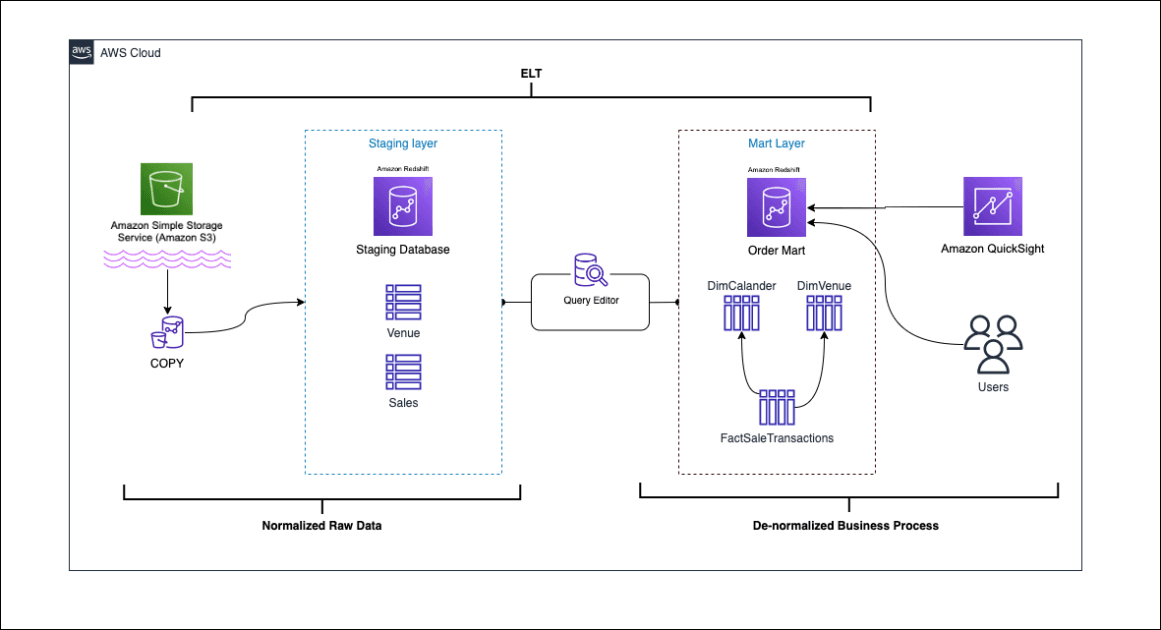
Dimensional modeling organizes data like a story: 'facts' are what happened (sales numbers) and 'dimensions' are the who, what, and where (customer, product). It's the foundation for data warehouses, turning raw data into analyzable BI reports.
Why it exists
Raw operational data is optimized for writing transactions, not for business analysis. Dimensional modeling solves this by restructuring data specifically for fast, aggregated queries, making it possible to derive insights from massive datasets.
The mental model
Think of a business event, like a single ticket sale. The dimensional model separates the measurable numbers from that event into a central "fact table" and the descriptive context into surrounding "dimension tables". The fact table holds metrics like price_paid and quantity. Dimension tables describe the who (customer), what (event), and where (venue). This is often called a star schema.
How it works
The Kimball methodology, a popular approach, involves four steps. First, identify a core business process, which is a measurable event like 'sales', not a department. Second, declare the grain, the most atomic level of detail, like a single line item on an invoice. Third, identify the dimensions, which are the descriptive text attributes (e.g., venue name, event date). Fourth, identify the facts, which are the numeric measurements from the process (e.g., sale amount, tickets sold).
When to use it
Use dimensional modeling when building a data warehouse or data mart for business intelligence and analytics (OLAP). It's perfect for systems like Amazon Redshift, where the goal is to power dashboards that let users "slice and dice" data, such as viewing sales by region over time.
When not to use it
This model is not for online transaction processing (OLTP) systems, like an e-commerce checkout service. Those systems require a highly normalized structure to handle frequent, single-record writes and updates with maximum data integrity.
One canonical example
For an event ticketing system, the business process is "ticket sales". The fact table contains one row per sale line item (the grain) with metrics like sale_price and num_tickets. Dimension tables would include a venue dimension (with venue_name, city), an event dimension (event_name, artist), and a date dimension. An analyst can then join these to ask, "What were the total sales for artist X in New York during Q3?".
Interview question
What is the main advantage of structuring data using dimensional modeling for business intelligence?
- a.It enables real-time, high-volume transactional processing and immediate updates.
- b.It consolidates all related data into a single, wide table for simpler data entry.
- c.It optimizes data for rapid querying and aggregation to support analytical reporting.Correct
- d.It guarantees the highest level of data normalization, preventing data duplication.
Why? this is the answer
The card states that dimensional modeling "restructures data specifically for fast, aggregated queries" for business analysis and OLAP. Option D describes a characteristic of OLTP systems, not dimensional modeling. Options C and D misrepresent the purpose and structure of dimensional modeling, which separates data into fact and dimension tables for analytical performance, not transactional, efficiency.
Just read this? Test yourself on what you have been reading.
Read the original → aws.amazon.com
- #data warehousing
- #dimensional modeling
- #kimball
- #redshift
- #analytics
You just looked this up. Could you explain it out loud?
That is the part interviews actually test. Tezvyn takes questions like this one and gives you what the interviewer is really checking, the answer that lands, and the mistake that ends the conversation, in the four minutes before your next meeting.
The iPhone app is on the way
We are building it. Until it lands, nothing here is held back from you: every interview card, your saved cards, streaks and the job board all work in Safari, plus hundreds of free practice quizzes of thirty questions each. Sign in and it all carries over to the app the day it arrives.
Want it as an icon? Tap Share at the bottom of Safari, then Add to Home Screen. It opens full screen and the cards you have read stay available offline.
We are hiring for this. Every open role lists the topics its interview covers, so you can prepare for the real thing rather than guessing.
See open roles