Double Diamond: Explore, Then Focus, Twice
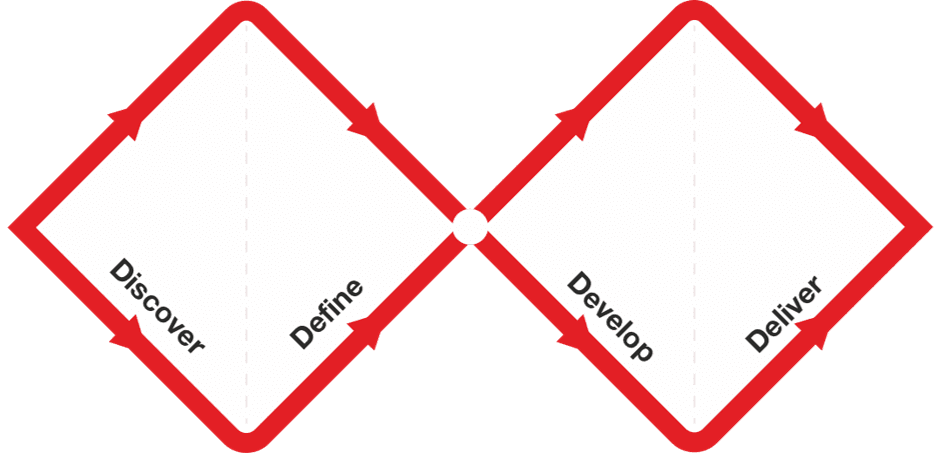
The Double Diamond model prevents building the wrong thing by forcing two cycles of 'go wide, then narrow down.' First, explore the problem space, then define a specific problem. Second, explore solutions, then deliver a tested one.
Why it exists
To prevent teams from building elegant solutions to the wrong problems. Without a formal process, engineers and designers often jump to building a solution based on assumptions. The Double Diamond provides a structured path to ensure you're solving a real, understood user need.
The mental model
Think of the process as two consecutive diamonds. Each diamond represents a cycle of divergent thinking (going wide, exploring possibilities) followed by convergent thinking (narrowing down, making decisions). The first diamond is for defining the right problem; the second is for building the right solution.
How it works
The process has four phases. The first diamond consists of Discover and Define. In Discover, you do user research to understand the issue broadly, without assumptions. In Define, you synthesize that research into a single, focused problem statement. The second diamond consists of Develop and Deliver. In Develop, you brainstorm and prototype multiple potential solutions to the defined problem. In Deliver, you test these solutions with users, iterate on what works, and ship a final, validated product.
When to use it
Use this for complex, ambiguous projects like creating a new product or redesigning a major feature. It provides a shared vocabulary and framework for a cross-functional team to de-risk development by validating both the problem and the solution. It forces you to answer "Are we building the right thing?" before you ask "Are we building the thing right?"
When not to use it
The full process is overkill for small, well-defined tasks. If the problem and solution are both obvious and low-risk (e.g., fixing a typo, changing a button color), a simpler workflow is more efficient. The Double Diamond's value is in navigating uncertainty, not executing simple changes.
One canonical example
A team assumes users aren't using a reporting feature because it's too slow. Instead of immediately optimizing code (jumping to the Develop phase), they start at the beginning. In Discover, they interview users and find the real issue is that the reports are confusing. They Define the problem as "Users don't trust the data because they don't understand how it's calculated." Now in Develop, they brainstorm solutions like adding tooltips or an inline FAQ. In Deliver, they test a prototype with clear explanations, which users love.
Interview question
What is the primary distinction between the first and second diamonds in the Double Diamond model?
- a.The first uses qualitative data, and the second uses quantitative data.
- b.The first focuses on team building, while the second focuses on client feedback.
- c.The first explores the problem space, and the second explores the solution space.Correct
- d.The first involves internal stakeholders, while the second involves external users.
Why? this is the answer
The card states, "The first diamond is for defining the right problem; the second is for building the right solution," clearly distinguishing their focus on problem exploration versus solution exploration. Option A is incorrect because both diamonds can involve various research methods, not just one type of data.
Just read this? Test yourself on what you have been reading.
Read the original → en.wikipedia.org
- #ux
- #product design
- #design process
- #discovery
You just looked this up. Could you explain it out loud?
That is the part interviews actually test. Tezvyn takes questions like this one and gives you what the interviewer is really checking, the answer that lands, and the mistake that ends the conversation, in the four minutes before your next meeting.
The iPhone app is on the way
We are building it. Until it lands, nothing here is held back from you: every interview card, your saved cards, streaks and the job board all work in Safari, plus hundreds of free practice quizzes of thirty questions each. Sign in and it all carries over to the app the day it arrives.
Want it as an icon? Tap Share at the bottom of Safari, then Add to Home Screen. It opens full screen and the cards you have read stay available offline.
We are hiring for this. Open roles that interview on ux — each one lists the topics its interview covers.
See open roles