Explain the Central Limit Theorem and its importance for hypothesis testing
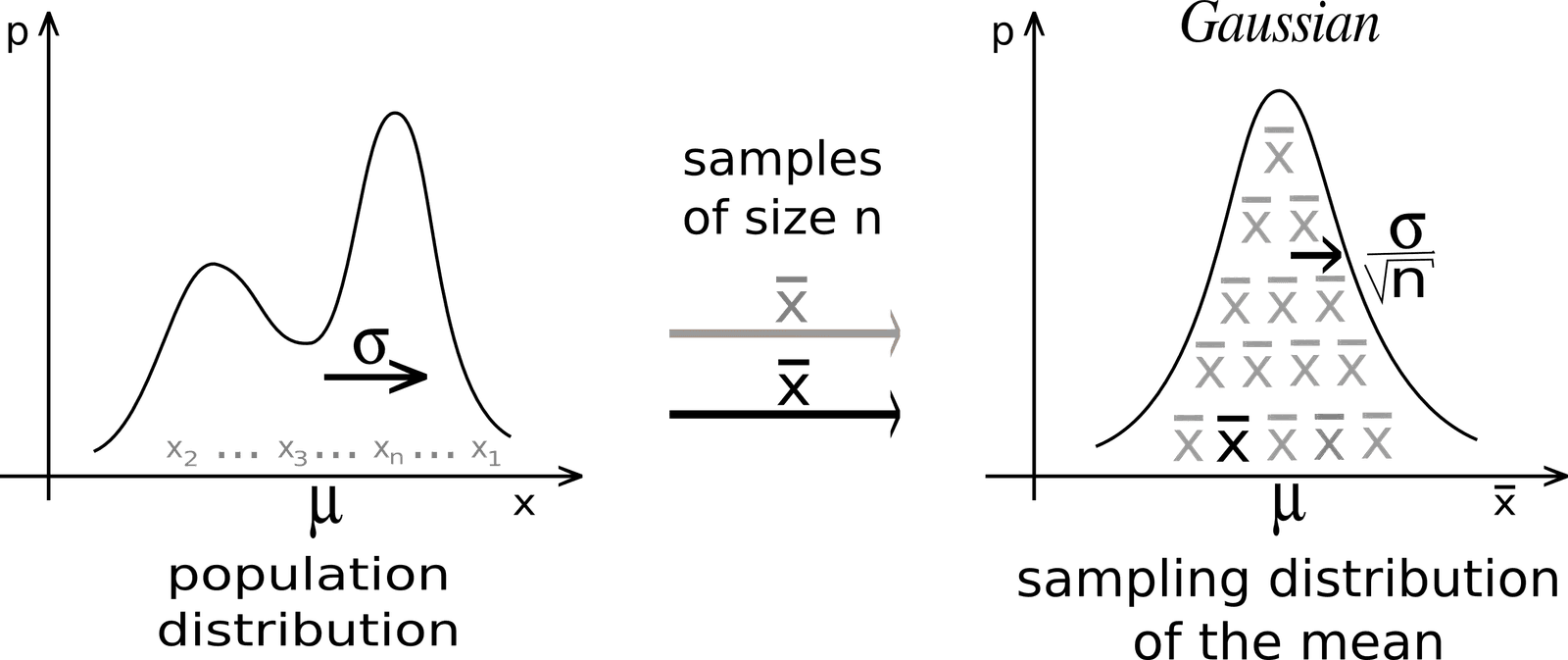
This tests whether you know why sample means from skewed populations tend toward normal as size grows, enabling tests. A strong answer covers mean convergence to normal and standard error. Red flag: claiming the CLT works for small samples or single points.
What's really being asked
The interviewer wants to know if you understand the mechanism that makes classical inference possible in real-world settings where population distributions are rarely normal. Specifically, they are checking whether you distinguish between the distribution of raw data and the sampling distribution of a statistic, and whether you know the conditions under which normality emerges.
The full answer
First, the core statement: for independent and identically distributed random variables with finite variance, the distribution of the sample mean approaches a normal distribution as sample size increases, even if the original variables are not normal. Second, the normalization detail: we are talking about a normalized version of the sample mean, typically subtracting the population mean and dividing by the standard error, converging to a standard normal distribution. Third, the practical importance: because of this convergence, we can construct confidence intervals and perform hypothesis tests using z-statistics or t-statistics without knowing the exact shape of the population distribution. Fourth, the conditions: mention finite variance, independence, and that the theorem describes large-sample behavior rather than small-sample exact distributions.
The mistakes people make
A major red flag is saying the CLT means any data becomes normal if you collect enough of it; the theorem applies to the sample mean or sum, not to individual observations. Another error is ignoring sample size and claiming the CLT applies universally even with n equals five or heavily dependent data. Some candidates also forget the finite variance requirement or conflate the CLT with the Law of Large Numbers, which concerns convergence of the sample mean to the population mean rather than convergence of its distribution to a bell curve.
What usually comes next
The interviewer may ask how large is large enough, which depends on skewness and kurtosis but often n greater than thirty is taught as a rule of thumb. They might ask what breaks the CLT, such as infinite variance distributions like the Cauchy distribution or strong serial dependence. They could also ask you to contrast the CLT with the Law of Large Numbers, or to explain why we use a t-distribution instead of the normal when the population variance is estimated from the sample.
A concrete example
Suppose you are measuring website load times that are heavily right-skewed, with most pages loading in under two seconds but a few taking ten seconds. The distribution of individual load times is far from normal. However, if you repeatedly take random samples of one hundred load times and plot the average of each sample, those averages will form an approximately normal distribution centered around the true mean. This lets you calculate a ninety-five percent confidence interval for the true average load time using the sample standard deviation and the normal or t-distribution, even though you never assumed the underlying load times were normal.
Interview question
What justifies using a z-test for a population mean when the underlying data are heavily skewed?
- a.The sampling distribution of the sample mean becomes approximately normal for large nCorrect
- b.The sample mean converges to the population mean as sample size increases
- c.The raw observations in large samples themselves become normally distributed
- d.The population variance is known and the sample size exceeds thirty
Why? this is the answer
The CLT states that the sampling distribution of the sample mean approaches normality as n grows, which justifies using z-tests even when the population is skewed. Option B describes the Law of Large Numbers, a common look-alike that explains convergence to a single value rather than the bell-curve shape required for inference.
Just read this? Test yourself on what you have been reading.
Read the original → en.wikipedia.org
- #central limit theorem
- #statistics
- #hypothesis testing
- #sampling distributions
- #inference
You just looked this up. Could you explain it out loud?
That is the part interviews actually test. Tezvyn takes questions like this one and gives you what the interviewer is really checking, the answer that lands, and the mistake that ends the conversation, in the four minutes before your next meeting.
The iPhone app is on the way
We are building it. Until it lands, nothing here is held back from you: every interview card, your saved cards, streaks and the job board all work in Safari, plus hundreds of free practice quizzes of thirty questions each. Sign in and it all carries over to the app the day it arrives.
Want it as an icon? Tap Share at the bottom of Safari, then Add to Home Screen. It opens full screen and the cards you have read stay available offline.
We are hiring for this. Every open role lists the topics its interview covers, so you can prepare for the real thing rather than guessing.
See open roles