How would Angular vs Vue philosophies influence your large-scale architecture choice?
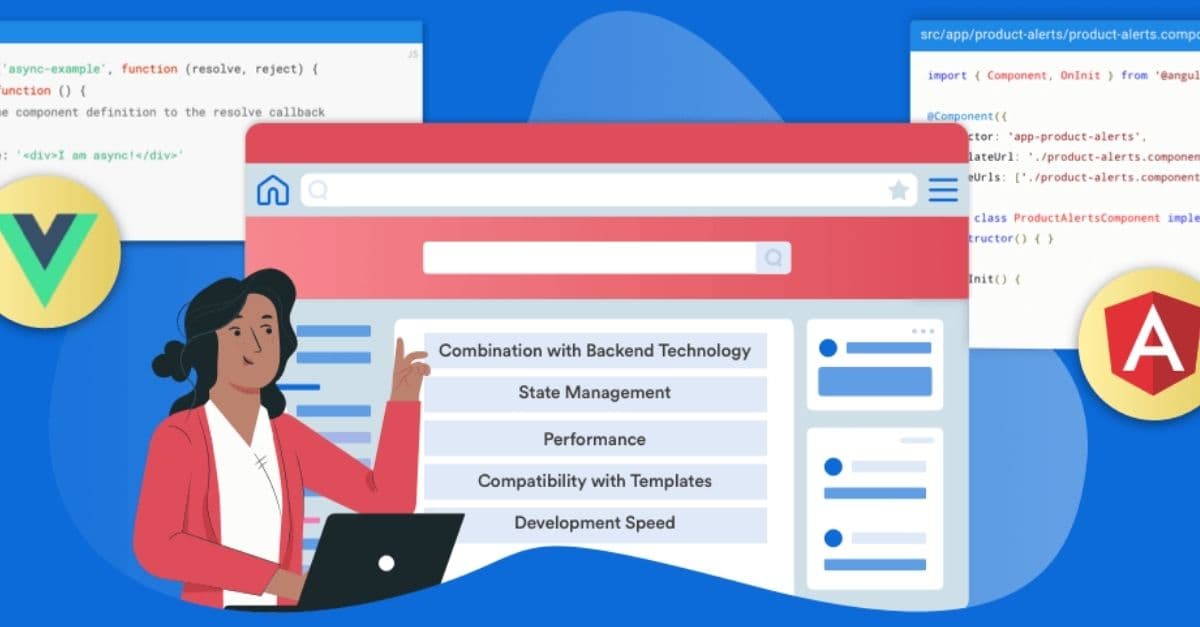
Tests mapping philosophy to team scale. Contrast Angular's opinionated batteries-included tooling and two-way binding with Vue's progressive incremental adoption and Composition API; pick Angular for standards or Vue for flexibility.
What's really being asked
The interviewer wants to see if you treat framework selection as an architectural decision tied to team topology and governance, not just technical preference. They are looking for awareness that Angular's opinionated batteries-included model and Vue's progressive flexible model create fundamentally different constraints on multi-team delivery.
The full answer
First, it characterizes Angular as an opinionated framework with built-in TypeScript tooling and a framework model designed for large teams and large applications. It notes that Angular encourages reusable code that can be used for any deployment target and integrates two-way data binding as a core architectural pattern, which standardizes how teams manage state and UI synchronization. Second, it characterizes Vue as a progressive lightweight framework built for incremental adoption, where teams can introduce Vue into existing systems without full rewrites. It references Vue 3's Composition API as the pattern that enables flexible logic reuse and modular feature development. Third, it makes an explicit choice grounded in team structure: choose Angular when the priority is cross-team consistency, strict contracts, and a unified toolchain that reduces decision fatigue; choose Vue when the organization needs rapid migration, federated team autonomy, or gradual modernization. Fourth, it acknowledges trade-offs, noting that Angular's heaviness pays off in standardized governance while Vue's flexibility demands stronger platform discipline to avoid fragmentation.
The mistakes people make
A weak answer picks Angular simply because it is labeled enterprise-grade without citing its built-in tooling, reusable code model, or two-way binding architecture. Another red flag is recommending Vue for a large multi-team greenfield project without explaining how to enforce shared patterns or mitigate drift caused by incremental adoption. Favoring one framework based solely on familiarity rather than organizational scalability signals junior thinking.
What usually comes next
The interviewer may ask how you would enforce standards if forced to use Vue across multiple teams, or how you would mitigate Angular's learning curve and hiring challenges. They might also probe how you would handle shared libraries, or what migration path you would propose if the company currently uses an older stack.
A concrete example
Imagine a company with five distributed teams building a new dashboard from scratch. Angular fits here because its batteries-included approach gives every team the same TypeScript tooling, reusable code capabilities, and two-way binding conventions out of the box, reducing integration risk. Conversely, if the same company has a ten-year-old monolith and wants to modernize one module per quarter, Vue is preferable because its progressive nature lets teams incrementally adopt the Composition API without a full rewrite.
Interview question
Why does Vue's architectural philosophy make it the better choice for gradually modernizing a ten-year-old monolith one module per quarter?
- a.Vue enforces strict TypeScript contracts out of the box, ensuring all teams follow identical conventions during migration.
- b.Vue's progressive nature allows incremental adoption via the Composition API without requiring a full rewrite.Correct
- c.Angular's two-way binding is incompatible with legacy state management patterns found in older codebases.
- d.Angular's lightweight runtime is designed specifically for partial integration into existing monoliths.
Why? this is the answer
The card describes Vue as progressive and ideal for incremental adoption without full rewrites, using the Composition API for modular development. Distractor C incorrectly attributes Angular's built-in standardization to Vue, when in fact Vue's flexibility requires stronger platform discipline to prevent fragmentation.
Just read this? Test yourself on what you have been reading.
Read the original → simform.com
- #angular
- #vue
- #frontend architecture
- #system design
- #framework selection
You just looked this up. Could you explain it out loud?
That is the part interviews actually test. Tezvyn takes questions like this one and gives you what the interviewer is really checking, the answer that lands, and the mistake that ends the conversation, in the four minutes before your next meeting.
The iPhone app is on the way
We are building it. Until it lands, nothing here is held back from you: every interview card, your saved cards, streaks and the job board all work in Safari, plus hundreds of free practice quizzes of thirty questions each. Sign in and it all carries over to the app the day it arrives.
Want it as an icon? Tap Share at the bottom of Safari, then Add to Home Screen. It opens full screen and the cards you have read stay available offline.
We are hiring for this. Open roles that interview on angular — each one lists the topics its interview covers.
See open roles