How would you architect a unified quantitative and qualitative user experience view?
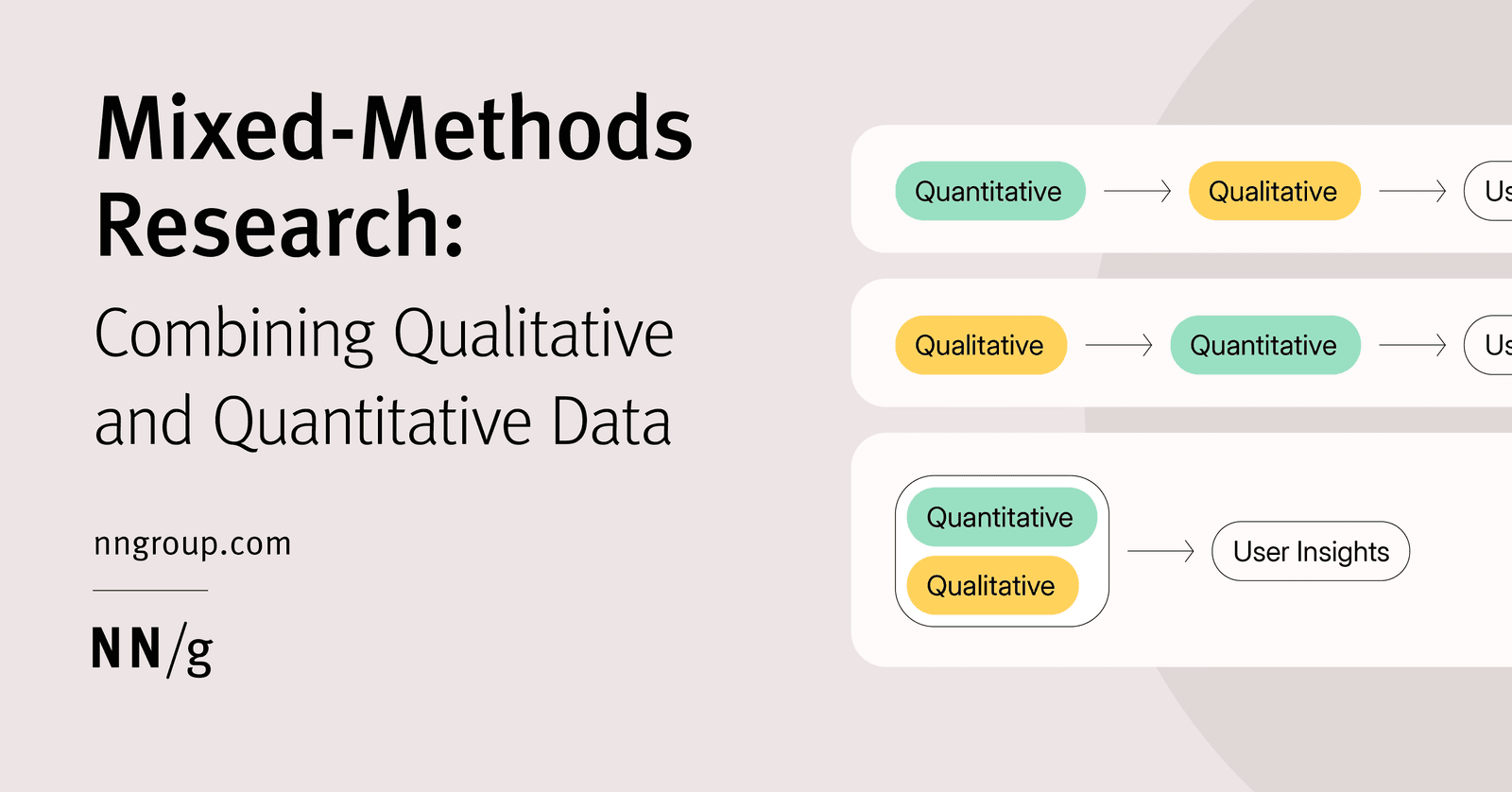
This tests intentional mixed-methods integration. A strong answer covers: shared research questions and user IDs; using quant struggles to guide qual interviews; linking datasets by session.
What's really being asked
Whether you can design research infrastructure that intentionally integrates qualitative and quantitative methods before, during, and after data collection to answer the same overarching research question. The interviewer wants to see that you treat mixed-methods as a unified strategy rather than a technical merge of two silos, and that you understand quantitative methods reveal patterns at scale while qualitative methods uncover motivations and mental models.
The full answer
A strong response hits four components in order. First, upfront alignment on shared research questions and user identifiers so that both data types serve a single goal from the start rather than producing disconnected insights. Second, using quantitative patterns to guide qualitative sampling and task selection, such as choosing interview participants from segments that show struggle in analytics or dropping tasks from the qualitative portion. Third, a linkage layer that connects behavioral events to interview notes by session or participant ID instead of leaving them in disconnected repositories. Fourth, analysis workflows where quantitative results surface anomalies and qualitative findings explain the why behind the numbers, creating a layered understanding that connects what is happening with why it is happening.
The mistakes people make
Proposing a data warehouse that simply stores both datasets side by side without an intentional integration plan or shared research goal. Suggesting that qualitative and quantitative teams run separate studies and merge reports afterward, which leaves blind spots. Ignoring the need for upfront planning around research questions, which often produces disconnected or redundant insights. Failing to address how qualitative protocols may evolve based on early quantitative findings, or treating mixed-methods as simply sprinkling a survey alongside interviews.
What usually comes next
How would you handle privacy constraints when linking identifiable interview notes to behavioral analytics at scale? What governance prevents qualitative bias from influencing quantitative interpretation during joint analysis? How do you version control interview protocols that adapt mid-study based on quantitative data? What happens when the same user ID appears in multiple studies with different research goals, and how do you prevent scope creep?
A concrete example
A hotel website redesign project where the team begins with a quantitative benchmarking study measuring task success and completion times for top tasks like booking a room or locating cancellation policies. The qualitative usability test is planned from the start under the same goal of understanding where and why users struggle, but the exact tasks are selected after reviewing the quantitative results, focusing specifically on the flows where users struggled most. Both datasets are tied to the same participant ID and research objective, so the quantitative trends guide the qualitative inquiry and the qualitative findings explain the reasons behind the struggles, providing a holistic view of the user experience.
Interview question
Which architectural practice distinguishes an intentionally unified mixed-methods study from a superficial merge of siloed data?
- a.Establishing shared research questions and user identifiers upfront while linking quant struggles to qual tasks by sessionCorrect
- b.Running parallel independent studies and reconciling the findings during final reporting and presentation
- c.Storing both dataset types in a shared warehouse with unified schemas and access controls
- d.Appending a quantitative survey to qualitative interviews to capture numerical metrics alongside observational notes
Why? this is the answer
True unification requires upfront alignment on shared goals and identifiers plus session-level linkage so quantitative patterns directly guide qualitative investigation. Simply warehousing both datasets in one repository stores them side by side without an intentional integration plan, which is a common misconception.
Just read this? Test yourself on what you have been reading.
Read the original → nngroup.com
- #mixed-methods
- #ux-research
- #data-architecture
- #user-analytics
- #qualitative-research
You just looked this up. Could you explain it out loud?
That is the part interviews actually test. Tezvyn takes questions like this one and gives you what the interviewer is really checking, the answer that lands, and the mistake that ends the conversation, in the four minutes before your next meeting.
The iPhone app is on the way
We are building it. Until it lands, nothing here is held back from you: every interview card, your saved cards, streaks and the job board all work in Safari, plus hundreds of free practice quizzes of thirty questions each. Sign in and it all carries over to the app the day it arrives.
Want it as an icon? Tap Share at the bottom of Safari, then Add to Home Screen. It opens full screen and the cards you have read stay available offline.
We are hiring for this. Every open role lists the topics its interview covers, so you can prepare for the real thing rather than guessing.
See open roles