In-Product Discovery: Finding Growth Inside Your App
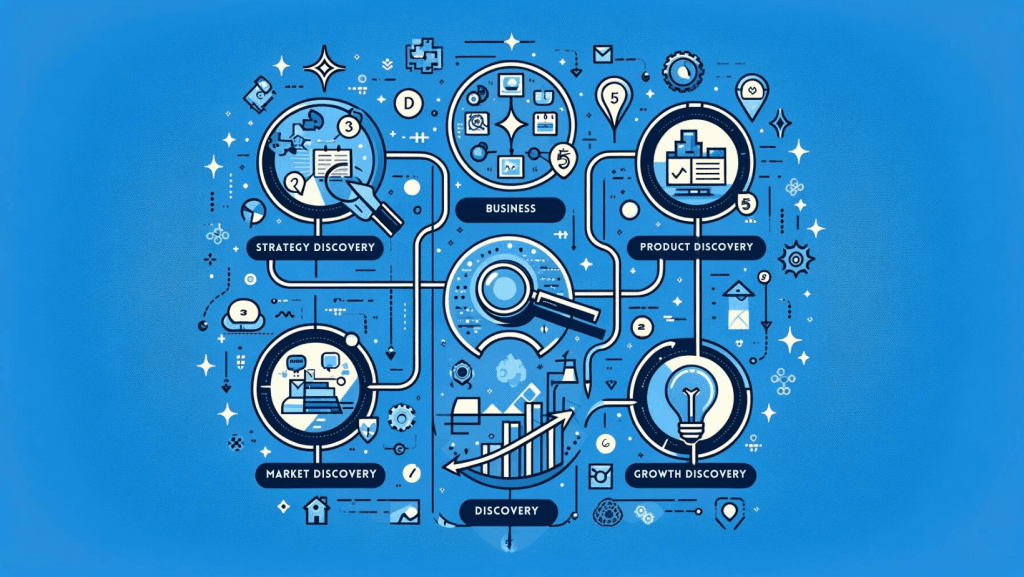
In-product discovery is finding your next growth lever by observing users within your live product, not just in pre-launch research. It's used to scale existing products via in-app experiments.
WHY IT EXISTS: Once a product is live, the richest source of information about its future is its current user base. In-product discovery exists to formalize this learning process. It aims to systematically find growth and improvement opportunities by leveraging the existing product and its users, moving beyond initial launch decisions to focus on long-term evolution and expansion.
THE MENTAL MODEL: Think of in-product discovery as mining for opportunities in a territory you already own. Instead of exploring new lands (market discovery), you're drilling deeper into your current product to find untapped value. It's the continuous process of asking "What's next?" by observing and interacting with users inside the app they already use. This is a shift from the initial "what to build" discovery to "how to grow what we've built."
HOW IT WORKS: Discovery is a cyclical process of addressing risks (problems) with strategies (solutions). In-product discovery applies this loop to a live product. It starts with observing user behavior to form hypotheses about potential improvements or growth levers, such as, "We believe users would adopt Feature Y if we reduced the steps from 5 to 2." You then validate this hypothesis with in-product experiments like A/B tests or beta feature flags. The results inform whether to scale the solution or pivot, feeding directly back into the product strategy. This is what the source calls "exploring opportunities for scaling and expanding your product's impact."
WHEN TO USE IT: Use this when your product has achieved some level of market fit and your focus shifts to growth, retention, or expansion. It's the primary mode of discovery for mature products, crucial for identifying adjacent user needs, optimizing core workflows, or finding opportunities for monetization and upselling. The source frames this as "Growth Discovery."
WHEN NOT TO USE IT: This is not the right tool for initial "zero to one" product creation. For a brand new product, you need broader Strategy and Business Discovery to validate the core problem and business model first. Trying to do in-product discovery without a product or a user base is putting the cart before the horse.
ONE CANONICAL EXAMPLE: A SaaS company notices low adoption of a powerful but complex feature. Instead of just writing more documentation, they use in-product discovery. They run an A/B test: Group A sees the old interface, while Group B sees a new, simplified onboarding flow for that feature, triggered on their third login. By measuring adoption rates between the groups, they validate whether simplifying the workflow is the right solution, using the live product as their laboratory.
Read the original → aktiasolutions.com
Get five bites like this every day.
Tezvyn delivers a daily feed of 60-second tech bites with quizzes to lock in what you learn.